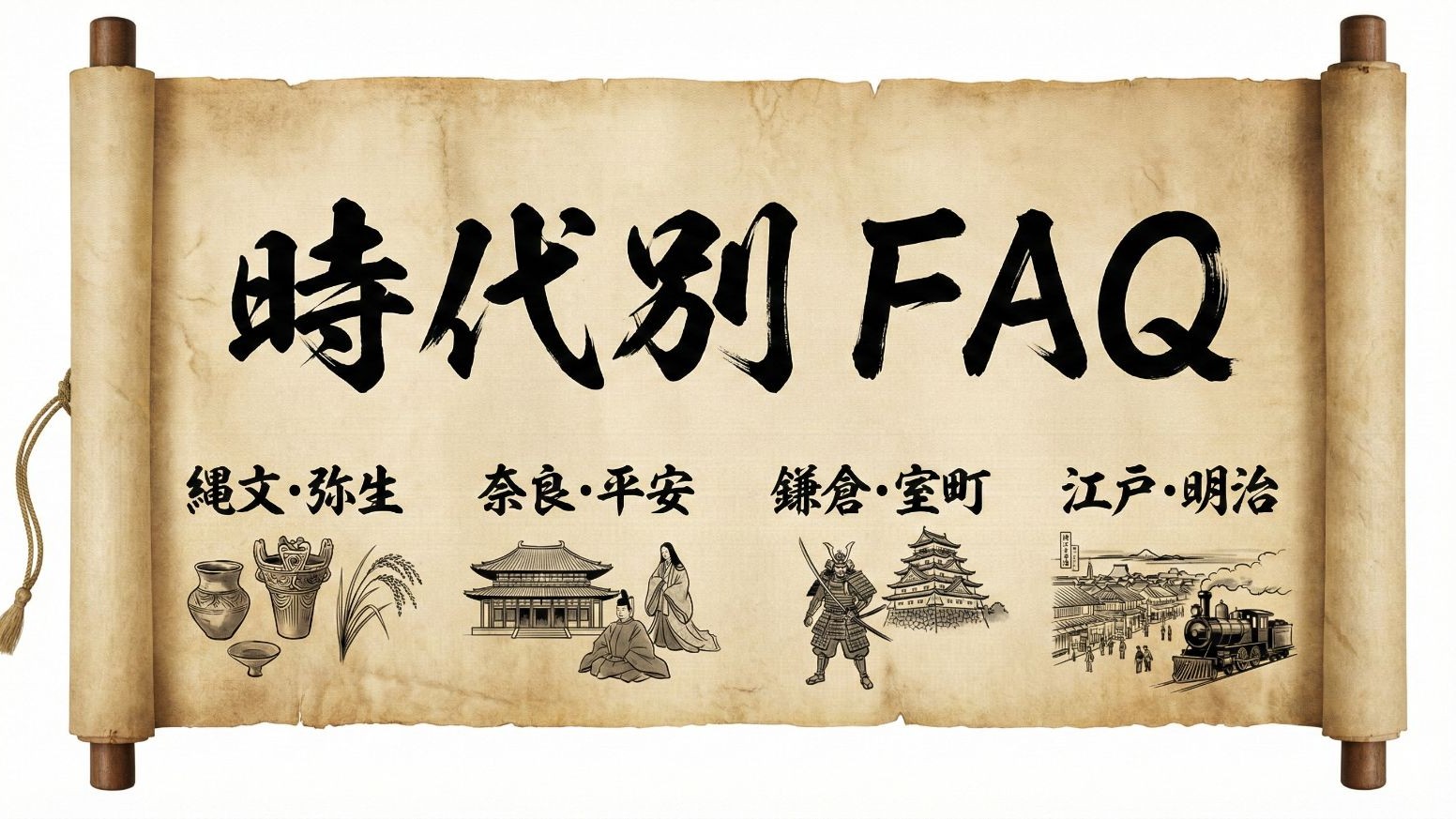
Ep.91
Q1. Why couldn’t the Shinto faction maintain power?
These court nobles and scholars lacked any military backing. Furthermore, their romantic ideal of returning to ancient times proved completely unrealistic compared to the pragmatic faction rushing toward Westernization.
Q2. What exactly did Haibutsu Kishaku involve?
This violent movement erupted during the separation of Shinto and Buddhism. Consequently, radicalized mobs systematically destroyed Buddhist statues and temples while attempting to confiscate their wealth.
Q3. Did Emperor Meiji personally dictate politics?
No. The Emperor primarily functioned as a sacred, unifying symbol. Ultimately, former samurai politicians from domains like Satsuma and Choshu executed the actual political decision-making.
Ep.92
Q1. When did the Iwakura Mission depart?
The mission departed in 1871 (Meiji 4). During this fragile period shortly after the Meiji Restoration, the new government urgently needed to solidify its foundation and secure international recognition.
Q2. What caused the conflict between the caretaker government and the overseas group?
The ideological difference concerning reform speed triggered the conflict. The returning delegates demanded radical Westernization, while caretaker leaders like The tragic hero, Saigo Takamori, cautiously prioritized the grievances of disgruntled former samurai.
Q3. What was the background behind introducing a “meritocracy”?
Leaders feared that the hereditary class system fatally drained national strength. Therefore, building a powerful, Western-style nation required utilizing brilliant talent entirely independent of their social origins.
Ep.93
Q1. Why did Saigo Takamori rebel against the government?
He resigned over intense conflicts regarding rapid Westernization and Seikanron (the invasion of Korea). Consequently, bearing the immense frustration of his loyal, disenfranchised samurai followers forced his reluctant rebellion.
Q2. What is the decisive difference between the British and German models?
The British model embraced liberalism, prioritizing the power of parliament and political parties. Conversely, the German model championed authoritarianism, preserving absolute executive power for the monarch.
Q3. Why was the Meiji government in such a rush to create a constitution?
Western powers refused to revise unequal treaties unless Japan proved itself a “constitutional state governed by law.” Therefore, establishing a constitution became the absolute prerequisite for securing true national independence.
Ep.94
Q1. When and by whom was the Meiji Constitution primarily created?
Promulgated in 1889, The founding father, Ito Hirobumi, spearheaded its creation. He drafted it alongside Inoue Kowashi and Kaneko Kentaro, heavily relying on advice from German constitutional scholars like Gneist.
Q2. Why were the Liberal Party and Constitutional Reform Party split?
Their support bases and ideal political models clashed. The Liberal Party demanded radical, French-style revolution, while the Reform Party advocated for moderate, British-style parliamentary politics.
Q3. Why didn’t the Emperor actually govern despite holding sovereign power?
This structure protected the Emperor from political responsibility. Therefore, while he acted as a sacred symbol, the Ministers of State formally assumed all accountability for actual political decisions.
Ep.95
Q1. Why didn’t industrialization advance immediately after the Meiji Restoration?
Unifying the administration through the abolition of domains and processing massive debts from the former regime consumed immense time. Consequently, building the state’s basic foundation took absolute priority.
Q2. What was the Matsukata Deflation policy?
It enforced strict tax increases and spending cuts to crush inflation. While this stabilized national finances, it plunged rural areas into a severe depression, forcing countless farmers to abandon their land.
Q3. What are the characteristics of Japanese capitalism?
It operates as a state-led system where the government aggressively protects industries while Zaibatsu conglomerates cooperate. Therefore, achieving national goals consistently took precedence over pure free-market competition.
Ep.96
Q1. Why did domestic unemployment rise despite increased raw silk exports?
Surging export demand caused raw silk prices to skyrocket. Consequently, domestic weavers could no longer afford the raw materials, resulting in massive job losses for artisans in cities like Kyoto.
Q2. What simply is an “economic dual structure”?
It describes a stark reality where world-class modern industries and impoverished, feudal-era rural farming villages exist simultaneously within the exact same country.
Q3. Did the government benefit from rural areas remaining poor?
Yes. These impoverished villages functioned as a massive, continuous supply chain of cheap labor, providing desperate youths willing to endure military conscription to escape poverty.
Ep.97
Q1. When and by whom was Datsu-A Ron (Leaving Asia) advocated?
The pragmatic intellectual, Fukuzawa Yukichi, advocated it during the mid-Meiji period. This strategic philosophy abandoned Asian solidarity, arguing Japan must act like a Western power to guarantee its independence.
Q2. Why was the Rokumeikan built?
The government built it to prove Japan’s status as a “civilized” nation, aiming to revise unequal treaties. However, this extreme Westernization policy attracted severe domestic criticism.
Q3. How did people at the time feel about Westernization?
Initial backlash and discomfort eventually gave way to immense national confidence following victories in the Sino-Japanese and Russo-Japanese Wars. Yet, intellectuals like Natsume Soseki observed these rapid changes with cold skepticism.
Ep.98
Q1. When did the State Shinto system begin in earnest?
It strengthened significantly after the victory in the Russo-Japanese War (1904). Ultimately, it achieved completion during the Showa era as an absolute tool for national mobilization leading up to WWII.
Q2. Did people back then not consider Shinto a religion?
The government officially categorized it as “civic ritual.” However, the inclusion of prayer and divine entities made it a de facto religion, a contradiction the public largely accepted as a necessary political facade.
Q3. What should we learn from this history today?
It highlights the severe danger of “social atmosphere” or “national policy” crushing individual freedom of conscience. Therefore, we must remain constantly vigilant against the absolute tyranny of the majority.
Ep.99
Q1. Why was Japan so obsessed with the Korean Peninsula?
Hostile powers like Russia or Britain controlling Korea presented a direct staging ground for invading Japan. Therefore, securing it as a “buffer zone” was considered absolutely vital for national survival.
Q2. What is the biggest difference between Western and Japanese imperialism?
Western powers primarily aggressively pursued “economic profits” like market expansion. In contrast, Japan prioritized “military defense” to secure its absolute sphere of survival against those Western powers.
Q3. Was Japan disobeying international law at the time?
Formally, Japan acted within treaty frameworks. However, similar to the outbreak of the Sino-Japanese War, they frequently utilized broad interpretations and deceptive tactics, like claiming undelivered notices, to suit their agenda.
Ep.100
Q1. Why could a small country like Japan defeat the Qing dynasty?
Despite its massive size, the Qing military suffered from severe technological and organizational backwardness. Consequently, Japan’s highly modern military systems and rapid troop deployments guaranteed their victory.
Q2. What were the official reason and the true motive for the Triple Intervention?
Officially, it aimed to preserve “peace in the Far East.” However, the true motive was Russia’s desperate desire to control the ice-free ports of the Liaodong Peninsula, which they subsequently occupied.
Q3. How did the Anglo-Japanese Alliance relate to the war?
British backing effectively neutralized the threat of French intervention on Russia’s behalf. Therefore, this critical alliance convinced Japan it could successfully engage Russia in a one-on-one conflict.
Ep.101
Q1. Why could a small country like Japan defeat Russia?
The outbreak of the Russian Revolution crippled their ability to continue the war. Furthermore, the absolute annihilation of the Russian fleet at the Battle of Tsushima decisively forced a peace settlement.
Q2. What did Japan gain and lose in the war?
Japan secured Great Power status, gaining Manchurian interests, southern Sakhalin, and dominance over Korea. However, the staggering loss of life and massive war debts without reparations triggered explosive domestic fury.
Q3. How did this war affect later Japan?
It dangerously implanted the myth that “spiritual strength overcomes material reality” into the military’s core doctrine. Consequently, this irrational belief spawned disastrous strategies during the Siberian Intervention and WWII.
Ep.102
Q1. Why lacked consistency in the colonial policy?
Severe internal conflict plagued the government. Therefore, constant friction between the “assimilationist faction” and the “racial segregation faction” prevented the establishment of any coherent, long-term policy.
Q2. What exactly did “Soshi-kaimei” do?
This brutal policy outlawed traditional Korean names, forcibly demanding adoption of Japanese-style names. It stands as the most infamous example of the forced imperialization (Kominka) policy.
Q3. How did Japanese colonial rule differ from the West?
Japan aggressively promoted an ideological facade of “assimilation among fellow Asians.” However, the stark reality of economic exploitation and systemic violence perfectly mirrored Western colonial brutality.
Ep.103
Q1. When roughly was the Taisho Democracy?
It primarily peaked during the Taisho era (1912-1926). However, the foundational movements driving this democratic wave had already begun accelerating toward the end of the Meiji period.
Q2. What is the difference between Hanbatsu and political parties?
The Hanbatsu operated as an unelected, elite clique of former Satsuma and Choshu samurai monopolizing power. Conversely, political parties functioned as organizations representing citizens (albeit a restricted electorate) through the electoral process.
Q3. Why is it necessary to learn about this era?
Studying the Japanese people’s organic struggle to cultivate their own democracy powerfully reaffirms the critical importance of proactive, rather than passive, political participation.
Ep.104
Q1. Why couldn’t Japan extract reparations?
Despite constant battlefield victories, Japan’s national strength was utterly exhausted. Because Russia retained significant reserve power, Japan desperately needed to secure peace, even if it meant sacrificing financial compensation.
Q2. Weren’t there large-scale riots before this incident?
While agrarian uprisings occurred previously, this marked the first massive, urban riot driven by explicit political demands. Crucially, the masses mobilized over a national issue rather than a localized grievance.
Q3. What does this incident teach us today?
It emphasizes the danger of blindly accepting government narratives and the necessity of independent thought. Furthermore, it reminds us that the right to participate politically through speech, not violence, was bought with our ancestors’ intense struggles.
Ep.105
Q1. When and where did the Rice Riots begin?
The initial spark ignited in July 1918 on the coast of Uozu, Toyama Prefecture. Desperate fishermen’s wives vehemently protested the outbound shipping of locally grown rice.
Q2. Why was Hara Takashi called the “Commoner Prime Minister”?
The pioneering politician, Hara Takashi, lacked any aristocratic peerage upon taking office. Consequently, assuming the premiership while retaining his status as a regular member of the House of Representatives earned him this popular title.
Q3. How did this event affect later history?
It served as the definitive turning point, shifting power from the oligarchy of elder statesmen to the era of true party politics, where elected parties formed the cabinet.
Ep.106
Q1. Why was Hara Takashi called the “Commoner Prime Minister”?
He bypassed the traditional domain-based clique and actively declined aristocratic titles to become Prime Minister as a common representative. Therefore, the public enthusiastically celebrated his unprecedented defiance of the privileged elite.
Q2. What is the difference between Taisho Democracy and modern democracy?
During Taisho, absolute sovereignty remained with the Emperor, and voting rights were strictly limited to men. This structure differs fundamentally from modern, inclusive democracy built upon absolute “popular sovereignty.”
Q3. Why did they allow the military to rise to power?
Rampant corruption fatally destroyed public trust in party politicians. Consequently, the military exploited the constitutional loophole of “independence of the supreme command” to aggressively seize political control.
コメント欄