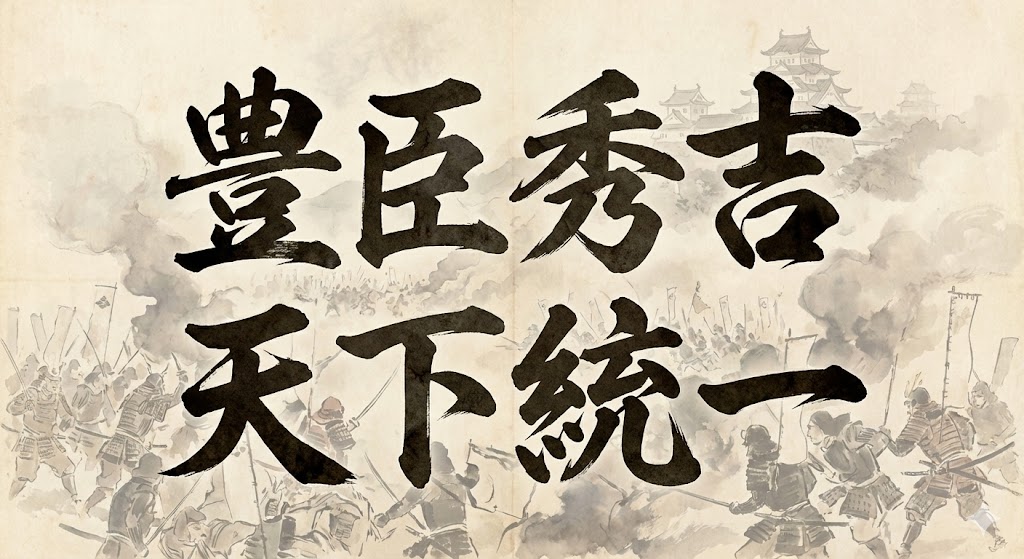
Following Oda Nobunaga’s death, Toyotomi Hideyoshi (The unifying ruler) successfully completed national unification in 1590 by masterfully balancing overwhelming military force and strategic conciliation. He established a unique power structure by differentiating vassal loyalty and acquiring the supreme imperial title of Kanpaku. However, the unexpected late birth of his biological heir, Hideyori, inevitably sparked a catastrophic succession crisis that ultimately doomed his seemingly invincible regime.
Hideyoshi’s national unification avoided simple brute force. Instead, he presented surrounding daimyo with a stark choice between absolute submission or complete destruction. For instance, the formidable Chosokabe clan chose surrender after fierce resistance. Consequently, Hideyoshi spared them but drastically reduced their territory, brilliantly instilling both profound gratitude and absolute terror simultaneously.
Furthermore, Hideyoshi strategically categorized submitting lords based on their historical loyalty. He allowed the powerful Tozama to survive but intentionally marginalized them from the political center. Conversely, he granted extensive administrative authority to his intensely loyal Fudai retainers. Therefore, this meticulously calculated balance maintained overwhelming central military supremacy while deliberately preserving necessary regional decentralization.
🟢 Key Takeaways 🟢
Hideyoshi prioritized efficient control over complete annihilation. This strategic leniency established a highly functional system that strictly differentiated between loyal insiders and heavily monitored external powers, enabling rapid and efficient national pacification.

While Nobunaga subjugated rivals through destruction, Hideyoshi utilized appeasement and absolute authority. Surprisingly, he rejected the traditional title of Shogun, deliberately choosing the supreme imperial posts of Kanpaku and Daijo-daijin. This highly advanced political strategy successfully combined the terrifying face of a military conqueror with the legitimate, traditional authority of an imperial protector.
To further project this power, Hideyoshi heavily invested in Kyoto’s reconstruction. He publicly showcased his intimate relationship with the imperial court by hosting the Emperor at his magnificent Jurakudai palace. Therefore, by exchanging massive financial support for supreme aristocratic titles, this mutually beneficial relationship completely erased his low-born complex and established his unquestionable, absolute supremacy.
🟢 Key Takeaways 🟢
Hideyoshi cleverly bypassed the weakened Shogunate framework to stand at the pinnacle of the aristocratic hierarchy. Merging overwhelming military might with traditional imperial authority created an unassailable and universally recognized absolute dictatorship.

By the 1590s, Hideyoshi’s power reached its absolute zenith, yet the critical absence of a biological heir deeply threatened the regime. Consequently, he adopted his nephew, Toyotomi Hidetsugu (The doomed successor), and officially transferred the Kanpaku title to him. Operating as the retired Taiko, Hideyoshi seemingly secured a smooth, stable generational transition for the newly established dynasty.
However, destiny violently disrupted these plans in 1593 when his concubine, Yodo-dono, unexpectedly gave birth to a biological son. Hideyoshi’s intense parental desire to install his own bloodline instantly transformed the established successor, Hidetsugu, into a massive political liability. Ultimately, this catastrophic reversal of policy bred irreversible suspicion and fatal fractures within the once-solid Toyotomi retainer band.
🟢 Key Takeaways 🟢
Prioritizing bloodline over a finalized succession plan proved to be a fatal misjudgment. This sudden betrayal of his own established system violently destabilized the loyalist factions, proving that even the strongest organizations crumble under emotional inconsistencies.
── Finally, let's recap with the summary and FAQ of this article.
Toyotomi Hideyoshi achieved national unification through a masterful blend of military might, diplomatic appeasement, and imperial authority. However, his unassailable regime ultimately cracked under the weight of a late-stage succession crisis. The main points of this article are:
‣ Legitimizing absolute rule via the imperial Kanpaku title.
‣ A biological birth catastrophically destroying the succession plan.
We hope these historical lessons highlight the profound danger of emotional inconsistency when managing complex organizational transitions.
Q1. Why didn’t Hideyoshi simply execute all his defeated enemies?
Completely annihilating entrenched resistance requires massive time and resources. Therefore, permitting surrender and strategically weakening opponents proved vastly more efficient for rapid national unification.
Q2. Why did he choose the title of “Kanpaku” instead of “Shogun”?
He deliberately avoided the severely weakened image of the Ashikaga Shogunate. By seizing the pinnacle of the aristocratic court, he successfully harnessed the ancient, unquestionable authority of the Emperor to legitimize his absolute rule.
Q3. What can modern leaders learn from Hideyoshi’s ultimate failure?
Even the most brilliant organizations easily collapse from botched succession planning. Overturning established agreements purely based on personal emotion instantly breeds systemic distrust and inevitable self-destruction.
コメント欄