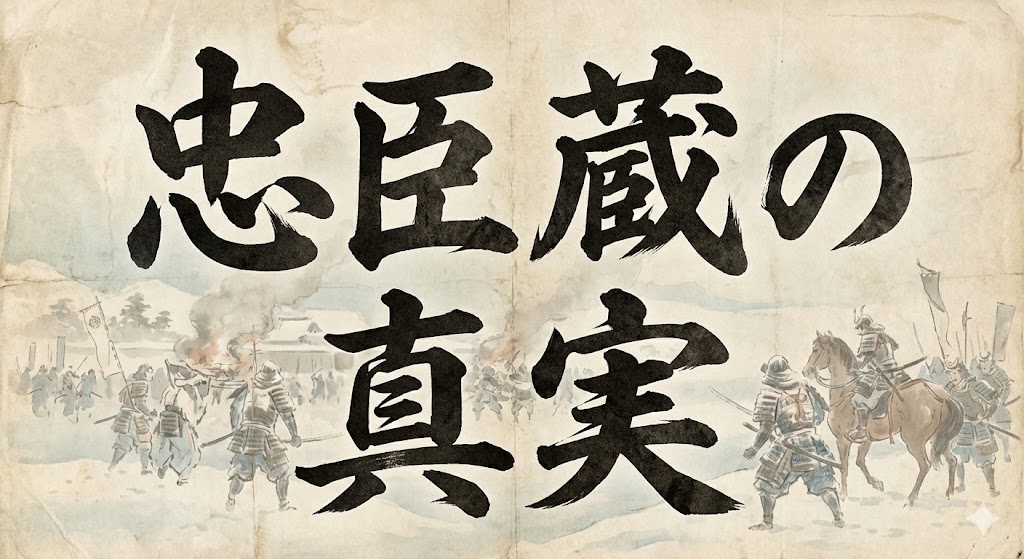
In 1701, an unprecedented sword attack in Edo Castle by Asano Naganori against Kira Yoshinaka ignited the legendary “Chushingura” saga. While the exact motives remain shrouded in mystery, the Shogunate’s seemingly unfair ruling—ordering Asano’s immediate seppuku while fully acquitting Kira—sparked fierce resentment among the Ako retainers. Consequently, following grueling years as impoverished ronin, Chief Retainer Oishi Kuranosuke and forty-six loyalists launched a desperate raid on Kira’s mansion, successfully executing their ultimate revenge.
In 1701, a history-altering incident erupted in the Matsu no Roka (Pine Corridor) of Edo Castle. Asano Naganori, the imperial envoy reception official, suddenly drew his blade and attacked Kira Yoshinaka, the ceremonial instructor. According to Kajikawa Yoriteru (The restraining witness), Asano furiously shouted about a “lingering grudge.” However, despite this dramatic outburst, the true motives behind this unprecedented violence remain shrouded in profound historical mystery.
The Shogunate’s response proved exceptionally swift and coldly severe. Categorizing drawing a sword inside the castle as a massive felony, the government ordered Asano’s immediate seppuku. Conversely, because Kira did not actively resist, the authorities granted him a complete acquittal. Traditionally, samurai law demanded Kenka Ryoseibai (equal punishment for both parties in a dispute). Therefore, this shockingly one-sided ruling appeared profoundly unfair, immediately igniting the furious resentment that fueled the impending revenge plot.
🟢 Key Takeaways 🟢
The Shogunate abruptly ordered Asano’s immediate seppuku without investigating his motives while completely acquitting Kira. Consequently, this seemingly biased ruling blatantly violated traditional samurai justice, deeply implanting a burning desire for vengeance within the hearts of the surviving retainers.

Following their lord’s execution, the Shogunate completely confiscated the Ako domain and installed Nagai Naohiro as the new ruler. Consequently, the entire Asano retainer band instantly suffered catastrophic unemployment, transforming into impoverished Ronin. During this prolonged peacetime era, securing new military employment proved practically impossible. Therefore, these proud warriors faced a brutally harsh reality, struggling desperately just to survive extreme poverty while attempting to maintain their samurai dignity.
Despite this crushing despair, Oishi Kuranosuke (The patient mastermind) successfully unified his scattered comrades and meticulously awaited the perfect opportunity for revenge. Finally, in December 1702, the forty-seven loyalists executed a flawless night raid on Kira’s heavily guarded mansion. After successfully claiming their enemy’s head, they marched triumphantly to Sengakuji Temple to present it at their master’s grave. Surprisingly, this spectacular display of loyalty instantly captivated the suppressed society, cementing their eternal legend.
🟢 Key Takeaways 🟢
Stripped of their employment and homes, the Ako retainers endured severe poverty as ronin while patiently plotting their ultimate revenge. Under Oishi’s unyielding leadership, they successfully executed the raid, dramatically demonstrating unbreakable loyalty and raw samurai spirit to a complacent world.

Following the successful raid, the loyalists immediately surrendered to the authorities, creating a massive legal nightmare for the Shogunate. While their absolute loyalty to their master deserved high moral praise, their highly organized, violent conspiracy blatantly violated the strict Buke Shohatto. Furthermore, the Shogunate’s earlier failure to apply Kenka Ryoseibai heavily haunted this new deliberation. Therefore, simply executing these men as common criminals would dangerously invalidate the very core of Bushido ideology.
After prolonged, agonizing debates, the Shogunate delivered a ruling that acknowledged their profound loyalty while strictly enforcing the law. The government ordered all participants to commit Seppuku. Crucially, this was not a common criminal beheading; it was a highly respectful concession allowing them to die with absolute samurai honor. Forty-six men (excluding Terasaka Kichiemon) proudly accepted this fate. Ultimately, this ruling represented a desperate, agonizing compromise balancing absolute legal authority with deep moral empathy.
🟢 Key Takeaways 🟢
The actions of the Ako Ronin constituted a severe legal felony but represented a magnificent moral triumph. By ordering honorable seppuku instead of common execution, the Shogunate brilliantly balanced the strict maintenance of legal authority with deep respect for the ultimate samurai spirit.
── 👀 読むのが疲れてきませんか? 「歴史は好きだけど、文字を読む時間はあまりない…」 そんな方には、耳で聴く読書がオススメ。
── 最後に、この記事のまとめとFAQでおさらいしましょう。
The Ako Incident transcended a simple revenge narrative; it profoundly questioned the very existence of samurai in a peaceful era. The forty-seven loyalists who risked everything to protest an unreasonable ruling represent a universal theme: how individuals maintain personal convictions while navigating rigid organizational laws. The main points of this article are:
‣ The desperate raid executed amidst severe unemployment.
‣ The honorable seppuku ruling that preserved samurai dignity.
We hope analyzing this legendary conflict between law and loyalty provides you with a deeper understanding of the complex ethical dilemmas that shape human history.
Q1. Why exactly did Asano Naganori attack Kira?
While popular theories suggest insufficient bribes or severe insults, zero concrete evidence exists, leaving the true motive permanently unknown. Asano himself committed seppuku without fully explaining his reasons.
Q2. Why was Kira Yoshinaka initially unpunished?
Because Kira never drew his sword or actively resisted, the Shogunate legally categorized the event not as a mutual “fight,” but strictly as a unilateral “assault” by Asano.
Q3. What does the name “Chushingura” actually mean?
It originates from “Kanadehon Chushingura,” the famous Kabuki play based on the incident. It roughly translates to “A Treasury of Loyal Retainers,” explicitly honoring their ultimate devotion.
コメント欄