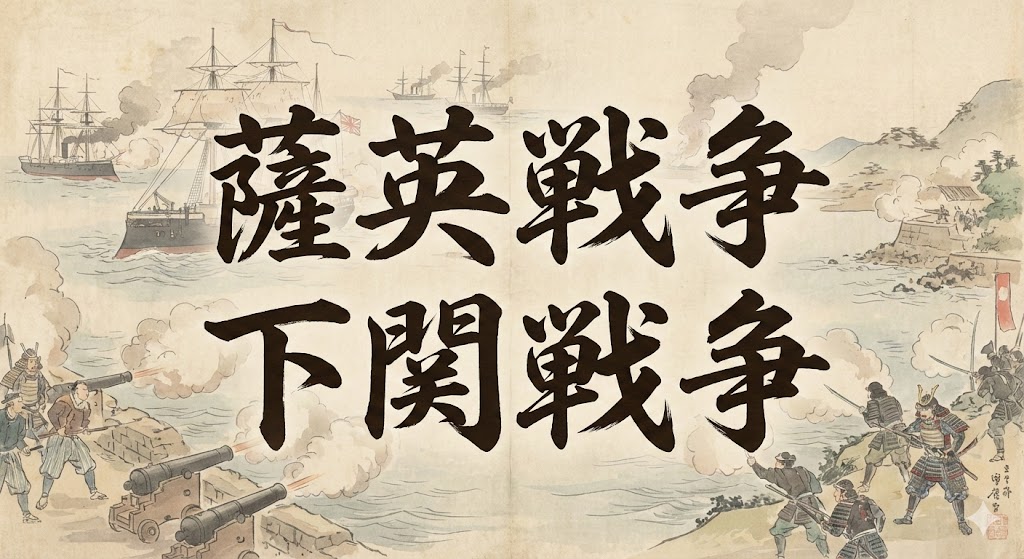
In 1864, devastating military clashes at Shimonoseki and Kagoshima brutally proved the physical impossibility of the “Joi” (expel the barbarians) policy. Furthermore, the Choshu domain suffered catastrophic domestic defeats during the Kinmon Incident and the subsequent First Choshu Expedition. However, this profound desperation birthed a pragmatic survival strategy. By secretly dispatching the “Choshu Five” to study in Britain and reorganizing under Takasugi Shinsaku, these defeated radicals brilliantly pivoted from xenophobic isolationism toward modernizing the nation to ultimately overthrow the Shogunate.
The overwhelming firepower of Western fleets instantly silenced the aggressive anti-foreign chants of the loyalists. During the Shimonoseki Senso, allied Western navies thoroughly destroyed Choshu’s coastal defenses, humiliatingly taking commemorative photographs with the captured cannons. Consequently, this crushing defeat brutally demonstrated that confronting Western military might head-on guaranteed absolute annihilation rather than glorious victory.
Simultaneously, the powerful Satsuma domain endured a similarly bitter lesson. Following the Namamugi Jiken, the Royal Navy fiercely retaliated, igniting the Satsuei Senso. Therefore, as British naval guns reduced much of Kagoshima to ashes, Satsuma practically realized the sheer physical impossibility of “Joi.” This devastating damage forcefully proved that mere spiritual determination could never repel modern industrial warfare.
🟢 Key Takeaways 🟢
Both Choshu and Satsuma learned through catastrophic military defeats that their antiquated weaponry was utterly useless. Consequently, this crushing reality forced them to abandon blind xenophobia and aggressively analyze Western technology for national survival.

Following their international humiliation, Choshu faced a catastrophic domestic crisis. Desperately attempting to seize the Emperor and reverse their political fortunes, Choshu forces marched on Kyoto, sparking the Kinmon no Hen. However, a fierce counterattack led by Matsudaira Katamori and Satsuma forces completely crushed this rebellion. Furthermore, by firing upon the Imperial Palace gates, Choshu officially became an “Enemy of the Court,” triggering massive fires that devastated central Kyoto.
Seizing this golden opportunity, the Shogunate immediately launched the Dai-ichi-ji Choshu Seibatsu. Faced with an overwhelming coalition of western domains, the Choshu government surrendered without fighting. Consequently, following the execution of responsible officials, conservative Shogunate loyalists completely seized control of the domain. Therefore, the radical Sonno Joi movement appeared permanently eradicated from the political landscape.
🟢 Key Takeaways 🟢
Choshu’s reckless coup attempt resulted in absolute domestic and international devastation. While the radical movement seemed temporarily annihilated, this severe political purge actually provided a crucial incubation period for a more pragmatic, evolved revolutionary strategy.

Defeat did not signify the end. Former students of Yoshida Shoin boldly decided to learn directly from their conquerors. Risking execution for violating isolation laws, Ito Hirobumi and the Choshu Five secretly smuggled themselves into Britain. Witnessing the overwhelming superiority of the Industrial Revolution firsthand, they decisively realized that national survival required abandoning “Joi” in favor of aggressive westernization and military modernization.
Meanwhile, Takasugi Shinsaku refused to accept Choshu’s conservative submission to the Shogunate. Fleeing into the mountains to escape political persecution, he secretly organized irregular militias comprised of both samurai and commoners. Eventually, he launched a brilliant, underdog military uprising, successfully recapturing domain control from the conservative faction. Therefore, this critical period of underground preparation steadily generated the explosive energy required for the impending revolution.
🟢 Key Takeaways 🟢
The radical movement did not die; it evolved. By pragmatically sending scholars to study the enemy and organizing modern underground militias, Choshu brilliantly transformed its catastrophic defeats into the essential foundation for the Meiji Restoration.
1864 marked the violent death of conceptual isolationism. However, experiencing catastrophic physical defeat allowed both Satsuma and Choshu to fundamentally pivot toward modern reality. The main points of this article are:
‣ The complete suppression of radicals following the Kinmon Incident.
‣ The Choshu Five utilizing defeat to pursue aggressive Westernization.
We hope observing this massive paradigm shift helps you appreciate how profound failures often force the essential ideological evolutions needed for survival.
Q1. When exactly did the movement shift from “Expel the Barbarians” to “Overthrow the Shogunate”?
The devastating defeats in the 1863 Anglo-Satsuma War and the 1864 Shimonoseki War were the primary catalysts. Realizing Western military dominance, the domains shifted their focus toward destroying the weak Shogunate to build a modern, centralized nation capable of defending itself.
Q2. What was the main difference between Satsuma and Choshu at this time?
Choshu was heavily driven by fiery, ideological “Sonno Joi” zealotry. Conversely, Satsuma operated with colder, pragmatic political calculation, utilizing concepts like Kobu Gattai (Union of Court and Camp) to systematically accumulate wealth and military power.
Q3. Why did the Choshu Five study in Britain, the very nation that attacked them?
They adopted the ultimate pragmatic mindset: “To preserve our independence, we must deeply understand our enemy and steal their technology.” Their extraordinary flexibility and willingness to learn from their conquerors became the administrative backbone of the future Meiji government.
コメント欄