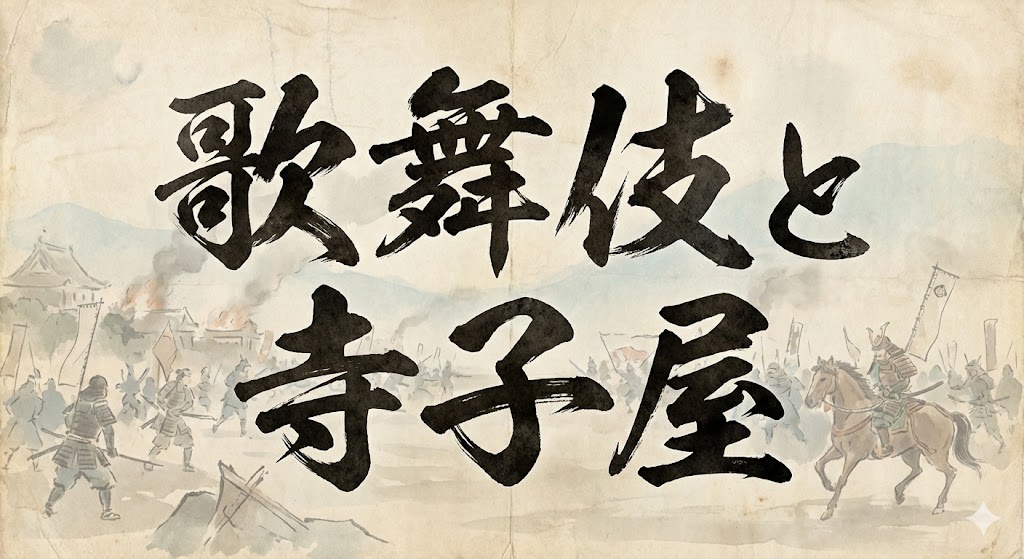
During the Edo period, Japan achieved an astonishingly high global literacy rate through the widespread establishment of Hanko for samurai and Terakoya for commoners. Meanwhile, Kabuki emerged as a massive mass-media phenomenon, captivating the public and evolving despite repeated Shogunate regulations. Furthermore, urban centers established strictly zoned Yukaku districts, forging a complex cultural sphere where dazzling glamour and dark economic exploitation intersected.
Despite strict social hierarchies, educational access improved dramatically during the Edo period. Samurai children attended Hanko to master reading, writing, and the philosophy required to become a Jukyo-teki Kanryo in a peaceful era. However, as Fukuzawa Yukichi (The critical educator) later lamented, strict class discrimination prioritizing lineage over talent severely divided these very classrooms.
Conversely, Terakoya supported commoner education nationwide. Evolving from Buddhist temples, these private schools provided fundamental literacy and morality at remarkably low costs. Consequently, while not universally accessible, this widespread system propelled late Edo Japan to achieve astonishing global literacy rates. Therefore, education ceased to be the exclusive monopoly of the privileged elite.
🟢 Key Takeaways 🟢
The democratization of education equipped samurai with administrative philosophy and commoners with practical literacy. This widespread academic infrastructure elevated the entire society’s intellectual standard, successfully engineering a highly advanced knowledge economy with unprecedented global literacy rates.

Following work and study, citizens eagerly consumed entertainment. The Edo period essentially birthed Japan’s “mass media” era, centered heavily around the extravagant productions of Kabuki. Initially founded by Izumo no Okuni (The pioneering female entertainer), the performances proved so scandalous and overwhelmingly popular that the Shogunate banned women, forcing the transition to the all-male format known today.
Surprisingly, this strict regulation only fueled public obsession, transforming legal controversies into massive promotional buzz. Commoners unable to afford expensive theater tickets eagerly purchased mass-produced Ukiyo-e prints to immerse themselves in this glamorous world. Consequently, historical records show even impoverished citizens becoming utterly obsessed with Kabuki culture, establishing the absolute roots of modern idol fandom.
🟢 Key Takeaways 🟢
Kabuki reigned as the ultimate entertainment, successfully weaponizing scandals and Shogunate regulations to amplify its immense popularity. The rapid circulation of Ukiyo-e prints democratized this glamour, forging a passionate, cross-class fandom remarkably similar to modern pop-culture crazes.

Official red-light districts like Edo’s Yoshiwara and Kyoto’s Shimabara represented far more than mere entertainment zones. The Shogunate executed strict urban zoning to physically isolate, manage, and tax elements considered public immorality within designated Yukaku. Interestingly, contemporary morality condemned these districts less for sexual taboo and more for functioning as “parasitic” businesses generating wealth without producing tangible goods.
Buyo Inshi (The anonymous samurai critic), author of the Seji Kenbunroku, fiercely criticized this societal decay and the brutal exploitation of women trapped in Nenki Hoko. Therefore, while Yukaku served as brilliant hubs of high culture and fashion, they simultaneously functioned as brutal centers of human trafficking. Ultimately, this stark duality perfectly mirrored the profound socio-economic complexities plaguing the Edo megacity.
🟢 Key Takeaways 🟢
The Shogunate utilized Yukaku to rigidly zone and tax urban vices. However, beneath the dazzling cultural surface lay a brutal system of economic exploitation and indentured servitude, drawing fierce criticism from contemporary intellectuals.
── Finally, let's recap with the summary and FAQ of this article.
The Edo period revolutionized public access to education and entertainment. Hanko and Terakoya established a formidable knowledge base, while Kabuki and Yukaku defined vibrant urban lifestyles. However, deep economic exploitation lurked beneath this prosperity. The main points of this article are:
‣ The unstoppable, scandal-fueled rise of Kabuki media.
‣ The dark economic realities beneath sanctioned urban zoning.
We hope exploring these complex historical dualities helps you better understand the deep cultural roots and socio-economic paradoxes of modern society.
Q1. How much education could ordinary commoners actually receive?
While wealthy commoners could afford advanced private academies, the vast majority attended local Terakoya. This accessible system provided exceptional foundational literacy, propelling late Edo Japan to some of the highest literacy rates globally.
Q2. Why did women stop performing in Kabuki theater?
The original female-led Kabuki performances pioneered by Izumo no Okuni became overwhelmingly popular and deeply scandalous. The Shogunate quickly banned women to maintain public morals, forcing the transition to the iconic all-male format.
Q3. How did the general public view the Yukaku districts?
Instead of purely sexual taboo, many critics condemned the districts as “parasitic” for draining wealth without producing tangible goods. Furthermore, intellectuals openly criticized the severe structural exploitation of women trapped by family debts.


コメント欄