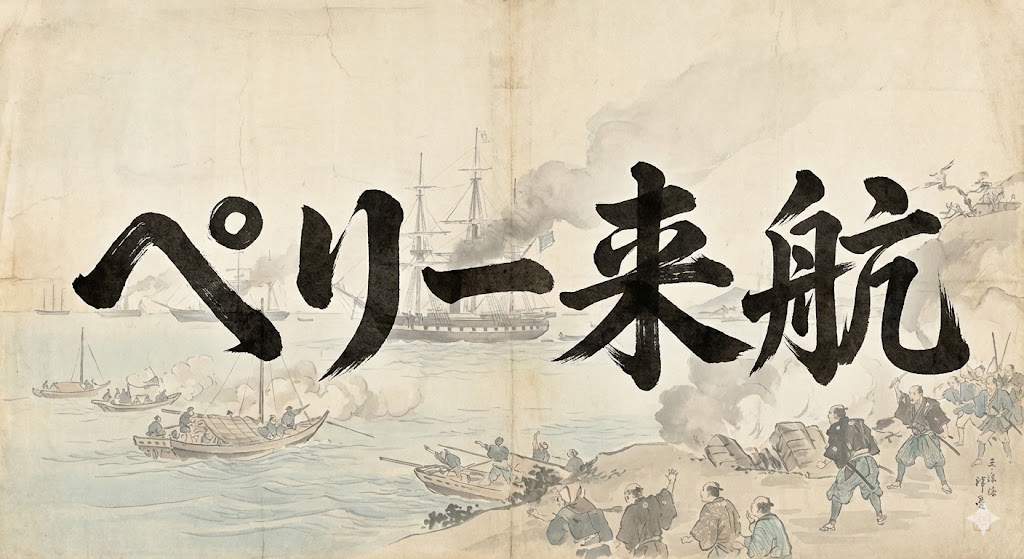
The 1853 arrival of the Black Ships represented far more than a simple American demand for open ports. The shocking British victory in the Opium War had already brutally exposed the overwhelming military gap forged by the Industrial Revolution, rendering Japan’s isolationist policies obsolete. Meanwhile, severe domestic divisions over slavery forced the US President to seek a distracting diplomatic triumph in Japan. Consequently, a dying Shogun and a terrified Shogunate faced an impossible crisis where international ambition and domestic vulnerability violently collided.
Historically, the Shogunate aggressively repelled foreign vessels using military force, perfectly demonstrated by the Morrison Incident. However, shocking intelligence arriving in 1842 completely shattered this confident isolationism. Britain had effortlessly crushed Qing China—the undisputed Asian superpower—in the Opium War. Consequently, this horrifying reality brutally proved that traditional expulsion policies were now dangerously obsolete.
The core reason for China’s defeat was terrifyingly obvious. Propelled by the Industrial Revolution, Western nations now commanded steam-powered warships and devastating modern artillery. Wooden vessels and antiquated matchlocks offered absolutely zero defense against this unprecedented firepower. Therefore, acutely recognizing this massive technological disparity, the Shogunate realized that violently repelling Commodore Perry’s advanced fleet would guarantee national annihilation.
🟢 Key Takeaways 🟢
Qing China’s catastrophic defeat in the Opium War completely destroyed Japan’s confidence in its military isolationism. Acknowledging the insurmountable technological gap created by the Industrial Revolution forced the Shogunate to abandon armed expulsion and desperately seek new diplomatic survival strategies.

In 1851, US President Millard Fillmore faced a catastrophic domestic crisis. Fierce internal conflicts over slavery threatened to tear his administration and the nation apart. Consequently, to forcibly divert public attention outward, he orchestrated a spectacular foreign policy gamble. By forcing the isolated Japanese empire to open supply ports for American Whaling Ships, Fillmore desperately sought a unifying diplomatic victory.
To execute this critical mission, he deployed Matthew Perry (The veteran commander), granting him explicit authority to utilize military force if necessary. Perry did not arrive as a humble diplomat. By aggressively firing blank cannons in Edo Bay and presenting white surrender flags, he executed a terrifying psychological performance. Therefore, this extreme gunboat diplomacy clearly signaled America’s absolute willingness to initiate war if negotiations failed.
🟢 Key Takeaways 🟢
The Black Ships expedition was heavily driven by America’s desperate need to distract its citizens from explosive domestic slavery disputes. President Fillmore utilized Perry’s terrifying gunboat diplomacy not just to secure whaling ports, but to manufacture a desperately needed political triumph.

When Perry’s ominous fleet anchored at Uraga, the Shogunate suffered incredibly tragic timing. Tokugawa Ieyoshi (The reigning Shogun) lay critically ill, completely paralyzing the government’s executive leadership. Consequently, the monumental burden of facing this terrifying foreign threat fell squarely upon Abe Masahiro (The Chief Councilor). He was forced to navigate an overwhelming external invasion while simultaneously managing a disastrous internal succession crisis.
The Presidential Letter delivered by Perry feigned friendship but carried absolute military coercion. Furthermore, Perry gifted the Shogunate working telegraphs and a miniature steam train, deliberately flaunting America’s crushing technological supremacy. Terrified and leaderless, Abe strategically avoided an immediate answer. Therefore, he desperately chose to “buy time” until the following year, executing the only viable survival tactic available to an outgunned, paralyzed government.
🟢 Key Takeaways 🟢
The Shogun’s untimely death paralyzed Tokugawa leadership exactly when decisive action was required. Faced with overwhelming technological intimidation and severe internal chaos, Abe Masahiro secured national survival through the desperate strategy of delaying the inevitable.
── 👀 読むのが疲れてきませんか? 「歴史は好きだけど、文字を読む時間はあまりない…」 そんな方には、耳で聴く読書がオススメ。
── 最後に、この記事のまとめとFAQでおさらいしましょう。
The 1853 arrival of the Black Ships was a perfect historical storm where American domestic turmoil violently collided with Japanese leadership paralysis. The technological disparity proven by the Opium War rendered continued isolation physically impossible. The main points of this article are:
‣ US domestic division fueled aggressive gunboat diplomacy.
‣ A leaderless Shogunate survived only by desperately buying time.
We hope understanding the complex international and domestic pressures behind this event clarifies exactly why Japan was forcefully dragged onto the modern global stage.
Q1. Why didn’t the Shogunate simply repel the Black Ships with cannons?
They fully understood it was impossible. Having witnessed Qing China’s catastrophic defeat in the Opium War, the Shogunate knew that engaging Industrial Revolution-era warships with outdated weaponry would result in immediate annihilation.
Q2. Why was Commodore Perry so aggressive?
He was explicitly authorized by the US government to utilize intimidation and force. By firing blank cannons and presenting white flags, he aggressively showcased American technological superiority to terrify Japan into submission.
Q3. What was President Fillmore’s ultimate political goal?
He desperately needed a major foreign policy victory to distract the American public from explosive, deeply divisive domestic debates over slavery. Forcing Japan to open its ports was a calculated gamble for his own political survival.


コメント欄