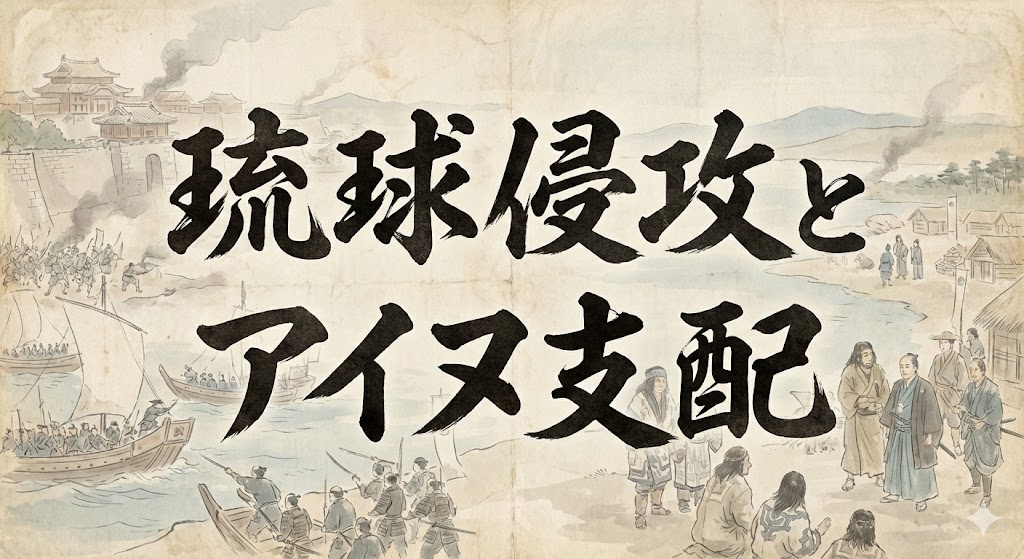
Operating under Tokugawa orders, the Satsuma domain ruthlessly invaded the Ryukyu Kingdom, enforcing a bizarre dual subordination to secretly exploit Chinese trade. Simultaneously in the north, the Matsumae clan monopolized trade with the indigenous Ainu. Following Shakushain’s desperate rebellion, this severe economic extortion rapidly devolved into absolute colonial subjugation. Ultimately, these hidden, ruthless expansions at the northern and southern borders actively fueled Japan’s supposedly isolated economy.
When King Sho Nei (The defiant monarch) consistently refused submission, the Satsuma domain launched a highly calculated military invasion. Consequently, the defeated kingdom was ruthlessly forced to cede the Satsunan Shoto and pay heavy tributes. This aggressive territorial expansion established the complex, historical roots of modern Okinawa’s unique cultural and political relationship with mainland Japan.
Surprisingly, the Shogunate deliberately allowed Ryukyu to maintain its official status as a Chinese Chokokoku. This bizarre dual subordination functioned as a brilliant geopolitical loophole. Because official direct trade with China remained impossible under isolationist policies, Japan utilized the subjugated Ryukyu as a covert intermediary to acquire highly lucrative Chinese goods. Therefore, this strategy coldly prioritized massive economic extraction over overt political assimilation.
🟢 Key Takeaways 🟢
Satsuma’s military conquest masterfully preserved Ryukyu’s tributary status with China as a geopolitical facade. This calculated dual domination served as a hidden economic pipeline, allowing an isolated Japan to secretly drain massive profits from continental trade.

The massive Shin-ocho undoubtedly recognized this bizarre, dual-subordination anomaly. However, despite Jukyo doctrines strictly condemning material greed, corrupt Chinese bureaucrats consistently turned a blind eye to Japan’s blatant geopolitical interference. Exploring their silence reveals a stark contrast between high-minded imperial philosophy and raw human avarice.
The true motivation behind this diplomatic silence was entirely financial. Massive bribes and highly profitable Mitsuboeki heavily incentivized these mainland officials to maintain the lucrative status quo. Consequently, human greed and underground economies easily overpowered formal state dignity. Therefore, theoretical morality proved utterly useless against the overwhelming gravity of cold, hard cash.
🟢 Key Takeaways 🟢
Despite preaching strict Confucian morality, Chinese officials actively ignored the Ryukyuan subjugation to line their own pockets. Massive illicit trade profits and systemic bribery successfully silenced any potential diplomatic outrage from the imperial court.

In the freezing northern frontier, the Matsumae-shi established absolute economic dominance. Lacking rice-producing agricultural lands to pay their samurai, they utilized the Basho Chigyo-sei. This system granted retainers exclusive trading rights with the indigenous Ainu. However, this structure rapidly devolved, severely distorting fair trade into systematic, crippling economic extortion against the native population.
When Shakushain (The fierce chieftain) launched a massive indigenous rebellion to protest this systemic abuse, the Matsumae unleashed overwhelming military force. Consequently, violently crushing this uprising permanently transformed a fragile trade partnership into absolute colonial subjugation. The Matsumae subsequently banned Japanese language education and weapon ownership among the Ainu, ruthlessly solidifying their status as a permanently exploited underclass.
🟢 Key Takeaways 🟢
The Matsumae clan weaponized their trade monopoly to ruthlessly exploit the Ainu population. Brutally crushing Shakushain’s rebellion permanently eradicated indigenous autonomy, replacing trade relations with a harsh, unyielding colonial regime in the northern frontier.
── Finally, let's recap with the summary and FAQ of this article.
Beneath the facade of peaceful national isolation, Japan aggressively executed strategic colonial expansions at its northern and southern borders. The Shogunate actively devoured distinct cultures to fuel its own economic engine. The main points of this article are:
‣ Corrupt Chinese bureaucrats ignoring geopolitical shifts for bribes.
‣ Matsumae transforming Ainu trade into brutal colonial exploitation.
We hope understanding the cold, economic mechanics behind these historical border expansions provides a sharper lens for analyzing modern geopolitical conflicts and trade relations.
Q1. When did Ryukyu and Hokkaido officially become Japanese territory?
Formal annexation occurred much later during the Meiji era. Through the Ryukyu Disposition and the establishment of the Hokkaido Development Commission, they were officially integrated as modern prefectures.
Q2. What is the historical difference between “Ezo” and “Ainu”?
“Ezo” was a broad, somewhat derogatory term used by the central Yamato government to describe all northern indigenous peoples. “Ainu” specifically refers to the distinct ethnic group and their descendants who inhabited those northern regions.
Q3. Why did the Shogunate permit Ryukyu to remain subordinate to China?
It was a purely economic calculation. By maintaining Ryukyu’s facade as an independent foreign nation, Japan successfully bypassed its own strict Sakoku laws to continually extract massive profits from Chinese trade.
コメント欄