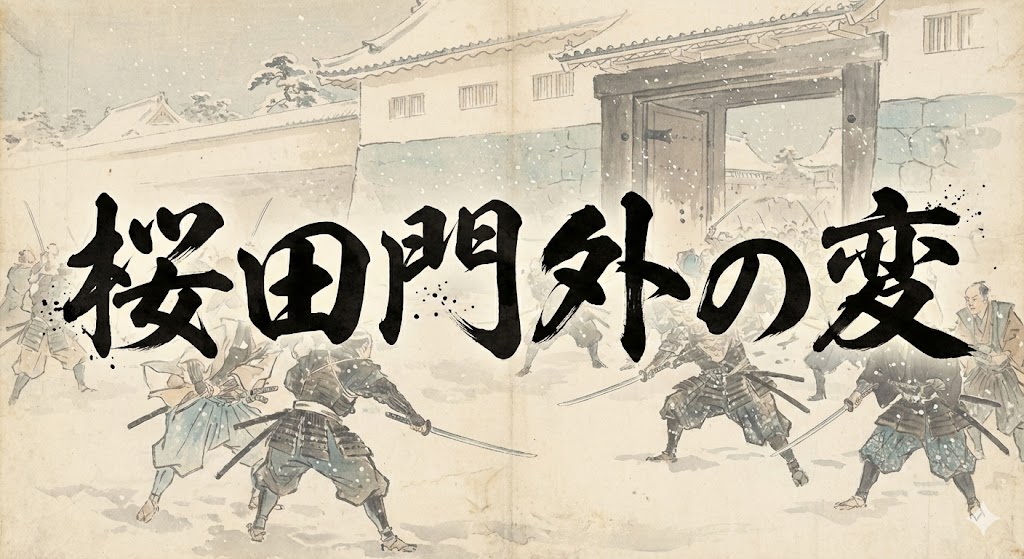
Although Tairo Ii Naosuke believed his brutal Ansei Purge had secured Shogunate supremacy, his shocking assassination during the Sakuradamon Incident completely shattered the Tokugawa regime’s aura of invincibility. Consequently, the paralyzed, leaderless government desperately sought survival through the Kobu Gattai (Union of Court and Camp) policy, strategically arranging a political marriage with the imperial family. However, this overt display of weakness only fueled the radical Sonno Joi movement, permanently weaponizing imperial loyalty to forcefully dismantle the failing Shogunate.
Initially, Tairo Ii Naosuke appeared to have cemented absolute Tokugawa supremacy through the terrifying Ansei no Taigoku. Firmly believing that immediate westernization offered the only viable survival strategy for Japan, he aggressively bulldozed his policies through immense political opposition. However, this extreme authoritarianism inevitably bred radical, violent enemies, guaranteeing his own incredibly abrupt and violent demise.
In March 1860, during a heavy snowstorm, rogue swordsmen from the Mito domain successfully ambushed Ii’s procession in the Sakuradamon-gai no Hen. Following the brutal assassination, the attackers distributed a Zankanjo, passionately declaring that Ii’s foreign concessions actively destroyed the national interest. Consequently, the successful daylight murder of the nation’s highest-ranking official irrevocably shattered the foundational myth of Tokugawa invincibility.
🟢 Key Takeaways 🟢
Ii Naosuke’s reliance on brutal suppression triggered a catastrophic violent backlash. His shocking assassination did not merely remove a politician; it unleashed decades of violently suppressed anti-Shogunate frustration, permanently derailing the Tokugawa regime’s control over the nation.

Following Ii’s death, a catastrophic leadership vacuum paralyzed the Shogunate. Because Shogun Iemochi remained extremely young and capable leaders had been purged, the government desperately pivoted to the Kobu Gattai policy. Therefore, to mask their own crippling weakness, the Shogunate humiliatingly sought to borrow the sacred authority of the very Imperial Court they had previously suppressed.
Iwakura Tomomi (The brilliant imperial strategist) enthusiastically orchestrated this alliance. Recognizing the Shogunate’s vulnerability, he engineered the political marriage of Kazu-no-Miya Chikako to the young Shogun. Although the Princess deeply resisted moving to the eastern military capital, she ultimately submitted. Consequently, this strategic marriage radically shifted the national power dynamic; the Shogunate could no longer execute political decisions without explicit Imperial consent.
🟢 Key Takeaways 🟢
Unable to rule independently, the Shogunate desperately utilized a political marriage to borrow Imperial legitimacy. However, this overt display of weakness completely backfired, publicly confirming the Shogunate’s dependency and permanently transferring supreme political leverage to the Emperor.

While the government pursued peaceful integration, the Sonno Joi movement rapidly radicalized. Their political logic proved devastatingly simple: the Emperor represented absolute sovereignty, while the Shogunate merely functioned as a temporary delegate. Heavily influenced by Mitogaku, these radicals argued that if the Shogunate defied the Emperor by opening the country, it immediately forfeited its legitimate mandate to rule.
Furthermore, the Sakuradamon Incident provided these radicals with a massive, intoxicating success story. It successfully validated the dangerous ideology that executing “traitors” who sold out the country was a righteous, heavenly duty. Consequently, Sonno Joi aggressively evolved from a simple xenophobic movement into a highly organized, violent revolution directly aiming for Taisei Hokan, actively plotting the total destruction of the Tokugawa regime.
🟢 Key Takeaways 🟢
Radical samurai completely delegitimized the Shogunate, branding them as treasonous failures incapable of protecting the nation. Empowered by successful assassinations, they weaponized the Emperor’s absolute authority to justify a bloody, revolutionary push for regime change.
── Finally, let's recap with the summary and FAQ of this article.
The assassination of Ii Naosuke fundamentally triggered the irreversible collapse of the Tokugawa Shogunate. By losing absolute leadership and desperately crawling back to the Imperial Court, the regime voluntarily surrendered its political supremacy. The main points of this article are:
‣ The Kobu Gattai policy exposing the Shogunate’s fatal dependence.
‣ Sonno Joi radicals weaponizing imperial loyalty for violent revolution.
We hope analyzing this rapid collapse of centralized power provides you with a clear understanding of how compromised authority fuels revolutionary movements.
Q1. Why exactly was Ii Naosuke assassinated?
Radical samurai were absolutely infuriated by his unilateral signing of foreign treaties without imperial consent, combined with his brutal, unforgiving executions of political opponents during the Ansei Purge.
Q2. What was the core purpose of “Kobu Gattai”?
It was a desperate political strategy attempting to fuse the Imperial Court (Ko) with the Shogunate (Bu). The severely weakened Shogunate utilized this marriage to artificially borrow imperial prestige and stabilize their crumbling authority.
Q3. Why did the Sonno Joi movement inevitably lead to the Shogunate’s downfall?
The movement established the uncompromising logic that the Shogunate was actively defying the Emperor’s will. Therefore, destroying the Shogunate and returning absolute power to the Emperor was perfectly justified as an act of supreme righteousness.
コメント欄