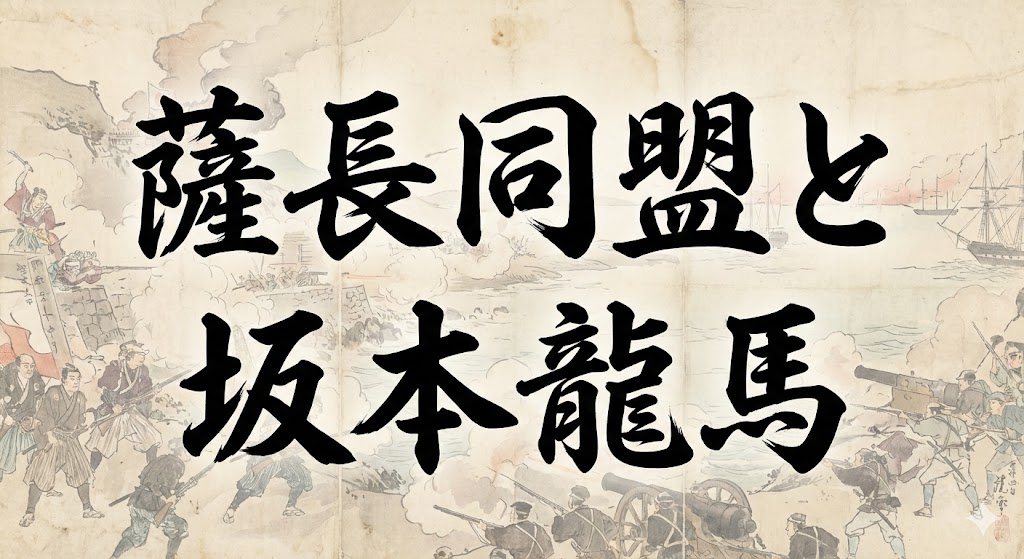
As the Shogunate’s control faltered, the bitterly rivalrous Satsuma and Choshu domains forged a historic alliance, brilliantly mediated by the masterless samurai Sakamoto Ryoma. This secret pact guaranteed the Shogunate’s military defeat and shattered its authority. Furthermore, the sudden deaths of the young Shogun Iemochi and the pro-Shogunate Emperor Komei created a massive power vacuum. Ultimately, this chaotic sequence of events paved the way for the 15-year-old Emperor Meiji’s ascension, marking the definitive collapse of the Tokugawa regime.
Despite their intense historical rivalry, Satsuma and Choshu faced a desperate need to survive mounting Shogunate pressure. Sakamoto Ryoma (The visionary mediator) emerged as a neutral third party to bridge this seemingly impossible gap. Consequently, his mediation produced the Satcho Domei, which was not merely a peace treaty, but a groundbreaking secret military pact specifically designed to overthrow the Shogunate.
The impact of this alliance was absolute. During the Second Choshu Expedition, Satsuma blatantly refused mobilization orders and covertly supplied advanced weaponry to Choshu. Therefore, the Shogunate suffered a catastrophic military defeat. In modern terms, this was a shocking scenario where fierce corporate competitors secretly merged to forcefully bankrupt the dominant market leader.
🟢 Key Takeaways 🟢
To overthrow the Shogunate, the rival domains of Satsuma and Choshu strategically united through Ryoma’s mediation. This historic betrayal triggered the Shogunate’s military defeat, causing the once-invincible Tokugawa structure to rapidly disintegrate and opening the door to a new era.
German sociologist Max Weber defined a state by its legitimate monopoly on violence. However, the Shogunate’s humiliating defeat by Choshu brutally exposed their inability to enforce laws through military power. Furthermore, compounding this disaster, the young Shogun Tokugawa Iemochi suddenly died at Osaka Castle at the age of twenty, dealing a devastating psychological blow to the paralyzed government.
Amidst this chaos, Tokugawa Yoshinobu assumed leadership, secretly managing Iemochi’s death while desperately negotiating a ceasefire with Choshu. Surprisingly, regional domains began openly ignoring Shogunate directives and conducting independent foreign arms deals. Consequently, Yoshinobu faced the unprecedented, isolating task of steering a sinking regime that had entirely lost its practical governing authority.
🟢 Key Takeaways 🟢
Having lost its military dominance, the Shogunate’s influence plummeted further with the untimely death of Shogun Iemochi. Yoshinobu inherited a government that was effectively a shell, as regional domains no longer felt compelled to obey Tokugawa commands, signaling a terminal state of authority.
Shogun Yoshinobu’s absolute strongest political shield was Emperor Komei. Although the Emperor intensely despised foreigners, he firmly supported the Shogunate’s continued existence. However, the Emperor suddenly collapsed with a high fever and died shortly after a Smallpox diagnosis. Because his condition worsened so unexpectedly during recovery, persistent rumors of assassination by radical nobles like Iwakura Tomomi continue to haunt historical debates.
With the loss of its ultimate protector, the Shogunate was left completely defenseless. The imperial throne passed to the fifteen-year-old Prince Mutsuhito, who was highly susceptible to the influence of the radical anti-Shogunate court nobles surrounding him. Therefore, this sudden transition provided the perfect opportunity for the Satsuma and Choshu forces to seize absolute political initiative and move decisively toward regime change.
🟢 Key Takeaways 🟢
The mysterious death of Emperor Komei stripped the Tokugawa family of its most powerful political shield. The ascension of the young Emperor Meiji ensured that the anti-Shogunate factions would dominate the new era, leaving the Shogunate vulnerable and accelerating the irreversible momentum toward revolution.
── Finally, let's recap with the summary and FAQ of this article.
The Satcho Alliance, the Shogunate’s military failure, and the consecutive deaths of the Shogun and the Emperor created the perfect storm for the end of the Tokugawa era. The main points of this article are:
‣ The loss of authority following military defeat and Iemochi’s death.
‣ The sudden passing of Emperor Komei, removing the Shogunate’s final shield.
We hope understanding these hidden structural collapses helps you recognize the inevitable forces that rapidly accelerated Japan toward the Meiji Restoration.
Q1. Why were Satsuma and Choshu such bitter enemies initially?
Beyond historical grudges dating back to the Battle of Sekigahara, the two domains had recently fought directly during the “Kinmon Incident.” However, their shared fear of Shogunate centralization ultimately forced them into a pragmatic alliance.
Q2. Was Sakamoto Ryoma truly as important as stories suggest?
While later historical fiction may have romanticized him, his role as a neutral mediator who facilitated the Satcho Alliance is a documented fact. He functioned as a critical practical coordinator during a time of extreme political distrust.
Q3. Was Emperor Komei actually assassinated?
The theory remains popular because the Emperor’s symptoms resembled arsenic poisoning, and his death was suspiciously convenient for the anti-Shogunate faction. However, no definitive proof exists, and the official cause remains smallpox.
コメント欄