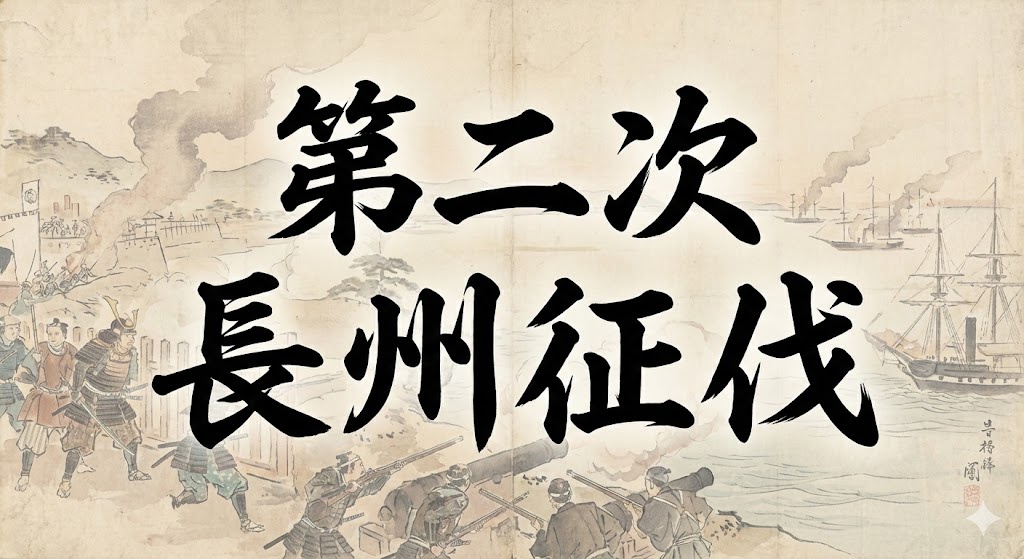
By 1865, the Shogunate appeared secure, yet a radical coup led by Takasugi Shinsaku and his Kiheitai militia reignited the flames of revolution in Choshu. When the Shogunate launched the Second Choshu Expedition in 1866, they suffered a humiliating defeat against Choshu’s superior Western weaponry and modern tactics. Crucially, the secret Satcho Alliance ensured the Satsuma domain’s refusal to mobilize, leaving the Shogunate politically isolated. This military catastrophe permanently shattered Tokugawa authority, signaling the inevitable end of the samurai era.
In early 1865, the Shogunate leadership felt a false sense of security after previously suppressing Choshu. However, Takasugi Shinsaku and his radical loyalists, who had been hiding in the countryside, refused to surrender. Takasugi launched a desperate, successful coup at Kozan-ji Temple, ruthlessly purging pro-Shogunate officials and seizing control of the domain once again.
The primary driver of this coup’s success was overwhelming firepower. Takasugi’s forces had secretly stockpiled massive quantities of US Civil War Surplus, including highly accurate Minie rifles. Consequently, the Kiheitai—a unique militia composed of both samurai and commoners—mastered Western-style skirmish tactics. Therefore, while the Shogunate remained complacent, Choshu meticulously sharpened its claws for the inevitable final confrontation.
🟢 Key Takeaways 🟢
While the Shogunate relaxed, Choshu fundamentally transformed its military. Takasugi Shinsaku built a merit-based army equipped with modern American rifles, creating a formidable force specifically designed to dismantle traditional samurai formations through superior technology and morale.
In 1866, the Shogunate launched the Second Choshu Expedition to restore its fading prestige. In an unprecedented move, Shogun Tokugawa Iemochi personally traveled to Osaka Castle to boost morale. However, this massive mobilization caused rice prices to skyrocket, triggering widespread Uchikowashi (riots) in major cities like Edo and Osaka. Consequently, the Shogunate’s domestic foundation began to crumble even before the first shots were fired.
Surprisingly, despite their numerical superiority, the Shogunate forces suffered total defeat on the battlefield. Poor communication and rigid, outdated formations paralyzed their four-pronged encirclement plan. Conversely, the Choshu army utilized steamships and accurate rifle fire to dominate the terrain. Ultimately, the Tokugawa’s traditional samurai legions proved entirely powerless against Choshu’s modern tactics, resulting in a humiliating retreat that permanently destroyed Shogunal authority.
🟢 Key Takeaways 🟢
Economic chaos and obsolete military strategy doomed the Shogunate’s final gamble. Choshu’s high morale and modern rifles effortlessly dismantled the Tokugawa’s massive but disorganized army, proving that the Shogunate no longer possessed the power to govern the nation.
The Shogunate’s defeat was ensured by the strategic desertion of its key allies. Most shockingly, the Satsuma Domain—the strongest military force in western Japan—refused to participate, claiming the Shogunate lacked a Taigi Meibun. In reality, Satsuma had already secretly signed the Satcho Alliance, forming a historic partnership with their former enemies in Choshu to actively overthrow the Shogunate.
Furthermore, other regional domains grew increasingly suspicious of the Shogunate’s centralized power grab. They feared that a victory over Choshu would allow the Tokugawa to strip away their own local autonomy. Consequently, many domains intentionally delayed their troops or avoided combat entirely. Therefore, with Satsuma’s covert support, Choshu was no longer isolated; instead, it was the Shogunate that found itself politically and militarily abandoned.
🟢 Key Takeaways 🟢
The secret Satcho Alliance was the ultimate turning point in the war. By successfully uniting Japan’s two most powerful domains against the Tokugawa, this pact neutralized the Shogunate’s political leverage and guaranteed its military collapse, paving the way for the Meiji Restoration.
── Finally, let's recap with the summary and FAQ of this article.
The failure of the Second Choshu Expedition signaled the irreversible end of the Tokugawa Shogunate. Modern technology and revolutionary alliances proved that traditional feudal authority could no longer sustain itself. The main points of this article are:
‣ The Shogunate’s self-destruction through economic chaos and outdated tactics.
‣ The secret Satcho Alliance shifting the absolute balance of power.
We hope understanding this dramatic transition from feudalism to a modern centralized state clarifies why the Tokugawa regime was destined to fall.
Q1. How did the small Choshu domain defeat the massive Shogunate army?
They successfully utilized modern Minie rifles and steamships acquired from the West. Furthermore, the Kiheitai utilized highly mobile skirmish tactics that completely overwhelmed the Shogunate’s rigid, traditional samurai formations.
Q2. What exactly was the Kiheitai?
Established by Takasugi Shinsaku, the Kiheitai was a merit-based militia that recruited both samurai and commoners. This integration created a force with exceptionally high morale and specialized training in modern Western warfare.
Q3. Why did Satsuma betray the Shogunate?
Satsuma feared that a Shogunate victory would lead to an oppressive centralized government. Consequently, they secretly allied with Choshu to ensure the destruction of the Tokugawa regime and the establishment of a new imperial government.
コメント欄