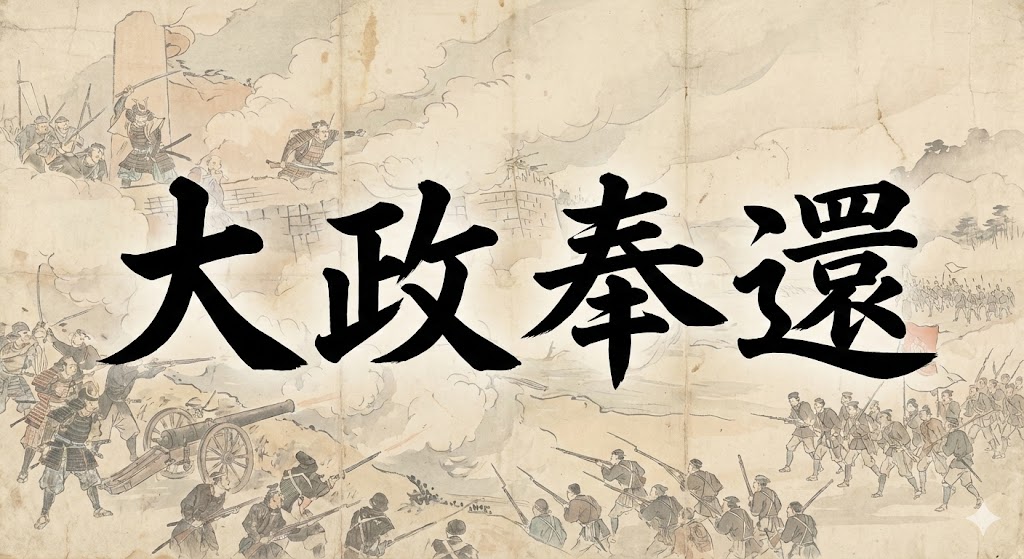
To outmaneuver the radical anti-Shogunate factions, the 15th Shogun Tokugawa Yoshinobu strategically executed the Taisei Hokan, officially returning political power to the Emperor. However, hardliners led by Iwakura Tomomi and Satsuma-Choshu forces brilliantly countered this with the Decree for the Restoration of Imperial Rule, stripping Yoshinobu of his lands and titles. This deliberate, intense political provocation inevitably ignited the Battle of Toba-Fushimi. Consequently, the new imperial forces crushed the former Shogunate army, officially terminating Tokugawa rule and forcefully opening the door to the Meiji era.
Under the newly enthroned Meiji Tenno, the Satsuma-Choshu alliance drastically escalated their pressure to overthrow the Shogunate. To brilliantly defuse this crisis, Tokugawa Yoshinobu declared the Taisei Hokan in November 1867. However, this was absolutely not an unconditional surrender. Rather, it functioned as a highly sophisticated political strategy to secure a dominant seat at the negotiating table while preserving his massive army and territories intact.
Yoshinobu actively envisioned a new political structure modeled heavily on the British parliament. By establishing the Emperor as a symbolic head of state, he proposed a bicameral legislature comprised of daimyo and samurai. Crucially, as the nation’s largest landholder, Yoshinobu calculated that he would inevitably be elected as the de facto Prime Minister. Therefore, by formally sacrificing the outdated “Shogun” title, he strategically plotted to secure even greater centralized executive power within the new imperial government.
🟢 Key Takeaways 🟢
Yoshinobu masterfully employed a “lose the battle to win the war” strategy. By voluntarily returning formal authority to the Emperor, he instantly stripped his enemies of their legal justification to attack, fully intending to dominate the new parliamentary system as its most powerful political leader.
However, Satsuma leaders like Saigo Takamori and Okubo Toshimichi completely saw through Yoshinobu’s parliamentary scheme. To preemptively destroy his influence, they forcefully executed the Kogosho Conference in January 1868, issuing the Osei Fukko no Daigorei. During this aggressive political coup, they successfully pushed through the Jikan Nochi directive, demanding the complete confiscation of Yoshinobu’s lands and the immediate termination of his official titles.
Following this humiliation, Yoshinobu strategically retreated to Osaka Castle to avoid immediate armed conflict. Surprisingly, the new government then sent a deeply hypocritical request: because the Imperial Court lacked funds, they demanded the Tokugawa entirely finance Emperor Komei’s memorial service. Being ordered to surrender their lands while simultaneously being extorted for money completely enraged the former Shogunate army. Consequently, the demand for immediate, violent retaliation became absolutely uncontrollable.
🟢 Key Takeaways 🟢
The Satcho alliance actively rejected a peaceful political transition. By forcefully stripping Yoshinobu of his assets and delivering highly hypocritical financial demands, they deliberately provoked the Tokugawa forces into initiating the armed conflict necessary to justify their total destruction.
The powder keg finally detonated. Following relentless provocations, Shogunate forces executed the Satsuma Yakiuchi Jiken in Edo. Enraged by this escalating violence, the Tokugawa army in Osaka finally marched on Kyoto in January 1868 to eliminate the “traitors manipulating the Emperor,” sparking the Toba-Fushimi no Tatakai. Although the Tokugawa forces boasted a massive 3-to-1 numerical advantage, the battlefield reality quickly proved disastrous.
The new imperial army utilized devastatingly superior modern artillery and highly disciplined rifle formations. Furthermore, when the Imperial Brocade Banner (Nishiki no Mihata) was raised, it officially branded the Tokugawa forces as enemies of the Emperor, triggering a massive psychological collapse. Witnessing allied domains instantly defecting, Yoshinobu shockingly abandoned his troops, escaping Osaka Castle by ship to Edo. Ultimately, the supreme commander’s cowardly flight guaranteed their absolute defeat, igniting the fierce Boshin War and effectively ending centuries of Tokugawa supremacy.
🟢 Key Takeaways 🟢
Despite possessing overwhelming numbers, the Tokugawa army was utterly destroyed by advanced weaponry and the paralyzing psychological shock of fighting the Emperor’s official banner. Yoshinobu’s unprecedented desertion cemented their doom, permanently closing the curtain on the samurai era.
── Finally, let's recap with the summary and FAQ of this article.
What began as Yoshinobu’s highly sophisticated political chess match ultimately concluded in brutal armed conflict. His brilliant calculations were utterly crushed by the revolutionary fervor and ruthless strategy of the Satcho alliance. The main points of this article are:
‣ Satcho deliberately provoking war through land confiscation demands.
‣ The decisive Tokugawa collapse at the Battle of Toba-Fushimi.
We hope analyzing this chaotic transition illuminates how the violent destruction of the old regime was an unavoidable prerequisite for the birth of modern Japan.
Q1. Why did Yoshinobu easily surrender power when he still had a massive army?
He never actually intended to surrender his practical authority. It was a highly calculated political maneuver designed to prevent civil war while ensuring he would remain the most powerful political figure as the Prime Minister of the new, modernized government.
Q2. What is the difference between the Taisei Hokan and the Decree for the Restoration of Imperial Rule?
The Taisei Hokan was Yoshinobu’s voluntary, strategic return of administrative power to the Emperor. In stark contrast, the Decree was a unilateral, aggressive coup executed by the Satcho alliance explicitly designed to abolish the Shogunate entirely and completely strip the Tokugawa of all power.
Q3. Why did the numerically superior Shogunate army lose so badly?
They were completely outclassed by the new government’s modern imported weaponry and disciplined tactics. Furthermore, being officially declared “Enemies of the Court” shattered their morale, and Yoshinobu’s shocking decision to abandon his troops finalized their catastrophic collapse.
コメント欄