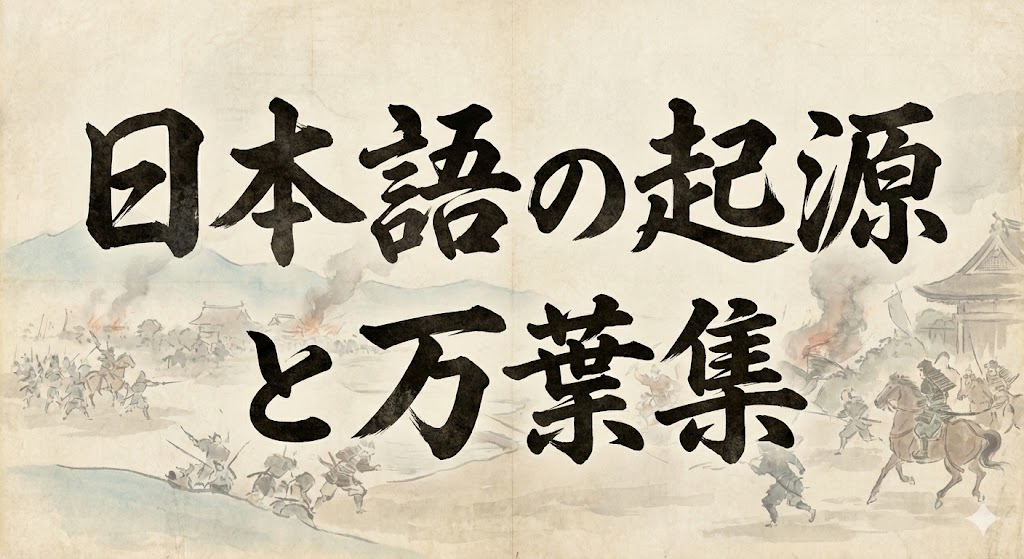
The grammatical structure of the ancient Japanese language drastically differed from Chinese. Therefore, directly applying imported Chinese characters to native Japanese sentences proved impossible. To solve this, ancient scholars invented “Manyogana,” utilizing characters purely for their phonetic sounds while completely discarding their original meanings. Ultimately, this revolutionary writing system birthed the *Manyoshu*, permanently recording the raw, unpolished emotions of ancient society in a uniquely Japanese format.
Modern linguistics classifies Japanese within the Nichiryu Gozoku, fundamentally separating it from the Chinese language family. The imported Chinese language utilized a rigid Subject-Verb-Object structure. However, Japanese natively employs an SOV-gata structure, completely reversing the sentence order.
Furthermore, Japanese operates as a Kochakugo. This system attaches various auxiliary verbs and particles to alter meanings. Conversely, Chinese lacks these grammatical conjugations entirely. Consequently, this massive structural discrepancy severely hindered ancient Japanese scholars from adopting Chinese characters directly as a functional writing system.
🌿 Key Takeaways 🌿
Grammatical differences block direct translation. The fundamental contrast in sentence structure and verb conjugation made it impossible for ancient Japan to simply borrow the Chinese writing system without major modifications.

Chinese literacy remained an essential skill for ancient Japanese elites. However, government officials urgently needed a functional method to record native names and indigenous terminology. Therefore, they invented Manyogana. This revolutionary system completely stripped Chinese characters of their original meanings, utilizing them exclusively as Hyoon Moji to represent Japanese syllables.
The *Kojiki* prominently utilized this phonetic approach to record ancient native myths and oral histories. To a native Chinese reader, these texts appeared as a nonsensical string of random characters. Ultimately, this phonetic adaptation successfully captured the exact sounds of ancient Japanese, eventually evolving into the modern hiragana and katakana alphabets.
🌿 Key Takeaways 🌿
Phonetic adaptation overcomes linguistic barriers. By discarding the meaning of imported characters and using them purely for sound, ancient scholars successfully engineered a system to write down their own native language.

The invention of Manyogana culminated in the compilation of the *Manyoshu*, a massive anthology containing over 4,500 poems. Otomo no Yakamochi (The aristocratic compiler) supervised this monumental project, which featured diverse poetic forms including Choka and Bussokusekika. Surprisingly, this vast collection famously included verses composed by ordinary commoners alongside elite aristocrats.
Furthermore, the anthology captured remarkably raw and direct human emotions. Unlike later, highly stylized poetry, these ancient verses frankly depicted passionate love and the stark realities of death. Consequently, the *Manyoshu* perfectly preserves the powerful, unfiltered voices of ancient society before strict cultural aesthetics completely dominated Japanese literature.
🌿 Key Takeaways 🌿
New writing systems democratize literary expression. The phonetic Manyogana script allowed the *Manyoshu* to permanently record the raw, authentic emotions of all social classes, creating an unprecedented cultural monument.

── Finally, let's recap with the summary and FAQ of this article.
The creation of a unique writing system was a monumental turning point in Japanese cultural history. By adapting a foreign script to fit their native tongue, the ancient Japanese secured their own literary voice. The main points of this article are:
✅ Manyogana ingeniously utilized Chinese characters strictly for their phonetic sounds.
✅ The Manyoshu permanently preserved the raw, unfiltered emotions of diverse social classes.
We hope this linguistic history illustrates how human ingenuity overcomes cultural barriers to preserve the authentic voice of a nation.
Q1. Where did the Japanese language originate?
Linguists classify it within the Japonic language family, which likely entered the archipelago via the Korean peninsula. It possesses a completely different grammatical structure from Chinese.
Q2. What exactly is Manyogana?
It is an ancient writing system that uses Chinese characters exclusively for their phonetic pronunciation, completely ignoring their original meanings. This allowed scholars to write down native Japanese words.
Q3. How does the Manyoshu differ from later poetry anthologies?
It uniquely includes poems written by commoners alongside aristocrats, and it features highly direct, raw expressions of emotion and death that later, more refined anthologies strictly avoided.



コメント欄