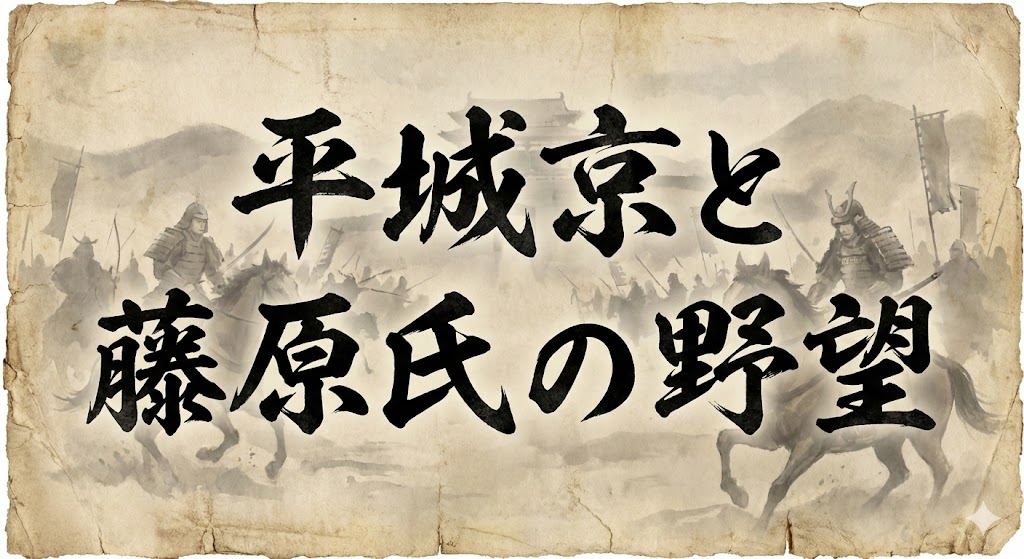
While the Nara period evokes images of brilliant Buddhist culture, a fierce power struggle raged behind the scenes. The monumental constructions of Fujiwara-kyo and Heijo-kyo served as massive devices to visually project the Emperor’s absolute authority. Simultaneously, the Fujiwara clan seized real political control through strategic imperial marriages and the ruthless purge of rivals. Ultimately, the state even pragmatically exploited popular religious figures to achieve its ambitious national projects.
Ancient capital cities functioned as massive apparatuses to visualize political authority rather than mere residential areas. Fujiwara-kyo perfectly embodied the Tenshi Nanmen philosophy by replicating the grid structure of Choan, placing the imperial palace at the northern center to demonstrate that the emperor was the absolute center of the world.
However, the government abandoned this city within decades to construct Heijo-kyo further north. This new “peaceful citadel” accommodated 200,000 residents and housed colossal institutions like Todai-ji. Consequently, this monumental relocation effectively projected the unprecedented, expanding power of the emperor to both domestic and foreign audiences.
🌿 Key Takeaways 🌿
Urban planning serves as political propaganda. The massive relocations to Choan-style capitals were not mere administrative moves; they were calculated, state-sponsored demonstrations of supreme imperial and religious authority.

Behind the construction of Heijo-kyo, a vicious power struggle engulfed the political center. Fujiwara Fuhito (The ambitious politician) successfully married his daughter to Monmu Tenno (The young emperor). Consequently, this strategic marital alliance secured an unshakeable position for his clan as the maternal relatives of the throne.
In contrast, Nagaya-o (The imperial prince) actively resisted this monopolization of power. Therefore, following Fuhito’s death, his four sons orchestrated the Nagaya-o no Hen. They completely fabricated treason charges, surrounded his residence with military forces, and ruthlessly forced the imperial prince and his family to commit suicide, guaranteeing absolute Fujiwara supremacy.
🌿 Key Takeaways 🌿
Marriage secures access; purges secure dominance. The Fujiwara clan masterfully utilized royal marriages to infiltrate the imperial household and subsequently deployed fabricated charges and military force to eliminate all political rivals.

Outside the aristocratic power struggles, Gyoki (The charismatic monk) captured the hearts of the commoners. His easily digestible teachings of Inga Oho inspired massive crowds of farmers to abandon their fields and follow him. Consequently, the government initially suppressed his movement for violating the strict Soni-ryo and threatening national tax revenues.
Surprisingly, the government completely reversed its policy as Gyoki’s following swelled to tens of thousands. The Fujiwara clan pragmatically decided that exploiting his massive mobilization power was far more beneficial than suppressing it. Ultimately, they officially recognized his activities and successfully redirected this enormous civilian workforce to construct massive state projects, such as the Great Buddha.
🌿 Key Takeaways 🌿
Pragmatism overpowers ideology. When suppression failed, the state effectively co-opted a popular religious movement, transforming a potential threat into an invaluable labor force for national infrastructure.

── Finally, let's recap with the summary and FAQ of this article.
The transition from Fujiwara-kyo to Heijo-kyo represented much more than urban development; it was a highly calculated process of establishing imperial authority while the Fujiwara clan relentlessly pursued absolute power. The main points of this article are:
✅ The Fujiwara clan seized absolute power through strategic marriages and ruthless purges.
✅ The state pragmatically exploited Gyoki’s religious influence for national projects.
We hope this exploration of Nara-period politics reveals the ruthless pragmatism required to build and maintain an ancient state.
Q1. What specific position did Fujiwara Fuhito attain?
He became the Minister of the Right (Udaijin) and established his clan’s absolute foundation by marrying his daughter into the imperial family, securing the crucial status of maternal relatives to the throne.
Q2. Did Nagaya-o actually plot a rebellion during the Nagaya-o no Hen?
Modern historical research strongly suggests he was entirely innocent. It was a completely fabricated conspiracy engineered by the Fujiwara clan to eliminate their most powerful political rival.
Q3. Why did the state both suppress and praise Gyoki?
His unprecedented ability to mobilize the masses initially threatened state control and tax revenues. However, once the government realized they could redirect this massive workforce for monumental public works, they pragmatically embraced him as an invaluable asset.
コメント欄