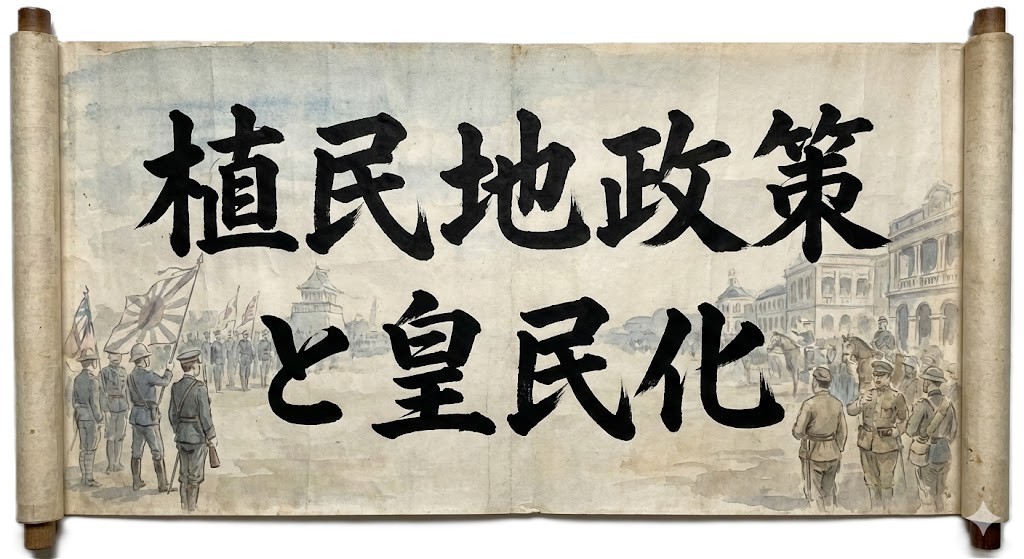
Following the 1919 Paris Peace Conference, Japan officially joined the ranks of the “Big Five” global superpowers. However, this prestigious international status masked deeply contradictory and oppressive colonial policies. The government fiercely debated whether to forcefully assimilate colonized populations through “Kominka” or to permanently segregate them based on deep-seated racial prejudice. Consequently, this severe policy inconsistency generated haphazard, brutal administrative practices. From the eradication of Ainu culture in Hokkaido to the violent suppression of the March First Movement in Korea, Japan’s colonial rule ruthlessly exploited human lives to fuel its imperial ambitions.
In 1919, the Paris Peace Conference officially cemented Japan’s status as a global superpower. However, fierce internal debates severely fractured the Takumusho and other bureaucratic agencies regarding the administration of these newly acquired territories. One faction passionately advocated for Kominka, arguing that a strict Doka Seisaku would successfully transform colonized populations into loyal, identical imperial subjects entirely indistinguishable from mainland Japanese.
Conversely, deep-seated racial prejudice fueled a powerful opposing faction that demanded permanent segregation between “superior” Japanese citizens and colonial subjects. Consequently, this severe ideological paralysis between aggressive assimilation and discriminatory subjugation uniquely defined the empire’s colonial approach. Therefore, this fatal lack of administrative consistency generated incredibly haphazard, oppressive field operations that profoundly tormented the colonized populations.
🟢 Key Takeaways 🟢
The Japanese government suffered from a massive ideological contradiction regarding its colonies. The fierce internal conflict between advocates of forced assimilation and proponents of racial segregation ultimately resulted in a highly unstable, hypocritical, and brutal colonial administration.
These contradictory and oppressive policies aggressively targeted regions already fully incorporated into the Japanese mainland. While Okinawa suffered intense forced assimilation regarding language and religion, Hokkaido experienced blatant segregation under the 1899 Hokkaido Kyudojin Hogoho. Surprisingly, this discriminatory legislation heavily modeled itself upon the oppressive Native American reservation systems utilized by the United States, deliberately forcing the indigenous Ainu people into restricted agricultural settlements.
Furthermore, the rapid construction of Sapporo as a symbol of modern urban planning actively required the systematic eradication of traditional Ainu Kotan. Behind the facade of beautiful Western parks and grid-like streets, state policies ruthlessly stripped the indigenous people of their ancestral lands and cultural heritage. Consequently, this discriminatory legal framework maintained its oppressive grip for decades. Astonishingly, the Japanese government did not finally abolish this law to actively promote Ainu culture until 1997.
🟢 Key Takeaways 🟢
Japan applied highly hypocritical double standards within its own borders. While Okinawa faced forced assimilation, the Ainu in Hokkaido suffered under a brutal reservation system that actively destroyed their culture in the name of “modernization.”
Overseas, military-led Governor-Generals ruled Korea and Taiwan with an iron fist. In Korea, the government aggressively weaponized the Nissen Doso-ron to mandate assimilation, ultimately implementing Soshi-kaimei to systematically eradicate traditional Korean identities. Consequently, this oppressive cultural erasure ignited the massive 1919 San-ichi Undo. The Japanese military ruthlessly crushed this nationwide independence movement, resulting in the tragic massacre of an estimated 7,500 people.
Furthermore, the situation in the South Sea Mandate (Micronesia) proved equally devastating. State policies actively stripped indigenous populations of higher educational opportunities, exploiting them purely as expendable manual labor. As World War II escalated, the military forcibly conscripted countless men for combat engineering and brutally mobilized women into the horrific “comfort women” system. Therefore, discarding any pretense of assimilation, the empire completely exploited its colonial subjects as dehumanized, disposable tools to fuel its massive war machine.
🟢 Key Takeaways 🟢
Despite utilizing pleasant rhetoric like “common ancestry,” the reality of Japanese colonial rule was sheer cultural eradication and physical violence. The empire violently crushed independence movements and systematically exploited colonial populations as disposable resources for its total war effort.
── Finally, let's recap with the summary and FAQ of this article.
Japan’s colonial policies were never driven by a genuine desire for “Asian solidarity” or local development. Instead, they were deeply rooted in selfish, imperialistic motives designed strictly to benefit the mainland. The main points of this article are:
‣ The domestic cultural eradication of the Ainu and Ryukyuan peoples.
‣ The violent suppression and brutal exploitation of Korea and Taiwan.
We hope confronting this dark, contradictory history helps you recognize the immense human cost inherent in any imperial system built upon racial hierarchy and cultural erasure.
Q1. Why were Japan’s colonial policies so incredibly inconsistent?
The central government was deeply paralyzed by an ideological war between two factions: one advocating for total cultural assimilation to create “Japanese” subjects, and another demanding strict racial segregation based on deep-seated prejudice. This unresolved conflict caused constant policy shifts.
Q2. What exactly did the “Soshi-kaimei” policy entail?
It was an incredibly humiliating cultural eradication policy implemented in Korea. It strictly outlawed traditional Korean surnames and given names, forcefully compelling the entire population to register under newly fabricated Japanese-style names.
Q3. How did Japanese colonial rule differ from Western colonialism?
While Japan uniquely utilized the rhetoric of “Asian solidarity” and “common ancestry” to justify forced assimilation, the actual physical reality of its rule—economic exploitation, cultural destruction, and extreme military violence—was fundamentally identical to the brutal practices of Western imperial powers.
コメント欄