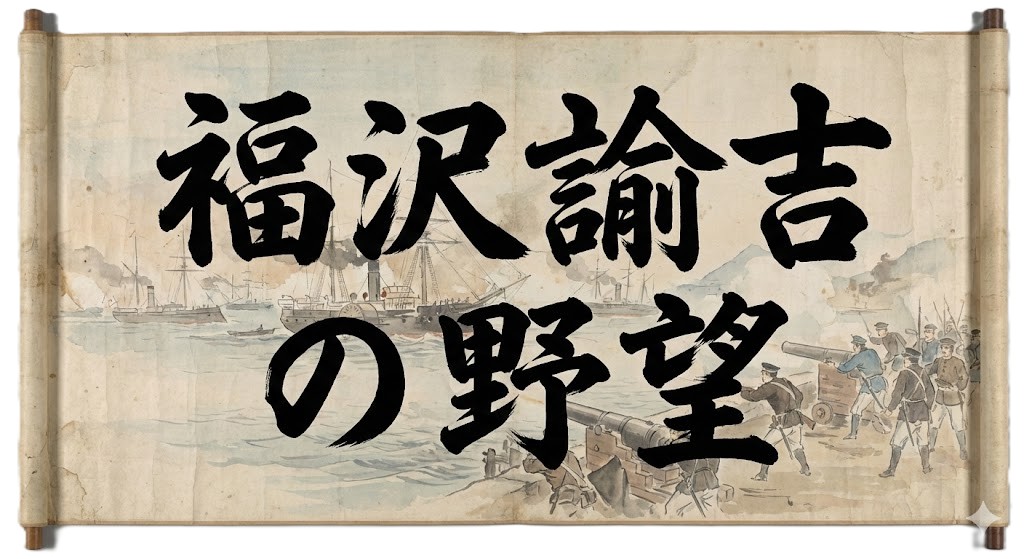
To survive the ruthless era of Western imperialism, Meiji Japan executed a radical national transformation. Fukuzawa Yukichi’s controversial “Datsu-A Ron” aggressively advocated severing ties with Asia to join the Western powers. Consequently, the government initiated extreme Westernization policies, symbolized by the Rokumeikan, to prove Japan’s “civilized” status. However, this superficial mimicry sparked massive domestic backlash. Ultimately, astonishing military victories over China and Russia birthed a fierce new nationalism, prompting intellectuals like Natsume Soseki to sharply critique the psychological distortions caused by this rapid, forced modernization.
The overwhelming technological and military supremacy of the West profoundly shocked the Japanese populace. Recognizing that fighting modern rifles with traditional swords guaranteed national extinction, Fukuzawa Yukichi urgently published Bunmeiron no Gairyaku. He passionately argued that to survive, Japan had to completely discard its outdated traditions and aggressively absorb Western civilization. This realization became the definitive starting point for Japan’s systematic distancing from its Asian neighbors.
During this brutal era of “eat or be eaten” imperialism, Fukuzawa formulated the Datsu-A Ron. He coldly branded nations resisting modernization, such as Qing China and Joseon Korea, as “bad friends.” Rather than risking shared colonization, he insisted Japan must exclusively associate with Western powers, even if it meant participating in imperial expansion. Therefore, while this strategy appears exceptionally ruthless today, it functioned as a desperate, highly calculated survival mechanism to guarantee national independence.
🟢 Key Takeaways 🟢
To ensure national survival, Fukuzawa Yukichi prioritized pragmatic national interests over historical regional solidarity. By actively choosing to “leave Asia” and join the Western powers, Japan hardened its resolve to become a colonizer rather than a victim.
To forcefully revise the humiliating unequal treaties, the Meiji government desperately needed to prove its status as a “civilized” nation. The ultimate symbol of this effort was the Rokumeikan, constructed under the direct leadership of Inoue Kaoru. By hosting nightly ballroom dances and strictly imitating European high-society etiquette, the government actively attempted to convince Western diplomats that the Japanese were their absolute cultural equals.
However, this extreme Westernization policy instantly triggered massive domestic outrage. The public fiercely criticized the project as a grotesque waste of national funds and a humiliating display of cultural subservience. Furthermore, merely mimicking Western fashion failed to earn true diplomatic respect. Consequently, the spectacular failure of Rokumeikan diplomacy decisively shifted public consensus back toward Fukoku Kyohei. Therefore, the nation realized that true international equality could only be achieved through overwhelming military and economic strength, not superficial flattery.
🟢 Key Takeaways 🟢
The government’s desperate attempt to win Western approval through superficial cultural mimicry spectacularly backfired. This humiliating diplomatic failure ignited intense public anger, fueling a powerful new consensus that Japan must force Western respect through sheer military dominance.
The astonishing victories in the Nisshin and Nichiro Senso completely revolutionized the Japanese national consciousness. Defeating both the Asian hegemon and a massive Western empire generated an explosive surge of patriotism and supreme self-confidence. Consequently, the era of blind Western imitation ended. Society rapidly began reevaluating traditional martial arts and arts, forging a powerful, independent nationalistic identity that completely eradicated their previous cultural inferiority complex.
Surprisingly, amidst this euphoric nationalistic fervor, brilliant intellectuals like Natsume Soseki maintained a highly skeptical perspective. In his satirical masterpiece, Wagahai wa Neko de Aru, he masterfully mocked the sheer absurdity of intellectuals blindly obsessed with Western trends. Soseki astutely recognized that forcibly importing a civilization without cultivating its internal spirit created a dangerously hollow society. Therefore, he quietly but sharply warned against the psychological distortions and loss of individual identity caused by this relentless, state-driven modernization.
🟢 Key Takeaways 🟢
Military victories successfully cured Japan’s cultural inferiority complex, birthing a fierce new nationalism. However, visionary writers like Soseki acutely identified the severe psychological emptiness and societal hypocrisy hidden beneath the gleaming surface of this rapid modernization.
── Finally, let's recap with the summary and FAQ of this article.
Meiji Japan’s desperate struggle to avoid colonization forced a massive, painful self-transformation. From Fukuzawa’s ruthless geopolitical calculation to the humiliating Rokumeikan era, and finally to the explosive rise of nationalism, the nation continually redefined itself. The main points of this article are:
‣ The Rokumeikan’s superficial Westernization sparking massive domestic backlash.
‣ Military victories fostering nationalism while intellectuals warned of cultural emptiness.
We hope analyzing this turbulent era provides valuable insights into the profound psychological struggles involved when a nation must completely alter its identity to survive in a globalized world.
Q1. When and why did Fukuzawa Yukichi propose the “Datsu-A Ron”?
He published it in the mid-Meiji period (1885). It was a strategic, geopolitical calculation arguing that to prevent Western colonization, Japan had to completely sever ties with its traditional Asian neighbors and actively behave as a Western imperial power.
Q2. What was the actual purpose of building the Rokumeikan?
The government built it specifically to facilitate the revision of unequal treaties. By hosting lavish, Western-style events, they desperately attempted to prove to foreign diplomats that Japan was a fully “civilized” nation deserving of equal legal standing.
Q3. How did the general public react to this rapid Westernization?
Initially, extreme policies like the Rokumeikan generated intense disgust and accusations of cultural subservience. However, the subsequent military victories over China and Russia dramatically restored national pride, shifting the public mood toward a highly confident, assertive nationalism.




コメント欄