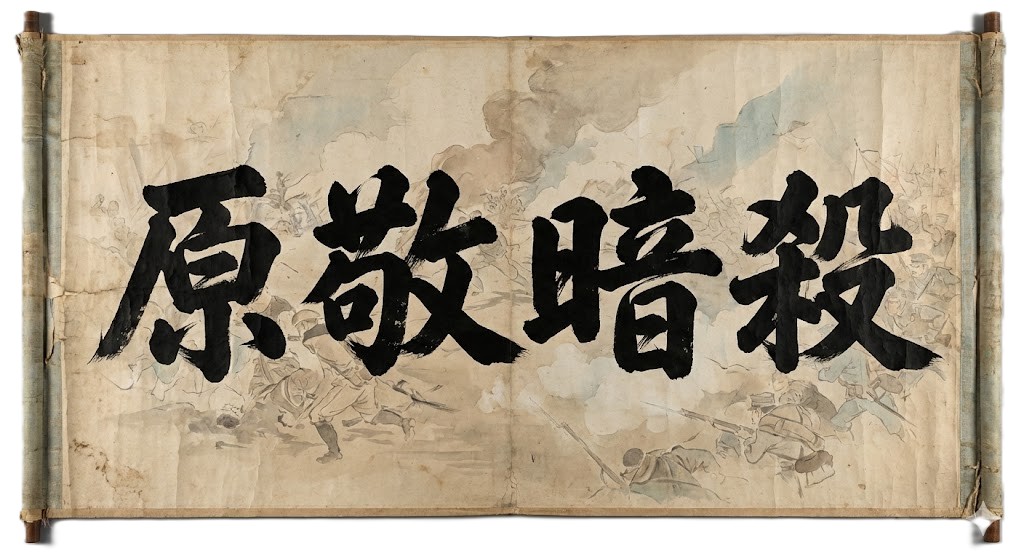
The “Commoner Prime Minister” Hara Takashi was less an idealist and more a ruthless pragmatist who mastered pork-barrel politics to seize power. By compromising with the oligarch Yamagata Aritomo, he established Japan’s first authentic party cabinet. However, his aggressive, party-first tactics provoked extreme backlash, ultimately leading to his assassination. Furthermore, while his successors established the “normal course of constitutional government” and enacted Universal Suffrage, they simultaneously passed the oppressive Peace Preservation Law. Consequently, this contradictory “carrot and stick” approach alienated the public, creating the fatal vulnerability that allowed the military to hijack the state and plunge Japan into a catastrophic war.
Historically, Hara Takashi is often romanticized as a pure hero of Taisho Democracy. However, the reality reveals a brilliant, cold-blooded pragmatist. He was an absolute master of Rieki Yudo Seiji, aggressively negotiating with the military by trading infrastructure development for defense budget approvals. Furthermore, by thoroughly ingratiating himself with the formidable Yamagata Aritomo, Hara successfully outmaneuvered his rivals to seize the premiership.
While Hara’s calculated methods successfully established a functioning party cabinet, his blatant prioritization of “party over country” generated intense, venomous criticism. Consequently, this mounting frustration culminated in the tragic Hara Takashi Ansatsu Jiken. Surprisingly, despite his violent death, his tenure successfully cemented a monumental political precedent: the leader of the majority party in the Diet inherently deserved to become Prime Minister.
🟢 Key Takeaways 🟢
Hara Takashi was not a starry-eyed idealist, but a highly effective political realist. He masterfully utilized the old oligarchic system to forcibly open the door for party politics, though his ruthless tactics ultimately cost him his life.
Following Hara’s death, conservative bureaucrats attempted to reclaim power by installing the Kiyoura Cabinet. However, the political parties fiercely retaliated by launching the Second Goken Undo, successfully forcing the cabinet to resign within mere months. Consequently, this decisive victory firmly established the Kensei no Jodo, officially normalizing the practice of party-led cabinets governing the Japanese empire.
This structural shift was heavily accelerated by the deaths of dominant oligarchs like Yamagata Aritomo, which critically weakened the once-almighty Sumitsuin. However, it is vital to understand that this transition did not represent true popular sovereignty. Ultimately, it was merely a lateral transfer of executive power from the bureaucratic elites to the new political party elites, fully maintaining the restrictive framework of the Meiji Constitution.
🟢 Key Takeaways 🟢
The “Taisho Democracy” was not a fundamental democratic revolution from the grassroots. Rather, it was a gradual, highly managed transfer of administrative power between competing factions of the national elite.
In 1925, the government finally passed the Futsu Senkyo-ho, dramatically expanding democratic participation. However, the ruling political parties were inherently bourgeois institutions primarily representing the Chusan Kaikyu. While they willingly offered the “carrot” of expanded suffrage, they were absolutely terrified of left-wing radicalism and the rapidly spreading influence of the global communist movement.
Therefore, to fiercely protect their capitalist interests and the imperial structure, they simultaneously enacted the Chian Iji-ho as a brutal “stick.” Surprisingly, the mainstream party politicians overwhelmingly supported this oppressive legislation. Consequently, by legally validating state suppression of ideological dissent, the political parties ironically forged the very weapon that the military would later utilize to entirely dismantle Japan’s fragile democratic institutions.
🟢 Key Takeaways 🟢
The expansion of voting rights was strictly conditional. By enacting the Peace Preservation Law to crush left-wing threats, the political parties fatally compromised the foundations of free speech, inadvertently paving the way for military fascism.
── Finally, let's recap with the summary and FAQ of this article.
From Hara’s assassination to the enactment of Universal Suffrage, the Taisho Democracy significantly modernized Japanese politics. However, because it remained a “top-down” elite reform heavily reliant on oppressive legal frameworks, it proved disastrously fragile. The main points of this article are:
‣ The “Normal Course” merely shifting power among conservative elites.
‣ The Peace Preservation Law fatally undermining the new democratic system.
We hope understanding this deeply flawed political evolution reveals exactly how Japanese democracy was slowly suffocated from within long before the military completely took over.
Q1. Why exactly was Hara Takashi called the “Commoner Prime Minister”?
Unlike previous Prime Ministers who held noble titles (like Baron, Count, or Marquis) or hailed from the dominant Satsuma-Choshu oligarchy, Hara deliberately declined all aristocratic peerages. He proudly assumed the highest office while remaining a standard, elected member of the House of Representatives.
Q2. How did the Taisho Democracy differ fundamentally from modern democracy?
In modern Japan, sovereignty explicitly resides with the people. During the Taisho era, absolute sovereignty still legally resided with the Emperor. Furthermore, even after the 1925 reforms, voting rights were strictly limited to men, completely excluding women from the political process.
Q3. Why were the political parties ultimately unable to stop the rise of the military?
The political parties severely lost the public’s trust due to endless corruption scandals and blatant self-interest. Consequently, when the military began weaponizing the “independence of the supreme command” to bypass the civilian cabinet, the deeply unpopular party politicians lacked the public support necessary to resist them.
コメント欄