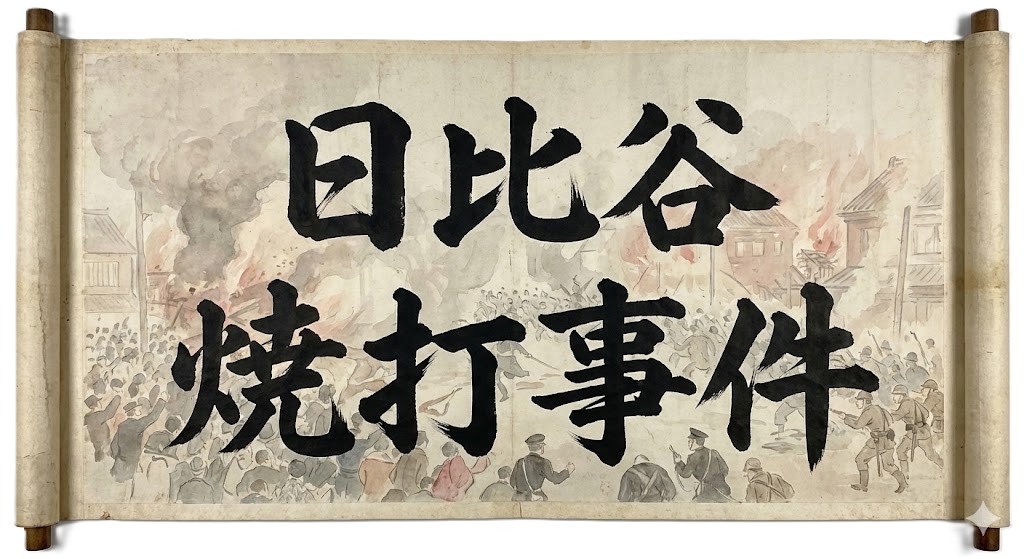
By 1905, Japan had miraculously emerged victorious in the Russo-Japanese War, yet the resulting Treaty of Portsmouth sparked unprecedented domestic fury. Fueled by relentless government propaganda masking the nation’s total exhaustion, citizens expected massive financial reparations. When the treaty yielded zero compensation, this profound sense of betrayal ignited the violent Hibiya Incendiary Incident, reducing much of Tokyo to ashes. However, this massive riot was not mere mob destruction; it signified the dramatic awakening of the Japanese public, violently transforming them from obedient subjects into politically conscious citizens demanding true constitutional democracy.
Historically, the Russo-Japanese War is often romanticized as a miraculous victory where a small Asian nation toppled a European giant. However, for the Japanese citizens living through 1905, the conclusion of the war brought profound shock rather than joyous celebration. Because the government utilized relentless Propaganda to convince the public of an “overwhelming victory,” the grim reality of the nation’s absolute military and financial exhaustion remained completely hidden.
Consequently, the terms of the US-brokered Treaty of Portsmouth utterly devastated the populace. Despite enduring crushing tax increases and horrifying human sacrifices, Japan received absolutely zero Baishokin. While the government secured southern Sakhalin and vital Manchurian interests, these abstract geopolitical gains meant nothing to the starving, heavily taxed citizens. Therefore, this massive, irreconcilable gap between manufactured expectations and harsh diplomatic reality instantly ignited explosive national fury.
🟢 Key Takeaways 🟢
To maintain morale, the government actively fabricated an illusion of effortless victory, concealing Japan’s desperate exhaustion. When the peace treaty failed to deliver the promised financial reparations, the deeply impoverished citizens felt profoundly betrayed by their own leaders.
As news of the humiliating treaty spread, hardline activists led by Kono Hironaka organized a massive protest rally at Hibiya Park on September 5, 1905. Although the police strictly prohibited the gathering, they were completely powerless to stop the surging crowds. Over 30,000 furious citizens violently breached the police barricades, flooding into the park to explosively voice their utter disgust with the government’s diplomatic failure.
Following the rally, segments of the highly agitated crowd rapidly transformed into a violent mob. They systematically attacked and torched newspaper offices, government ministries, streetcars, and notably, police boxes. Facing an unprecedented crisis where 70% of Tokyo’s police boxes were reduced to ashes, the paralyzed government was ultimately forced to declare Kaigenrei. Consequently, the military brutally suppressed the uprising, leaving 17 dead and over 2,000 arrested after Tokyo briefly descended into near anarchy.
🟢 Key Takeaways 🟢
Ignoring strict police bans, tens of thousands of enraged citizens gathered to protest the peace treaty, rapidly escalating into a highly destructive mob. The government completely lost control of the capital, requiring the extreme deployment of martial law to crush the violent insurrection.
The ultimate historical significance of this incident lies not in the physical destruction, but in its status as a massive, grassroots political protest. Previously, the populace passively submitted to the elite Hambatsu Seiji. However, this crisis brutally awakened them. They began strongly identifying as Kokumin—vital, indispensable members of the state. Consequently, they aggressively demanded a return to proper Kensei, fiercely criticizing the bureaucratic elites for conducting irresponsible, non-transparent diplomacy that betrayed the Emperor’s trust.
Ironically, the Meiji government’s decades-long educational campaign to forge a unified national identity finally reached its absolute completion during this riot. The people had successfully transformed from isolated villagers into highly conscious members of the Great Japanese Empire; therefore, they felt entirely justified in attacking the government’s failures. Furthermore, this explosive political energy did not vanish. It directly fueled subsequent democratic struggles, serving as the undeniable catalyst for the broader Taisho Democracy movement.
🟢 Key Takeaways 🟢
The Meiji government’s effort to create a unified nation ironically backfired, producing a politically conscious public that fiercely demanded accountability. This violent protest marked the crucial transition of the Japanese people from obedient subjects to active citizens demanding democratic governance.
── Finally, let's recap with the summary and FAQ of this article.
While the Hibiya Incendiary Incident originated as a violent outburst over a disappointing peace treaty, it fundamentally represented the painful birth of Japanese political consciousness. The main points of this article are:
‣ The explosive, destructive riots that forced the implementation of martial law.
‣ The crucial transformation of the populace from passive subjects to active citizens.
We hope understanding this fiery political awakening helps you appreciate the immense, often chaotic energy required to shatter oligarchic rule and lay the foundations for modern democracy.
Q1. Why couldn’t Japan secure any financial reparations from Russia?
Despite their continuous battlefield victories, Japan’s military and financial resources were absolutely exhausted. Conversely, Russia still possessed immense reserves. Because continuing the war would have bankrupted Japan, the government had no choice but to desperately accept a peace treaty without monetary compensation.
Q2. Had there ever been large-scale riots like this before in Japan?
While agrarian peasant uprisings (Ikki) were common historically, this was Japan’s first massive, politically motivated urban riot. It was groundbreaking because the masses mobilized not over localized economic grievances, but over overarching national foreign policy and state accountability.
Q3. What lesson can modern society learn from this historical incident?
It powerfully highlights the severe danger of blindly trusting state-sponsored propaganda. Furthermore, it reminds us that the modern right to participate in politics peacefully through voting and speech is built upon the chaotic, hard-fought struggles of past generations challenging authoritarian power.
コメント欄