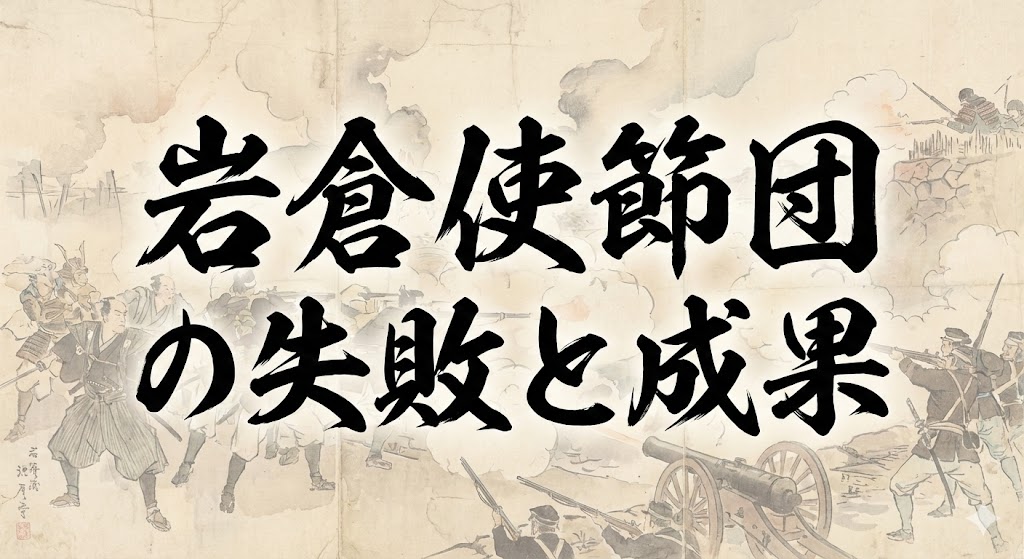
The early Meiji government dispatched the massive Iwakura Mission to renegotiate unequal treaties, but severe diplomatic unpreparedness caused immediate failure. However, witnessing overwhelming Western industrial supremacy firsthand forced the delegation to completely abandon outdated traditions. Consequently, upon returning, they executed radical centralization, abolished the feudal domain system, and aggressively instituted strict meritocracy. Ultimately, this humiliating diplomatic failure transformed into the absolute catalyst for Japan’s rapid, survival-driven modernization.
In the 1860s, intense foreign pressure forced Japan to desperately seek Western technology. While conservatives advocated for Wakon Yosai, progressive leaders realized that entirely dismantling the old feudal order was absolutely necessary for national survival. Therefore, the government executed the Haihan Chiken, completely abolishing autonomous domains to establish direct, central governance.
Surprisingly, this massive structural revolution proceeded without major rebellion, largely due to ancient legal precedents. Furthermore, the government explicitly monopolized military power by establishing the Goshinpei. Utilizing this overwhelming centralized force, the state systematically stripped samurai of their historical privileges. Consequently, this bold maneuver forged a solid foundation for a modern society where individual capability completely superseded hereditary rank.
🟢 Key Takeaways 🟢
To counter Western imperialism, the Meiji government ruthlessly dismantled the decentralized feudal system. By centralizing military power and abolishing traditional domains, they successfully forged a highly unified, emperor-centric state, permanently eradicating the samurai era.

To forcefully demonstrate the new government’s legitimacy, a massive delegation led by Iwakura Tomomi sailed for the United States. Their primary objective was renegotiating the oppressive Fubyodo Joyaku. However, instead of a diplomatic triumph in Washington D.C., they suffered a humiliating rejection due to sheer diplomatic ignorance. Shockingly, the delegation had arrived completely lacking a Zenken Ininjo.
Although Okubo Toshimichi frantically rushed back to Japan to retrieve the necessary documents, the American government ultimately refused to negotiate. Consequently, acknowledging this devastating diplomatic reality, the mission brilliantly pivoted their objective. They completely abandoned immediate negotiations, choosing instead to conduct a comprehensive, multi-year observation of Western civilization, industry, and political systems.
🟢 Key Takeaways 🟢
The Iwakura Mission suffered a humiliating diplomatic failure due to severe unpreparedness. However, this disaster brilliantly forced them to pivot from negotiation to comprehensive observation. Consequently, realizing their own ignorance became the ultimate catalyst for Japan’s radical modernization.

Witnessing overwhelming Western prosperity profoundly shocked the returning delegation. They firmly concluded that the government must completely abolish the Chitsuroku—which consumed an astonishing 30% of the national budget—to prevent imminent financial collapse. However, the caretaker government led by Saigo Takamori strongly opposed these rapid, agonizing changes. Therefore, this severe ideological temperature gap eventually triggered a massive political schism and bloody civil war.
The progressive returnees believed strict Jitsuryokushugi was absolutely essential for national survival. Heavily influenced by Social Darwinism, they aggressively stripped away hereditary privileges to forge a highly competitive, modernized state capable of resisting Western imperialism. Ultimately, their uncompromising determination dramatically accelerated Japan’s transformation into a formidable global power.
🟢 Key Takeaways 🟢
Witnessing Western industrial supremacy convinced the progressive leaders that Japan must completely abandon hereditary privileges. Despite fierce opposition from the conservative caretaker government, they aggressively instituted strict meritocracy, ruthlessly prioritizing national survival over traditional samurai welfare.
── Finally, let's recap with the summary and FAQ of this article.
While the Iwakura Mission was a diplomatic disaster, it functioned as the ultimate catalyst for Japan’s national trajectory. Experiencing the sheer gravity of Western power forced Japanese leaders to execute ruthless, systemic reforms upon their return. The main points of this article are:
‣ The humiliating failure of treaty negotiations due to unpreparedness.
‣ The aggressive shift toward meritocracy driven by global observation.
We hope analyzing this pivotal journey helps you understand how painful failures and harsh global realities forced Japan to completely reinvent itself.
Q1. When exactly did the Iwakura Mission depart?
They departed in 1871 (Meiji 4). It was an incredibly critical period just after the Meiji Restoration, where consolidating the new government’s domestic foundation and securing international diplomatic recognition were absolute priorities.
Q2. What caused the severe conflict between the caretaker government and the returning delegation?
It was a fundamental clash over the speed and direction of reform. The returnees demanded immediate, radical Westernization. Conversely, Saigo Takamori and the caretaker government favored a more cautious approach, highly concerned about triggering massive uprisings among disgruntled former samurai.
Q3. What was the core reason for introducing “Meritocracy”?
Leaders developed a profound crisis awareness that the rigid, hereditary status system fundamentally weakened national power. To build a robust state capable of rivaling Western empires, they realized they had to utilize brilliant talent strictly based on capability, regardless of family lineage.

コメント欄