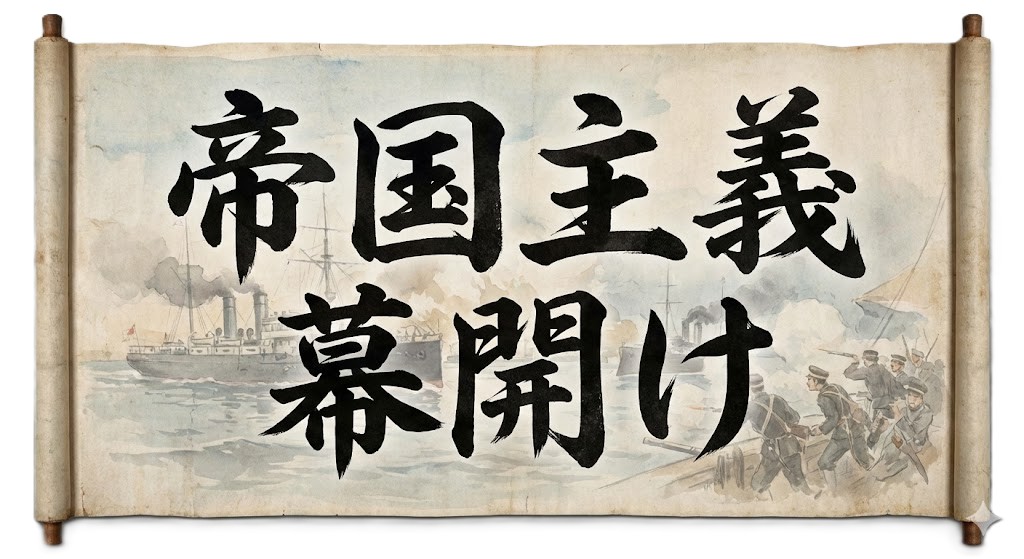
During the 19th century, while Western powers pursued imperialism primarily for economic exploitation, Meiji Japan adopted expansionism strictly for military defense. Fearing Western colonization, Japan proactively secured its borders by annexing Hokkaido and the Ryukyu Islands. Furthermore, viewing the Korean Peninsula as a geopolitical “dagger pointed at the heart of Japan,” the government fiercely contested Qing China’s influence over the region. Ultimately, Japan aggressively utilized the Donghak Peasant Revolution as a strategic pretext to launch the First Sino-Japanese War, desperately attempting to secure its national survival through preemptive military dominance.
The 19th century was completely defined by global imperialism. However, the fundamental motivations differed drastically between nations. Western powers like Britain, France, and Germany ruthlessly carved out Soshakuchi in China primarily for lucrative economic exploitation and market expansion. Furthermore, they hypocritically justified this aggressive global conquest by claiming the Hakujin no Sekimu to civilize “barbaric” regions.
Conversely, Meiji Japan’s Teikokushugi possessed a fundamentally different nature. While economic interests certainly existed, the paramount motivation was absolute military defense. To avoid being swallowed by Western empires, Japanese leaders believed they had to forcefully establish a heavily fortified defensive perimeter around the home islands. Therefore, Japan’s aggressive overseas expansion originated not from pure colonial ambition, but from a desperate, paranoid compulsion to secure national survival.
🟢 Key Takeaways 🟢
Unlike Western economic imperialism, Japan’s aggressive expansion was driven entirely by a desperate defensive anxiety. To protect their independence from Western colonization, Japanese leaders concluded they must forcefully expand their borders to create a geopolitical shield.
To actively defend the home islands, the government recognized the absolute necessity of fully subjugating its loosely connected peripheral territories. In 1869, the government established the Kaitakushi in Hokkaido to aggressively counter Russian southern expansion. Subsequently, they executed the Ryukyu Shobun in 1879 to solidify the southern maritime border. Consequently, these actions were not mere territorial grabs, but highly calculated military annexations designed to eliminate vulnerable geopolitical blind spots.
However, the ultimate national security obsession remained the Korean Peninsula. German military advisor Jakob Meckel famously warned that a hostile Korea functioned as a “dagger pointed at the heart of Japan.” If global powers like Russia or Britain seized the peninsula, it would provide a direct, devastating invasion route into Japan. Therefore, this profound geopolitical terror drove Japan to aggressively intervene in Korean affairs, viewing absolute control over the peninsula as the key to national survival.
🟢 Key Takeaways 🟢
Japan strategically annexed Hokkaido and Okinawa to construct a heavily fortified maritime shield. Furthermore, recognizing the Korean Peninsula as the ultimate geopolitical weak point, the government became absolutely obsessed with preventing any foreign power from controlling this critical “dagger.”
Following violent proxy clashes like the 1884 Koshin Jihen, Japan and Qing China temporarily managed their rivalry through the Tenshin Joyaku, mutually restricting their military deployments in Korea. However, the massive 1894 Togakuto no Ran completely shattered this fragile balance. Unable to suppress the immense peasant uprising independently, the Korean King desperately requested military reinforcements from his Qing suzerains, instantly providing the perfect catalyst for international intervention.
Although the Qing government properly notified Japan of their deployment per the treaty, the Japanese government aggressively seized this golden opportunity. Fabricating a flimsy diplomatic pretext by claiming “non-receipt” of the notification, Japan forcefully deployed a massive army into Korea. Consequently, this was a highly premeditated provocation designed specifically to violently expel Qing influence and establish absolute Japanese hegemony over the peninsula. Therefore, on July 25, 1894, this aggressive strategic calculation officially ignited the First Sino-Japanese War.
🟢 Key Takeaways 🟢
Japan deliberately exploited the Korean domestic crisis to execute a premeditated war against Qing China. By aggressively twisting treaty interpretations to justify a massive military invasion, Japan decisively demonstrated its terrifying commitment to securing the Korean Peninsula by any means necessary.
── Finally, let's recap with the summary and FAQ of this article.
Meiji Japan’s imperialism was fundamentally a defensive military strategy masquerading as aggressive expansion. The absolute necessity of securing the Korean Peninsula forced Japan to strategically provoke the First Sino-Japanese War. The main points of this article are:
‣ The geopolitical obsession with Korea as a “dagger pointed at the heart.”
‣ Japan aggressively utilizing the Donghak Rebellion to force a war with China.
We hope analyzing this geopolitical paranoia helps you understand the desperate strategic calculations that transformed Japan into a modern military empire.
Q1. Why was Japan so utterly obsessed with the Korean Peninsula?
Japanese leaders were terrified that if a hostile power like Russia or Britain controlled Korea, it would serve as a direct, unstoppable launchpad for invading the Japanese home islands. Establishing it as an absolute buffer zone was considered critical for national survival.
Q2. What was the primary difference between Western and Japanese imperialism?
While Western nations primarily expanded to exploit lucrative new economic markets and extract resources, Japan’s imperial expansion was overwhelmingly driven by a desperate, defensive military necessity to secure its national borders against Western encroachment.
Q3. Did Japan completely ignore international law during this period?
While Japan superficially adhered to the formal frameworks of international treaties, they aggressively manipulated and expanded legal interpretations to suit their strategic needs, as explicitly demonstrated by their fabricated justifications for initiating the Sino-Japanese War.
コメント欄