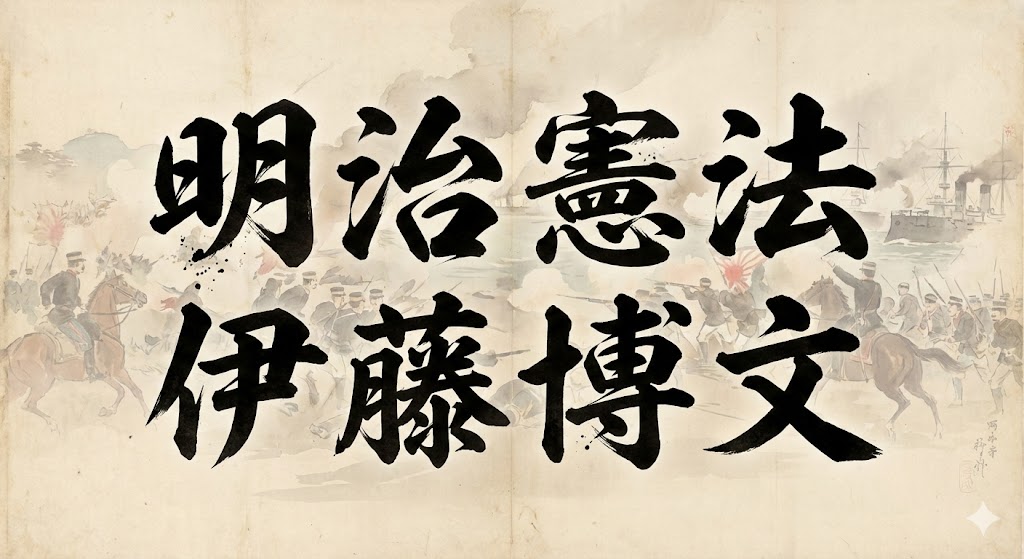
The early Meiji government was fractured by intense power struggles between the authoritarian Satsuma-Choshu faction and progressive liberals. By ruthlessly purging rivals like Itagaki Taisuke and Okuma Shigenobu, Ito Hirobumi successfully cemented an oligarchical dictatorship. Consequently, these exiled politicians launched the Freedom and People’s Rights Movement, utilizing political parties to demand a national diet. Although Ito drafted the authoritarian Meiji Constitution to suppress this democratic surge, the parliament weaponized its budget approval rights to relentlessly attack the government, ironically forcing Ito to embrace modern party politics.
The newly established Meiji government was absolutely not a monolithic organization. Internally, a fierce power struggle erupted between the autocratic Satsuma-Choshu faction and the liberal Tosa-Hizen faction. Consequently, this deep ideological fracture violently surfaced during the intense Seikanron dispute, directly triggering the massive Meiji Roku-nen no Seihen that split the government in half.
Even after Itagaki Taisuke departed, Okuma Shigenobu remained in the government to advocate for progressive reforms. However, Ito Hirobumi brilliantly orchestrated a ruthless political scheme to eliminate him. By weaponizing a political scandal to destroy Okuma’s credibility, Ito successfully executed the Meiji Juyo-nen no Seihen. Therefore, this decisive purge cemented an unshakeable, long-term dictatorial monopoly for the Satsuma-Choshu oligarchy.
🟢 Key Takeaways 🟢
The Meiji government’s internal conflicts were driven heavily by regional domain rivalries. By executing strategic political purges against progressive rivals, Ito Hirobumi and the Satsuma-Choshu faction successfully established an unchallenged, autocratic foundation for their government.
The purged politicians, Itagaki and Okuma, did not simply surrender to their political exile. Instead, they strategically organized the Jiyuto and the Rikken Kaishinto to challenge the autocratic government using the power of the masses. Consequently, this evolved into the nationwide Jiyu Minken Undo. Utilizing public speech and organized political pressure, they fiercely attempted to shatter the closed, dictatorial rule of the Satsuma-Choshu faction.
This fervent movement frequently overheated, occasionally triggering violent regional clashes. Surprisingly, when an assassin attacked Itagaki in Gifu, he famously shouted, “Itagaki may die, but liberty will never die!” This legendary incident dramatically amplified the movement’s momentum. Ultimately, this overwhelming societal pressure forced the cornered government to officially promise the establishment of a national diet.
🟢 Key Takeaways 🟢
Exiled liberals successfully weaponized public sentiment by forming Japan’s first political parties. Through intense and sometimes dangerous campaigning, they generated overwhelming national pressure, forcing the oligarchy to concede to the establishment of a democratic parliament.
To control this democratic surge, Ito Hirobumi strategically modeled the Dai Nippon Teikoku Kempo on authoritarian Prussia. This legal framework preserved immense imperial power while establishing the Teikoku Gikai primarily to safely vent public frustration. However, creating a system where the Emperor reigned but did not actively rule deliberately obscured the ultimate locus of power. Furthermore, this structural ambiguity later proved fatal, enabling the disastrous runaway militarism of the 1930s.
Ito’s most catastrophic miscalculation was severely underestimating the Diet’s constitutional right to approve the national budget. Elected opposition parties rapidly weaponized this budget approval right, ruthlessly holding government funding hostage to force political concessions. To effectively counter this parliamentary rebellion, Ito was ultimately forced to establish his own political party, the Rikken Seiyukai. Therefore, the very architect of the authoritarian oligarchy ironically opened the door to modern party politics.
🟢 Key Takeaways 🟢
Ito designed the Meiji Constitution to suppress democratic opposition, but the Diet’s budget authority provided the opposition with a devastating political weapon. This constant parliamentary warfare ironically forced the authoritarian government to actively engage in modern party politics.
── Finally, let's recap with the summary and FAQ of this article.
The Meiji constitutional system functioned as an elaborate mechanism designed by the oligarchy to suppress the Freedom and People’s Rights Movement. However, the sheer tenacity of purged politicians and the Diet’s budget authority successfully blasted massive holes in this dictatorship. The main points of this article are:
‣ The Freedom and People’s Rights Movement weaponizing public discourse.
‣ Ito Hirobumi establishing a ruling party to manage parliamentary resistance.
We hope understanding this fierce ideological battle helps you appreciate the complex, messy origins of modern Japanese democracy.
Q1. When was the Meiji Constitution created, and who led the effort?
It was officially promulgated in 1889. Ito Hirobumi spearheaded the highly secretive drafting process alongside Inoue Kowashi and Kaneko Kentaro, heavily utilizing the expert legal advice of German constitutional scholars like Rudolf von Gneist.
Q2. Why did the Jiyuto and Rikken Kaishinto remain split instead of uniting?
They fundamentally disagreed on their support bases and ideal political models. The Jiyuto fiercely advocated for a radical, French-style democratic revolution, while the Kaishinto preferred a moderate, British-style parliamentary system led by intellectuals.
Q3. If the Emperor held absolute sovereignty, why didn’t he actively rule?
To strictly protect the Emperor from political responsibility. The Emperor functioned as a sacred, inviolable symbol, while the actual political decisions—and the blame for any governmental failures—were legally shouldered by his appointed Ministers of State.
コメント欄