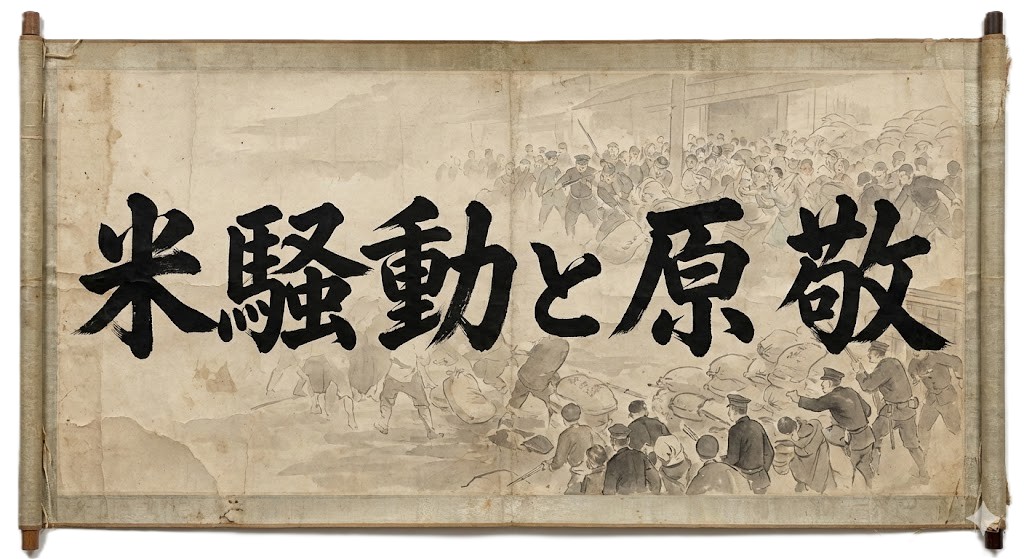
The 1918 Rice Riots were not mere mob violence; they were a massive political earthquake. Triggered by skyrocketing rice prices exacerbated by the Siberian Intervention, nationwide protests forced the authoritarian Terauchi Cabinet to collapse. Fearing a communist revolution, the conservative oligarchy desperately appointed Hara Takashi, Japan’s first commoner Prime Minister. Consequently, this unprecedented national crisis shattered oligarchic rule and officially launched the era of authentic party politics known as the Taisho Democracy.
It is a common misconception that the “Rice Riots” were simply chaotic, unorganized brawls. In reality, they completely overturned the foundations of the Japanese political system. By 1918, while Japan enjoyed a massive WWI economic boom, explosive urban population growth severely outpaced agricultural production. Consequently, rice—the absolute staple of the Japanese diet—fell into a critical shortage, directly threatening the survival of the working class.
Furthermore, the government’s announcement of the Siberia Shuppei triggered catastrophic market speculation. Merchants aggressively hoarded military rice provisions, causing prices to double in a matter of weeks. Shockingly, basic rice consumption began devouring nearly 30% of an average laborer’s annual income. Unable to endure this starvation, housewives in Uozu, Toyama, launched the Etchu Nyobo Ikki. Therefore, this desperate local protest instantly ignited a nationwide inferno, serving as the explosive starting gun for the Taisho Democracy.
🟢 Key Takeaways 🟢
A combination of explosive population growth and predatory wartime hoarding priced the working class entirely out of their staple food. The resulting nationwide riots proved that the desperate masses could no longer be silenced by mere government authority.
An estimated 10 million people participated in these massive uprisings, effectively blowing away the sitting government. Prime Minister Terauchi Masatake, a Choshu Army General, recklessly deployed the military to crush the riots. However, violently attacking starving citizens generated catastrophic public backlash, forcing his entire cabinet to resign. Consequently, this humiliating collapse explicitly exposed the fatal limitations of Hambatsu Seiji.
This crisis severely cornered the supreme oligarch, Yamagata Aritomo. Although he intensely despised party politicians, the situation was historically dire. With the Russian Revolution occurring just a year prior, he was utterly terrified that a similar communist wave would destroy Japan. “If we do nothing, the nation will perish,” he concluded. Therefore, driven by pure existential dread, Yamagata compromised his deepest conservative principles, actively selecting a party leader capable of pacifying the enraged public.
🟢 Key Takeaways 🟢
Brute military suppression failed entirely to quell the starving masses. Terrified of a total communist revolution, the entrenched oligarchy realized their only chance for survival was to temporarily surrender executive power to elected politicians.
The man chosen to save the state was Hara Takashi. Hailing from the Nambu domain—which had fought against the imperial forces during the Boshin War—he possessed absolutely no Satsuma or Choshu connections. Transitioning from a journalist and bureaucrat, he ruthlessly climbed the ranks to dominate the Rikken Seiyukai. Surprisingly, he deliberately refused all aristocratic peerages, serving as the unprecedented Heimin Saisho while maintaining his seat in the House of Representatives.
However, Hara was not merely a populist champion of the masses. As a former bureaucrat, he still harbored Kanson Minpi tendencies, operating as an incredibly cold, pragmatic realist. He masterfully negotiated with privileged oligarchs like Yamagata while systematically expanding his party’s political infrastructure. Therefore, the historic birth of Japan’s first full-fledged party cabinet was not a spontaneous democratic miracle, but rather the brilliant culmination of Hara’s deeply calculated, highly pragmatic political strategy.
🟢 Key Takeaways 🟢
Hara Takashi brilliantly utilized his “commoner” brand while operating as a ruthlessly pragmatic political tactician. By masterfully balancing explosive public popularity with secretive oligarchic negotiations, he successfully established genuine party politics in Japan.
── Finally, let's recap with the summary and FAQ of this article.
The 1918 Rice Riots dramatically crystallized the explosive anger of a struggling populace. By completely exposing the fatal obsolescence of oligarchic rule, they forced the birth of a new political era. The main points of this article are:
‣ The humiliating collapse of the military-led Terauchi Cabinet.
‣ Hara Takashi strategically seizing the crisis to forge the first party cabinet.
We hope exploring this dynamic shift helps you appreciate how desperate grassroots protests fundamentally forced the Japanese government to embrace modern democratic governance.
Q1. When and where did the Rice Riots officially begin?
They are widely considered to have started in July 1918 in the coastal town of Uozu, Toyama Prefecture. Desperate fishermen’s wives collectively attempted to block the shipment of local rice out of their prefecture, sparking a movement that quickly engulfed the entire nation.
Q2. Why was Hara Takashi specifically called the “Commoner Prime Minister”?
Unlike his predecessors who were military generals or elite nobles holding prestigious titles (like Count or Marquis), Hara deliberately refused to accept a peerage. He became Prime Minister while retaining his ordinary status as an elected member of the House of Representatives.
Q3. How did this event permanently impact Japanese history?
It definitively broke the exclusive monopoly of the Satsuma-Choshu oligarchy. It established a powerful new precedent where the leader of the majority political party in the Diet would form the cabinet, marking the true, functional beginning of the Taisho Democracy.
コメント欄