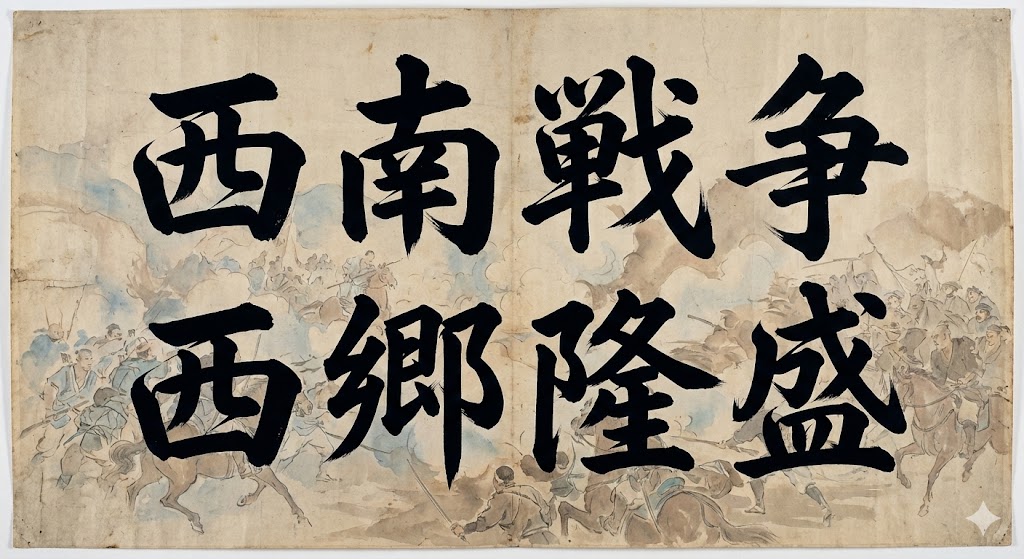
The Meiji government’s radical Westernization systematically stripped the samurai class of their historical privileges. Consequently, impoverished warriors rallied behind Saigo Takamori, igniting the massive Satsuma Rebellion. Following their crushing defeat by a modern conscript army, the era of armed resistance permanently ended. Furthermore, after the shocking assassination of Okubo Toshimichi, the battlefield shifted entirely to political discourse. Ultimately, Japan plunged into fierce ideological debates over whether to adopt a British or German constitutional model, marking the painful birth of a modern nation-state.
To aggressively promote rapid modernization, the former ruling samurai class became a severe obstacle for the Meiji government. Therefore, the state issued a rapid succession of laws ruthlessly stripping away their ancient privileges. Specifically, the Haitorei forced warriors to abandon their swords, entirely negating their core identity. Furthermore, the Chitsuroku Shobun delivered a fatal economic blow, instantly plunging countless samurai lacking commercial skills into absolute poverty.
Consequently, impoverished and deeply humiliated, these frustrated elites directed their explosive hatred toward the government. Igniting the Saga no Ran in Hizen, followed quickly by violent uprisings in Choshu and Akizuki, the disgruntled samurai launched a desperate, life-or-death military struggle to preserve their traditional social order and fading pride.
🟢 Key Takeaways 🟢
The Meiji government forcibly confiscated the samurai’s “swords (honor)” and “stipends (livelihoods)” to enforce national modernization. Consequently, economically ruined and deeply insulted warriors initiated fierce armed rebellions to passionately defend their cultural existence.
The ultimate climax of these violent uprisings was the 1877 Seinan Senso, commanded by the legendary Restoration hero, Saigo Takamori. Surprisingly, this massive civil war definitively proved the absolute obsolescence of the samurai class. The government army, composed of commoners drafted under the new Chohei-rei, utilized superior modern firepower to completely crush the sword-wielding traditionalists. Therefore, Saigo’s tragic death officially marked the permanent end of organized military rebellions in Japan.
However, bitter resentment lingered heavily within the defeated class. The following year, desperate former samurai assassinated the government’s paramount leader, Okubo Toshimichi, during the Kioizaka no Hen. Despite these shocking acts of terrorism, they were merely the final thrashings of a dying era. Ultimately, Saigo’s crushing defeat explicitly proved to the entire nation that violently returning to feudalism was physically impossible.
🟢 Key Takeaways 🟢
The decisive defeat of Saigo’s elite samurai by a conscripted army of commoners proved that hereditary warrior status possessed zero modern military value. Although political assassinations continued briefly, the era of attempting government overthrow via armed insurrection vanished forever.
Following the eradication of armed conflict, former samurai strategically transitioned their battleground to the power of the pen and public speech. This sparked the massive Jiyu Minken Undo. Subsequently, intense internal fractures emerged over the exact blueprint of the new nation. While progressive leaders like Okuma Shigenobu passionately advocated for a liberal British model, the dominant Satsuma-Choshu faction fiercely opposed this. Instead, they firmly believed an authoritarian German-style Constitution was the only suitable framework to maintain national stability.
Why did politicians desperately rush to establish a constitution? Securing a modern legal framework was the absolute, non-negotiable prerequisite for revising the humiliating unequal treaties with Western powers. Therefore, to achieve true international independence while simultaneously building a powerful, emperor-centric state, Japanese leaders engaged in a fierce, bloodless political war that would permanently define the nation’s core structure.
🟢 Key Takeaways 🟢
The method of rebellion completely shifted from armed violence to fierce political discourse. Because a constitution was legally required to achieve international equality, intense ideological warfare erupted between advocates of British liberalism and German authoritarianism to define the modern Japanese state.
── Finally, let's recap with the summary and FAQ of this article.
In the early Meiji period, the samurai class fought desperately to preserve their fading privileges but were ultimately crushed during the Satsuma Rebellion. The main points of this article are:
‣ Conscripted commoner armies permanently invalidating the class system.
‣ The ideological shift toward establishing a modern constitutional model.
We hope understanding this painful transition from the battlefield to the parliament helps you appreciate the immense sacrifices required to construct a modern nation-state.
Q1. Why did Saigo Takamori rebel against the very government he helped create?
He resigned from the government due to profound ideological conflicts regarding rapid Westernization and the Korea debate (Seikanron). Returning to Satsuma, he ultimately felt compelled to lead the desperate, disgruntled former samurai who deeply admired him.
Q2. What is the fundamental difference between the British and German constitutional models?
The British model is a liberal parliamentary democracy where the elected assembly holds primary power. Conversely, the German (Prussian) model is highly authoritarian, deliberately concentrating supreme military and executive power in the hands of the monarch (Emperor).
Q3. Why was the Meiji government in such a desperate rush to create a constitution?
Western powers absolutely refused to renegotiate the humiliating unequal treaties unless Japan possessed a modern, Western-style legal code. Therefore, establishing a constitution was the mandatory first step toward reclaiming full national sovereignty and independence.

コメント欄