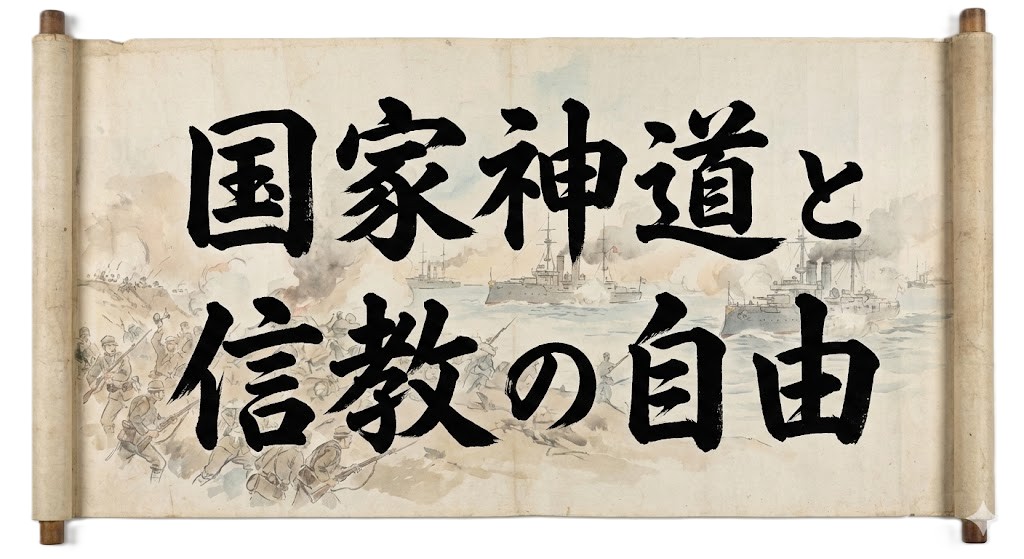
To achieve parity with Western powers, Meiji Japan constitutionally guaranteed freedom of religion. However, the government faced a profound dilemma: they desperately needed Emperor-centric Shinto to forcibly unify the nation. To resolve this, they brilliantly but deceptively categorized Shinto not as a religion, but as a mandatory “national civic duty.” Consequently, this contradictory logic forced public compliance, led to the persecution of Christians like Uchimura Kanzo, and ultimately established the totalitarian State Shinto system that psychologically mobilized the entire nation for World War II.
To rapidly secure international respect, the Meiji government actively pursued Kindai-ka and enacted the Dai Nippon Teikoku Kempo, formally guaranteeing freedom of religion. However, the government simultaneously required a powerful spiritual pillar to unify the newly centralized nation under the Emperor. Therefore, this created a profound, structural dilemma: balancing modern Western liberties with traditional, authoritarian ideological control.
To ingeniously bypass this constitutional contradiction, the government weaponized the Jinja Hi-shukyo-ron. By officially declaring that Shinto was merely a traditional Japanese custom rather than a religion, the state could legally compel citizens to participate in shrine rituals and school ceremonies. Consequently, while the constitution superficially protected religious freedom, this semantic manipulation effectively forced mandatory state worship upon the entire populace, planting the dangerous seeds of future totalitarianism.
🟢 Key Takeaways 🟢
The Meiji government desperately needed both Western-style legal freedoms and absolute imperial unity. By legally redefining Shinto worship as a mandatory civic duty, they successfully bypassed constitutional violations, establishing a highly coercive ideological framework disguised as cultural tradition.
Following the astonishing victory in the Nichiro Senso, surging nationalism prompted the government to heavily reinforce Shinto as a political weapon. Furthermore, as the military seized control during the Showa era, the ancient concept of the Emperor as an Arahitogami was aggressively revived. Surprisingly, this term transformed into an absolute, inescapable mandate, legally requiring every citizen to submit to the living deity.
This ideological evolution ultimately finalized the oppressive Kokka Shinto system. To constantly fuel the endless military campaigns across China and the Pacific, the government heavily utilized institutions like Yasukuni Shrine to legally sanctify dying for the state. Consequently, shedding the previous excuse of “mere civic custom,” the state ruthlessly enforced absolute psychological domination, trapping the entire populace within an inescapable, religiously driven war machine.
🟢 Key Takeaways 🟢
As military conflicts escalated, the government required unprecedented sacrifices from the public. By elevating the Emperor to a living god and sanctifying death in combat, State Shinto successfully generated the overwhelming psychological pressure necessary for total war mobilization.
While Buddhism remained deeply integrated, Christians constantly battled accusations of being national traitors. The most infamous example is Uchimura Kanzo. As a teacher at the First Higher Middle School, his strict religious convictions prevented him from bowing to the Emperor’s signature on a sacred document. Consequently, this sparked the Fukei Jiken. The resulting national hysteria branded him an enemy of the state, eventually forcing his humiliating resignation.
Furthermore, Shinshukyo groups like Tenrikyo and Oomoto suffered devastating state crackdowns. Whenever these new sects prioritized their unique spiritual doctrines over absolute imperial loyalty, the government reacted with overwhelming police force. Therefore, while constitutional religious freedom existed on paper, it was strictly conditional. In reality, whenever personal faith collided with the supreme wall of Emperor worship, those constitutional rights instantly disintegrated.
🟢 Key Takeaways 🟢
Constitutional religious freedom was heavily restricted to beliefs that did not contradict imperial loyalty. As demonstrated by the vicious public destruction of Uchimura Kanzo’s career, prioritizing personal faith over state rituals resulted in immediate social and professional execution.
── Finally, let's recap with the summary and FAQ of this article.
Meiji Japan profoundly struggled to balance modern Western liberties with the necessary ideological cohesion required for national survival. However, deceptively categorizing Shinto as a non-religious civic duty ultimately paved a disastrous road toward reckless wartime mobilization. The main points of this article are:
‣ The aggressive reinforcement of the Living God ideology for total war.
‣ Uchimura Kanzo’s tragic persecution highlighting the limits of legal freedom.
We hope analyzing this history highlights the severe dangers that arise when a nation attempts to forcefully override the inner spiritual freedom of its citizens.
Q1. When did the State Shinto system truly reach its peak?
It rapidly intensified following the 1904 Russo-Japanese War. However, it reached its absolute, totalitarian peak during the Showa era as Japan hurtled toward World War II, serving as the ultimate psychological tool for national military mobilization.
Q2. Did the general public genuinely believe Shinto was not a religion?
While the government strictly defined it as a “national civic ritual,” the practices clearly involved prayers and deities. Most citizens practically recognized its religious nature but silently accepted the government’s official façade to avoid persecution.
Q3. What critical lesson does this history offer modern society?
It demonstrates the terrifying fragility of legal rights when confronted by overwhelming state pressure and societal “atmosphere.” It warns us to remain highly vigilant when the majority’s logic is weaponized to crush minority beliefs and individual conscience.
コメント欄