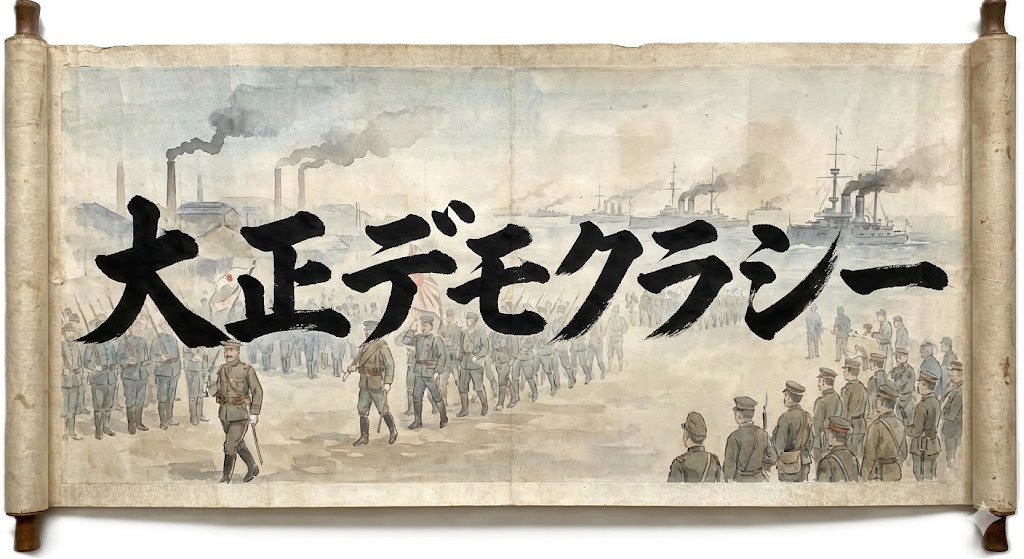
Many mistakenly believe Japanese democracy was purely a post-WWII American import. However, the seeds of a homegrown democratic movement vigorously sprouted during the late Meiji and Taisho eras. Facing the impenetrable wall of the unelected oligarchy, early political parties brilliantly weaponized their constitutional right to approve the national budget. Furthermore, by aggressively exposing massive corruption scandals like the Siemens Incident, they successfully mobilized public outrage to topple elite cabinets. Ultimately, these visionary pioneers actively cultivated a distinctly Japanese democracy within the rigid confines of the Meiji Constitution.
Modern textbooks often suggest that Japanese democracy is purely a product of the post-WWII GHQ Occupation. Consequently, this deep-seated assumption ignores a crucial historical reality. Long before the devastating war, a powerful, homegrown democratic movement actively fought to dismantle elite rule during the late Meiji and Taisho eras. Therefore, true Japanese democracy was not simply a foreign gift; it was a hard-fought domestic struggle.
Initially, absolute political authority rested securely with the Hambatsu. These unelected former samurai wielded dictatorial power without any democratic mandate. However, as the era transitioned to the reign of Emperor Taisho, this rigid dynamic shifted dramatically. Elected political parties bravely challenged this formidable establishment, successfully utilizing the parliamentary system to amplify the voices of the citizens and demand legitimate political participation.
🟢 Key Takeaways 🟢
Japanese democracy did not originate solely from post-war American intervention. A vibrant, domestic struggle for political representation actively challenged the unelected oligarchy decades earlier, demonstrating a powerful homegrown desire for democratic governance.
Under the Meiji Constitution, the Shugiin appeared incredibly weak. It possessed an extremely limited voter base and completely lacked the authority to appoint the Prime Minister. Surprisingly, despite these severe restrictions, they held one devastating trump card: the absolute right to approve the Yosan. Without this critical parliamentary approval, the government was legally paralyzed, unable to execute any new policies or military expansions.
Driving a modern empire requires astronomical funding. For an oligarchic government desperate to rapidly expand its military, failing to pass the budget meant absolute political death. Furthermore, accurately recognizing this shifting power dynamic, even the authoritarian architect Ito Hirobumi was forced to establish the Rikken Seiyukai just to manage the Diet. Consequently, political parties ruthlessly leveraged these “purse strings,” demanding policy concessions in exchange for financial approval.
🟢 Key Takeaways 🟢
Even authoritarian giants are powerless without funding. By masterfully weaponizing their constitutional right to approve the national budget, elected politicians successfully forced the unelected oligarchy to the negotiating table.
The political parties possessed another highly effective weapon: public opinion. In 1914, a German employee named Karl Richter leaked highly confidential documents, abruptly exposing the Siemens Jiken. Newspapers aggressively publicized this severe naval corruption, causing public outrage to explode nationwide. Consequently, this explosive scandal thoroughly shattered the citizens’ remaining trust in the authoritarian elites.
At the time, Prime Minister Yamamoto Gonnohyoe desperately needed parliamentary approval for a massive naval expansion budget. However, opposition parties fiercely weaponized the scandal, absolutely refusing to fund a “corrupt Navy.” Furthermore, as massive, enraged crowds physically surrounded the Diet building, the paralyzed Yamamoto cabinet was humiliatingly forced to resign en masse. Therefore, this stunning event proved that combining parliamentary gridlock with explosive public anger could successfully destroy the highest echelons of power.
🟢 Key Takeaways 🟢
Strategic political parties masterfully utilized journalistic exposés and public protests to corner the government within the Diet. This highly modern political tactic successfully demonstrated that the power of the people could actively dismantle unelected elite cabinets.
── Finally, let's recap with the summary and FAQ of this article.
The Taisho Democracy was not merely a fleeting political trend. It represents the profound historical struggle of early politicians utilizing limited constitutional tools to reflect the public’s will. The main points of this article are:
‣ The strategic weaponization of the Diet’s budget approval rights.
‣ The successful overthrow of an oligarchic cabinet using public scandal.
We hope exploring this dynamic era helps you recognize that true democratic participation requires active, intelligent engagement rather than passive acceptance.
Q1. When exactly did the “Taisho Democracy” take place?
It primarily occurred during the Taisho era (1912–1926). However, the foundational democratic movements, such as the Freedom and People’s Rights Movement, had already been actively building momentum since the late Meiji period.
Q2. What is the difference between the “Hambatsu” and the political parties?
The Hambatsu was a highly exclusive, non-elected oligarchy consisting primarily of former samurai from the Satsuma and Choshu domains. Conversely, political parties were organizations composed of elected representatives fighting to reflect the will of the citizens.
Q3. Why is it important to learn about this specific era today?
Understanding that Japanese democracy was cultivated through intense domestic struggles, rather than simply being gifted by foreign powers, strongly reaffirms the absolute necessity of proactive and vigilant civic participation in maintaining a healthy society.
コメント欄