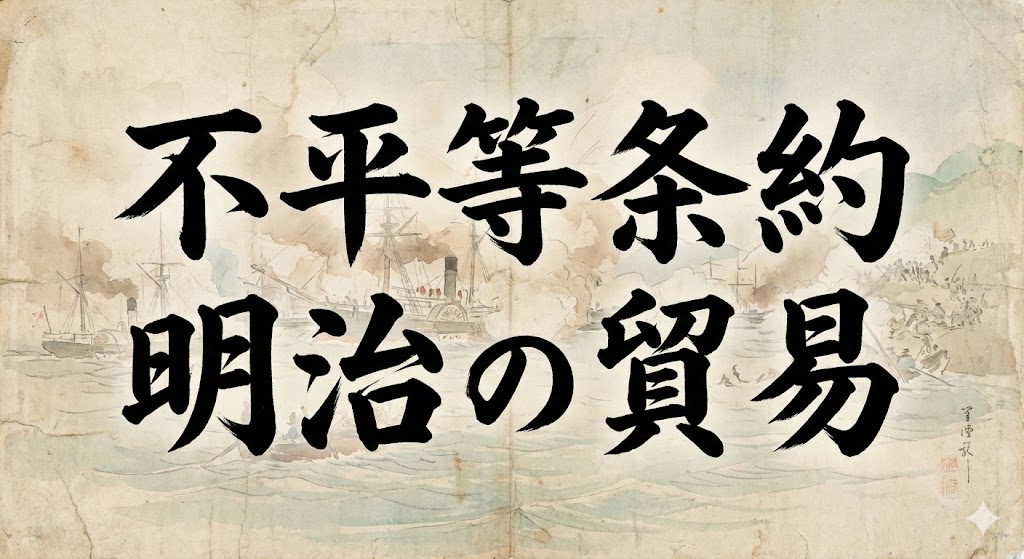
The Meiji economy initially struggled under the crippling weight of unequal treaties, severely restricted by fixed tariffs and unilateral most-favored-nation clauses. While raw silk exports exploded, the subsequent influx of cheap imports and rampant inflation devastated the common populace. Furthermore, following the brutal Matsukata Deflation, Japan engineered a “dual economy.” This unique structure simultaneously fostered world-class modern military industries while deliberately maintaining an impoverished, pre-modern rural society to fuel colonial expansion and supply cheap military labor.
Desperate for resources, Meiji Japan aggressively entered international trade, but immediately hit a massive structural wall: the unequal treaties forced upon them by Western powers. The Kyotei Kanzei-sei completely paralyzed Japan’s ability to protect its domestic industries through protective tariffs. Consequently, a massive flood of cheap, high-quality Western manufactured goods devastated Japan’s traditional handicraft sectors.
Furthermore, the Henmuteki Saikeikoku Taigu critically complicated the situation. For example, if Japan successfully negotiated a 5% tariff with America, but later conceded 4% to Britain, the American rate automatically dropped to 4%. Therefore, forced into this highly exploitative version of Jiyu Boeki, the Japanese economy was violently thrown into the unforgiving waves of the global market completely unarmed from the very beginning of its modernization.
🟢 Key Takeaways 🟢
Unequal treaties stripped Japan of its primary economic shield: tariff autonomy. Consequently, the nation was forced onto the global trade battlefield entirely defenseless, severely crippling its early attempts at independent economic development and exposing domestic industries to crushing foreign competition.
Initially, international trade presented a golden opportunity for a select few. Japanese Kiito became globally highly sought after, generating massive profits for sericulture farmers. However, diverting domestic silk entirely to exports caused local material prices to skyrocket. Consequently, traditional textile weavers in Kyoto faced sudden, widespread unemployment, generating such severe societal anxiety that city magistrates were forced to prepare for imminent riots.
Simultaneously, severe currency chaos triggered rampant Inflation. While opportunistic merchants accumulated immense wealth, day laborers and former samurai suffered absolute destitution. Surprisingly, Jisshitsu Chingin in Osaka halved within just a single decade. Therefore, rather than enriching the entire nation, the profits of early globalization drastically widened the wealth gap, actively threatening the survival of the common working class.
🟢 Key Takeaways 🟢
While export expansion superficially appeared to enrich the nation, the actual benefits were severely concentrated. Soaring inflation and sudden industrial shifts enriched a few elite merchants while plunging the majority of commoners into a harsh, rapidly expanding economic underclass.
Finance Minister Matsukata Masayoshi ultimately resolved the swelling trade deficit and inflation crisis. His notoriously severe deflationary policies inflicted catastrophic suffering upon the farming class, yet successfully stabilized the currency, providing a solid foundation for corporate growth. Furthermore, following the Sino-Japanese and Russo-Japanese Wars, newly acquired colonies like Taiwan and Korea functioned as Senzoku Shijo, powerfully bolstering domestic industrial expansion.
Ultimately, this dynamic forged Japan’s Niju Kozo. The nation simultaneously projected a “modern face” boasting world-class heavy industry, while deliberately maintaining an impoverished, pre-modern rural sector completely lacking electricity and dominated by strict landlords. These impoverished villages were intentionally preserved in this state to guarantee a limitless, cheap supply of soldiers and factory labor. Consequently, this profound structural distortion remained deeply entrenched until the end of World War II.
🟢 Key Takeaways 🟢
Japan achieved rapid modernization, but this success was built entirely upon rural sacrifice and colonial exploitation. The extreme contrast between gleaming modern warships and impoverished, feudal-era farming villages defined pre-war Japan’s dangerously unbalanced economic foundation.
── Finally, let's recap with the summary and FAQ of this article.
Meiji Japan was forcefully integrated into the global economy while carrying the massive handicap of unequal treaties. Through export-driven inflation and brutal financial deflation, the nation transformed into a polarized state defined by the stark duality of modern industry and rural poverty. The main points of this article are:
‣ Plummeting real wages and soaring inflation despite export booms.
‣ The Dual Economy blending modern militarism with pre-modern poverty.
We hope understanding these structural contradictions helps you recognize the immense domestic sacrifices that fueled Japan’s rapid rise on the global stage.
Q1. If raw silk exports were booming, why did domestic unemployment increase?
The massive overseas demand caused domestic raw silk prices to skyrocket. Consequently, traditional domestic textile weavers (like those in Kyoto) could no longer afford their base materials, forcing many businesses into immediate bankruptcy and mass unemployment.
Q2. What exactly does the “Dual Economy Structure” mean?
It refers to a severely polarized national economy where highly advanced, world-class modern industries (like shipbuilding and military manufacturing) operate directly alongside deeply impoverished, technologically stagnant agricultural communities that still resemble the Edo period.
Q3. Did the government actually benefit from keeping the rural areas poor?
Yes, significantly. Extreme rural poverty essentially functioned as a massive pressure cooker. It provided the government and massive conglomerates with an endless, highly motivated, and incredibly cheap supply of young labor desperately seeking to escape the villages through military conscription or factory work.
コメント欄