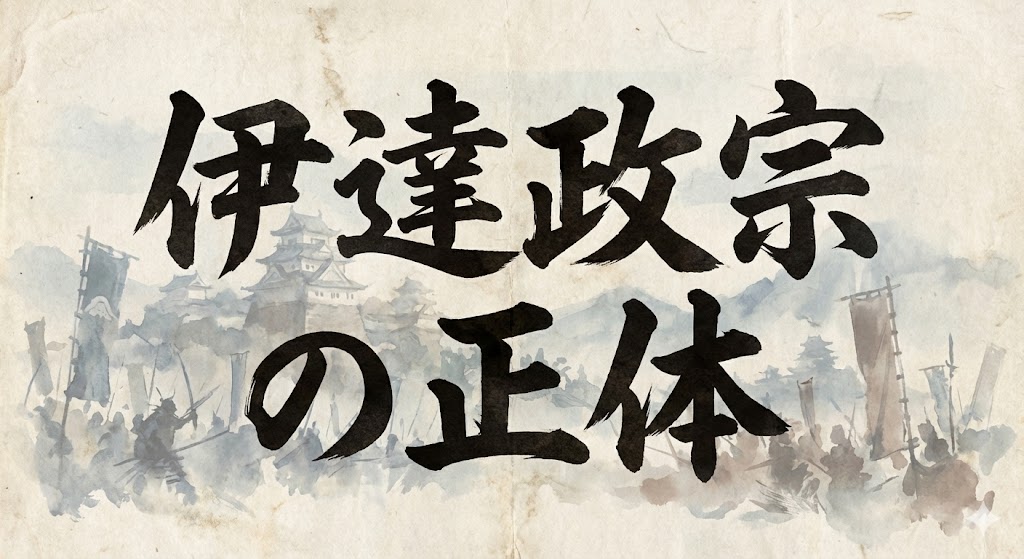
The Date clan, rooted in Mutsu Province since the Kamakura period, exploited their remote geography to avoid central conflicts and build a massive power base. During the Sengoku era, Terumune and his son Masamune expanded through cold pragmatism. Masamune, in particular, leveraged the tragedy of his father’s death to aggressively annex neighboring territories. Their core principle prioritized clan survival and prosperity over morality, utilizing the isolation of the north as a strategic asset for ultimate regional dominance.
The Date clan’s history began when Date Tomomune (The loyal founder) received estates in Mutsu Province from Minamoto no Yoritomo. At the time, Mutsu remained a complete backwater in the eyes of the central government. The Shogunate viewed it as a low-priority frontier, largely ignored as long as no major rebellions occurred.
However, this geographic isolation became their greatest salvation. Even when the Date supported the losing Southern Court during the Nanboku-cho turmoil or defied the Ashikaga Shoguns, the central government rarely sent punitive expeditions. Therefore, the clan thrived by maintaining distance from central chaos. They utilized this “ignored” status to quietly and systematically consolidate an absolute power base without external interference.
🔍 Key Takeaways 🔍
Distance from the political center allowed the Date clan to survive major mistakes without suffering fatal blows. They turned their remote location into a strategic shield, using time as an ally to build a foundation so solid it eventually became untouchable.
Date Terumune (The skilled diplomat) had even established ties with Oda Nobunaga, but a shocking incident occurred when Nihonmatsu Yoshitsugu kidnapped him during a peace negotiation. The young Masamune, having recently inherited the leadership, made the terrifying decision to gun down the kidnapper—along with his own father. Surprisingly, he leveraged this tragedy as a justification for relentless military expansion against neighboring rivals.
Masamune’s ambition spared no one, even within his family. He executed his younger brother and exiled his mother following a suspected poisoning attempt. Furthermore, he employed Nade-giri at Kotesamori Castle, massacring all inhabitants to instill absolute terror. By discarding traditional familial mercy, he destroyed the old regional order and rapidly established himself as the supreme hegemon of the north.
🔍 Key Takeaways 🔍
Masamune possessed the cold pragmatism to turn a personal tragedy into a pretext for territorial gain. By severing emotional ties and utilizing extreme violence, he bypassed traditional obstacles to reach the pinnacle of power in record time.
Masamune and his father shared a trait with the Three Great Unifiers: they were not merely violent combatants. They deeply understood that the “sinews of war” consisted of money. Therefore, Terumune obsessed over Kenchi (The rigorous land survey) even more than the battles themselves. He focused on securing stable tax revenue and economic foundations to sustain his long-term military goals.
Behind the flashy helmets and heroics, these leaders functioned as logical, administrative “managers.” They calculated how to efficiently extract resources from conquered lands to reinvest in the next conflict. Ultimately, this severe economic sensibility and superior administrative capacity were the true weapons of the Sengoku era, serving as the absolute condition for remaining a victor.
🔍 Key Takeaways 🔍
For a Sengoku Daimyo, administrative skill was more important than battlefield bravery. Only those who could coldly calculate resources and manage their territory like a “CEO” could survive the turmoil. Military might was a mere tool; economic power was the true engine.
── Finally, let's recap with the summary and FAQ of this article.
The Date clan leveraged their remote location in Mutsu to accumulate power and eventually dominate the north. Masamune utilized family tragedies and internal strife as springboards for expansion through calculated violence. Their history proves that cold pragmatism and a solid economic base are the true keys to surviving a chaotic era. The main points of this article are:
‣ Aggressive expansion achieved by overcoming personal tragedies.
‣ Prioritizing economic foundations over mere military bravery.
We hope these historical lessons offer valuable perspectives for navigating your own complex professional and personal environments.
Q1. Where exactly was Mutsu Province located?
It refers to a massive area in the northeastern part of Honshu, covering modern-day Fukushima, Miyagi, Iwate, and Aomori Prefectures, as well as parts of Akita.
Q2. Why did Masamune wear an eye patch?
He lost sight in his right eye due to a childhood bout with smallpox. His resulting appearance led him to be famously known as the “One-Eyed Dragon” (Dokuganryu).
Q3. What lesson can modern people learn from the Date clan?
The importance of “reframing” disadvantages, such as isolation or adversity, into strategic strengths. Additionally, it highlights the need for cold, rational decision-making that prioritizes long-term goals over temporary emotions.


コメント欄