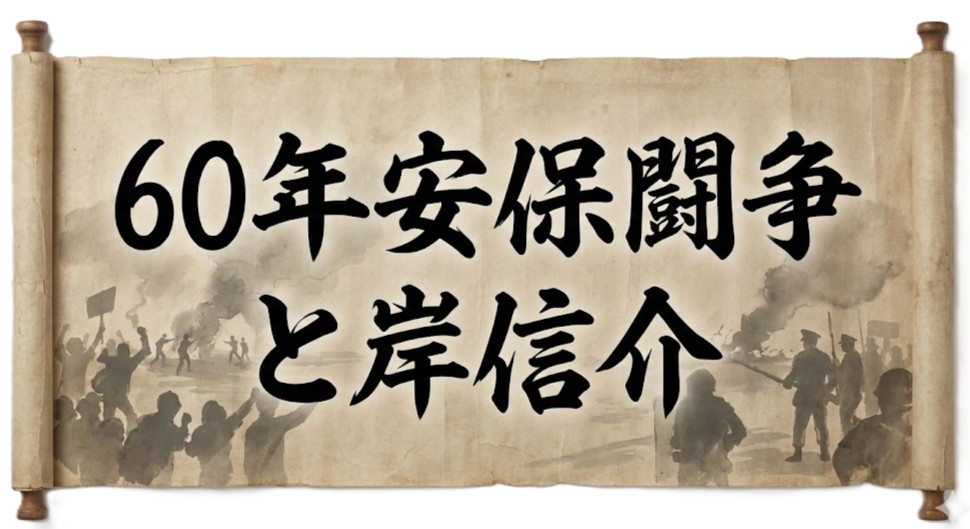
In 1960, Kishi Nobusuke risked his entire political career to revise the US-Japan Security Treaty, seeking an equal military partnership against Soviet threats. However, massive public fears of war ignited unprecedented protests. Consequently, Kishi utilized a highly controversial forced vote and police intervention to meet the US President’s schedule. Ultimately, while the treaty successfully passed, the ensuing nationwide riots forced his cabinet to resign, marking a massive turning point in post-war Japanese politics.
As post-war Japan recovered, Kishi Nobusuke (The Showa monster) decisively moved to revise the US-Japan Security Treaty. This ambitious policy aimed to elevate Japan from a mere dependent to an equal partner, securing the nation against Soviet threats. However, this aggressive maneuver instantly triggered massive public anxiety regarding potential entanglement in future wars.
Initially, the opposition remained limited. Surprisingly, the U-tsu Gekitsui Jiken in May 1960 completely altered the geopolitical landscape. The terrifying prospect of US bases in Japan becoming direct Soviet targets suddenly became highly realistic. Consequently, amidst collapsing pro-American regimes nearby, Kishi faced immense pressure to execute this irreversible political gamble.
🔍 Key Takeaways 🔍
Kishi attempted to strengthen the US alliance to protect Japan. However, his terrible timing coincided with severe international crises. Consequently, the public firmly linked the alliance expansion directly to the terrifying danger of war.

With the scheduled visit of the US President looming, Kishi initiated his drastic plan on May 19. He specifically targeted the constitutional mechanism of Shizen Seiritsu. Passing the bill through the lower house guaranteed automatic enactment after thirty days. Therefore, Socialist lawmakers frantically erected physical barricades inside the parliament to block the proceedings.
Late at night, an unprecedented democratic crisis unfolded. Kiyose Ichiro (The desperate speaker) authorized the Keikantai Donyu, summoning 500 officers to physically drag away the sitting opposition members. Subsequently, ruling party members literally carried Kiyose to his seat. Just before midnight, the Kyoko Saiketsu instantly passed the treaty extension, perfectly illustrating Kishi’s terrifying “ends justify the means” philosophy.
🔍 Key Takeaways 🔍
To exploit the 30-day automatic enactment rule, Kishi weaponized police forces to violently eject opposition members. This blatant disregard for democratic procedures infuriated the general public, violently pouring gasoline on the burning protests.

The news of the forced vote sent massive shockwaves across Japan. Suddenly, the core issue shifted from military alliances to a desperate defense of democracy itself. Hundreds of thousands of furious citizens surrounded the parliament daily. Furthermore, the humiliating Hagati Jiken forced a high-ranking US official to escape via helicopter. Tragically, violent clashes on June 15 crushed Kanba Michiko (The student activist) to death.
This fatal tragedy pushed anti-Kishi sentiment to its absolute boiling point. Even conservative newspapers and corporate elites demanded his immediate resignation to halt the overwhelming societal chaos. On June 19, the treaty achieved Shizen Seiritsu, but the political cost proved catastrophic. Consequently, Kishi announced his resignation, permanently cementing the Anpo Toso as the ultimate turning point of post-war democracy.
🔍 Key Takeaways 🔍
Kishi successfully achieved his ultimate goal of passing the treaty but sacrificed his entire administration to public outrage. Paradoxically, this intensely controversial alliance framework securely established the fundamental basis of Japan’s modern diplomatic policy.
── Finally, let's recap with the summary and FAQ of this article.
Kishi Nobusuke relentlessly forced the security treaty revision, entirely ignoring democratic procedures. While this ruthless action firmly established Japan’s long-term security architecture, it simultaneously triggered explosive public distrust. The main points of this article are:
‣ The massive political cost of utilizing an undemocratic forced vote.
‣ The unprecedented nationwide protests that reshaped post-war politics.
We hope these historical lessons offer valuable perspectives on the severe risks of prioritizing political objectives over democratic consensus, a dilemma that remains profoundly relevant today.
Q1. Why did Prime Minister Kishi rush the vote so aggressively?
He desperately needed to enact the treaty before US President Eisenhower’s scheduled June visit. He intended to present the ratified treaty as a grand diplomatic gift celebrating US-Japan friendship.
Q2. What ultimately happened to the revised Security Treaty?
Thirty days after passing the lower house, the constitutional automatic enactment rule applied. Therefore, the treaty officially became law on June 19 and remains the foundation of the US-Japan alliance today.
Q3. What is the primary historical lesson of this event?
Regardless of a policy’s strategic importance, completely disregarding the consensus-building process will violently fracture society and generate deep, lasting political distrust.
コメント欄