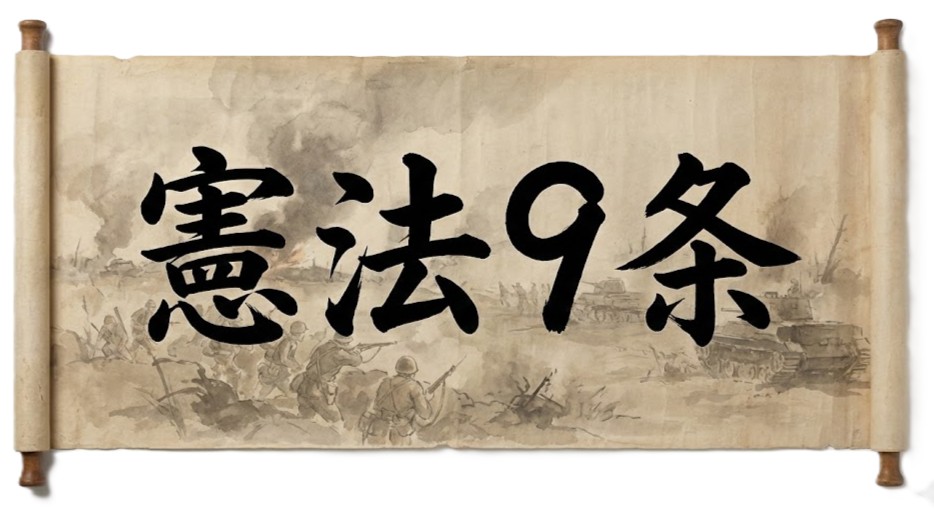
Article 9, the cornerstone of Japan’s post-war pacifism, contains subtle GHQ modifications that intentionally left room for self-defense. Furthermore, the intensifying Cold War and General MacArthur’s personal presidential ambitions triggered the “Reverse Course.” Consequently, this drastic policy shift transformed Japan from a democratic experiment into an anti-communist fortress, fundamentally shaping the conservative dominance of modern Japanese politics and the ongoing constitutional debate.
Kenpo Dai-kyu-jo stands as a globally unprecedented declaration of absolute pacifism. While its exact origins remain debated, many historians believe Shidehara Kijuro (The pacifist prime minister) tearfully pleaded with MacArthur to ensure the military could never again hijack the government. However, the final text actually contains a crucial, intentional softening compared to the original draft.
Specifically, Charles Kades (The pragmatic GHQ drafter) believed that explicitly forbidding defensive wars was too extreme. Therefore, he quietly deleted the phrase “renunciation of self-defense” during the drafting process. Consequently, this slight textual modification created the vital legal loophole that currently legitimizes the existence of the Self-Defense Forces. Ultimately, GHQ fiercely pressured the Japanese government to accept this draft, famously threatening them with the “atomic sunshine” of public exposure.
🔍 Key Takeaways 🔍
While aiming for total disarmament, pragmatic GHQ officials intentionally left semantic room for self-defense. This crucial, subtle modification remains the absolute legal foundation for Japan’s current military capabilities and all ongoing national security debates.

GHQ’s aggressive democratization policies executed a massive 180-degree turn within just a few years, a phenomenon known as the Gyaku Kosu. The intensifying Reisen, specifically the communist victory in China and the outbreak of the Korean War, forced this drastic change. Consequently, Washington urgently needed to transform Japan from a peaceful democratic experiment into a robust anti-communist fortress in Asia.
Furthermore, MacArthur’s personal political ambitions played a crucial role. He secretly planned to run in the upcoming Amerika Daitoryo Senkyo. However, conservative Republicans heavily criticized him for being too “soft on communists” during his occupation of Japan. To protect his political career and appease his domestic base, MacArthur had to aggressively demonstrate a hardline stance against Japanese leftist movements.
🔍 Key Takeaways 🔍
The idealistic democratization of Japan was rapidly abandoned due to Cold War realities and MacArthur’s personal presidential ambitions. Consequently, American domestic political needs completely hijacked and reversed the original goals of the occupation.

The practical impact of the Reverse Course violently materialized as severe suppression of labor movements. In 1947, impoverished workers organized the Ni-ichi Zenesuto to protest hyperinflation. However, MacArthur explicitly banned the strike just hours before commencement. Furthermore, the massive public purge, originally designed to remove militarists, transformed into the Reddo Paju, aggressively targeting and destroying communist party members.
Simultaneously, GHQ rapidly relaxed its pursuit of former wartime leaders. As the Tokyo Trials concluded, high-profile Class-A war crime suspects like Kishi Nobusuke (The pragmatic conservative) were quietly released. Astonishingly, they swiftly returned to the political center stage. Ultimately, this intentional rehabilitation of the right-wing old guard permanently cemented the conservative dominance that still characterizes post-war Japanese politics today.
🔍 Key Takeaways 🔍
To combat communism, MacArthur aggressively crushed left-wing movements while simultaneously rehabilitating pre-war conservative leaders. This dramatic 180-degree policy reversal fundamentally engineered the conservative-heavy political structure that governs modern Japan.
── Finally, let's recap with the summary and FAQ of this article.
Japan’s post-war democracy and pacifist constitution were aggressively implemented “from above” by the United States. However, Cold War pressures and MacArthur’s personal ambitions rapidly distorted these idealistic policies through the Reverse Course. The main points of this article are:
‣ The Cold War and US domestic politics forced a massive policy reversal.
‣ The Red Purge and the rehabilitation of conservatives shaped modern politics.
We hope these historical lessons offer valuable perspectives on how the deep contradictions embedded during the occupation continue to fuel today’s intense debates over constitutional revision and national security.
Q1. Who originally proposed Article 9?
Debate continues between MacArthur and Prime Minister Shidehara. However, the most critical historical fact is that GHQ drafters intentionally modified the text to permit future self-defense interpretations.
Q2. Why did the “Reverse Course” happen?
The intensifying Cold War, specifically communist expansion in Asia, forced the US to rebuild Japan as a military ally. Additionally, MacArthur’s ambition to run for US President required him to project a strong anti-communist image.
Q3. What is the legacy of this era?
Modern Japanese politics is built upon the profound contradiction of an imposed pacifist constitution clashing with the Reverse Course’s rearmament demands. Understanding this origin is essential for analyzing current constitutional debates.
コメント欄