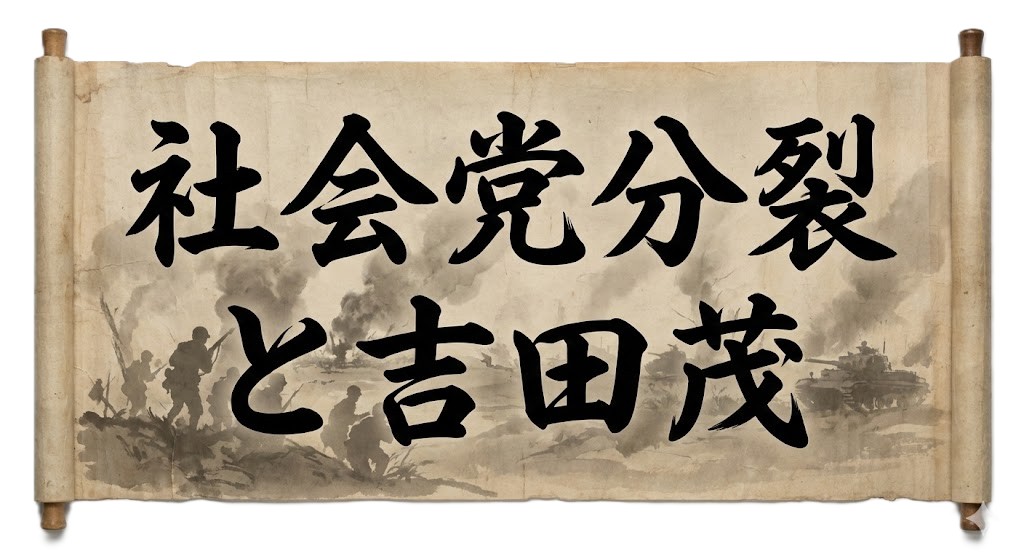
Following World War II, GHQ’s liberation policies fueled the rise of leftist forces, culminating in Katayama Tetsu’s historic socialist government. However, ideological conflicts rapidly destroyed this administration, fracturing the Socialist Party. Concurrently, conservative leader Hatoyama Ichiro won a landslide election but faced an abrupt purge just before taking office. Consequently, Yoshida Shigeru seized power, establishing a powerful bureaucracy-led government that ultimately paved the way for the enduring 1955 System.
GHQ’s post-war liberation policies initially released political prisoners, sparking a massive leftist surge. Consequently, the Japan Socialist Party triumphed in the 1947 elections, installing Katayama Tetsu (The first socialist prime minister). This historic socialist government initially generated massive public excitement. However, the administration immediately collided with harsh governing realities.
Although the cabinet successfully established the Ministry of Labor, it fundamentally lacked concrete economic reconstruction strategies. Therefore, the administration catastrophically collapsed in just ten months. Furthermore, GHQ’s Gyaku Kosu heavily suppressed labor movements, while the Nihon Kyosanto alienated the public through violent revolutionary tactics. Ultimately, these combined failures triggered the catastrophic fragmentation of the entire leftist movement.
🔍 Key Takeaways 🔍
The historic socialist government quickly collapsed due to severe economic incompetence and shifting international pressures. Furthermore, radical communist violence completely alienated the public, ensuring that leftist forces would remain distant from political power for decades.

Following their loss of power, the Socialist Party violently debated the causes of their failure. The Saha Shakaito firmly believed in a Marxist revolution, fiercely demanding the complete destruction of the current capitalist system. To these radicals, their pragmatic party colleagues appeared as unforgivable traitors.
In stark contrast, the Uha Shakaito, led by Nishio Suehiro (The pragmatic leader), championed gradual social democratic reforms through standard parliamentary procedures. Consequently, this unbridgeable ideological chasm formally split the party into two competing entities sharing the exact same name. Ultimately, instead of uniting against conservative rivals, the socialists engaged in a futile civil war that disastrously cannibalized their own voter base.
🔍 Key Takeaways 🔍
Unbridgeable ideological differences split the Socialist Party into radical and pragmatic factions. By prioritizing internal warfare over political unity, the left completely shattered public trust and essentially handed total dominance to conservative forces.

While the left fragmented, the conservative camp experienced its own dramatic upheaval. Hatoyama Ichiro (The conservative leader) formed the Japan Liberal Party and secured a crushing victory in the 1946 elections. However, GHQ abruptly hit him with a devastating Koshoku Tsuiho right before his prime ministerial inauguration, citing his wartime political responsibilities. This sudden intervention spectacularly derailed his imminent grasp on supreme power.
Consequently, the party desperately selected Yoshida Shigeru (The diplomatic statesman) as an emergency replacement. Deeply distrusting traditional party politicians, Yoshida strategically recruited elite former bureaucrats to run his government. What began as a mere substitute administration ultimately forged the absolute foundation of Japan’s post-war conservative mainstream, permanently shifting national power into the hands of the bureaucracy.
🔍 Key Takeaways 🔍
A sudden GHQ purge unexpectedly eliminated the elected conservative leader. This allowed Yoshida Shigeru to seize power and design a robust, bureaucracy-led government, laying the permanent architectural blueprint for decades of conservative dominance.
── Finally, let's recap with the summary and FAQ of this article.
Post-war Japanese politics forged the exact prototype of the modern state during this volatile era. The left tragically squandered its historic opportunity through internal ideological warfare. Conversely, conservative forces accidentally secured a powerful, visionary leader due to a sudden GHQ purge. The main points of this article are:
‣ The catastrophic failure of violent communist revolutionary tactics.
‣ Hatoyama’s sudden purge and Yoshida’s establishment of bureaucratic politics.
We hope these historical lessons offer valuable perspectives on how unexpected political maneuvers and ideological rigidity permanently shaped the modern Japanese political landscape.
Q1. Why did the socialist government collapse so quickly?
They fundamentally lacked concrete economic reconstruction policies and suffered from severe internal divisions. Furthermore, GHQ’s Reverse Course created a highly hostile political environment.
Q2. What divided the Right and Left Socialist Parties?
The Left vehemently demanded a Marxist revolution and fiercely opposed US alignment. Conversely, the Right pursued gradual, pragmatic democratic reforms strictly within the existing parliamentary system.
Q3. Why did Yoshida become prime minister instead of the election winner?
GHQ abruptly purged Hatoyama just before his inauguration due to his past wartime cabinet involvement. Yoshida, a former diplomat with less wartime baggage, stepped in to fill the massive leadership vacuum.
コメント欄