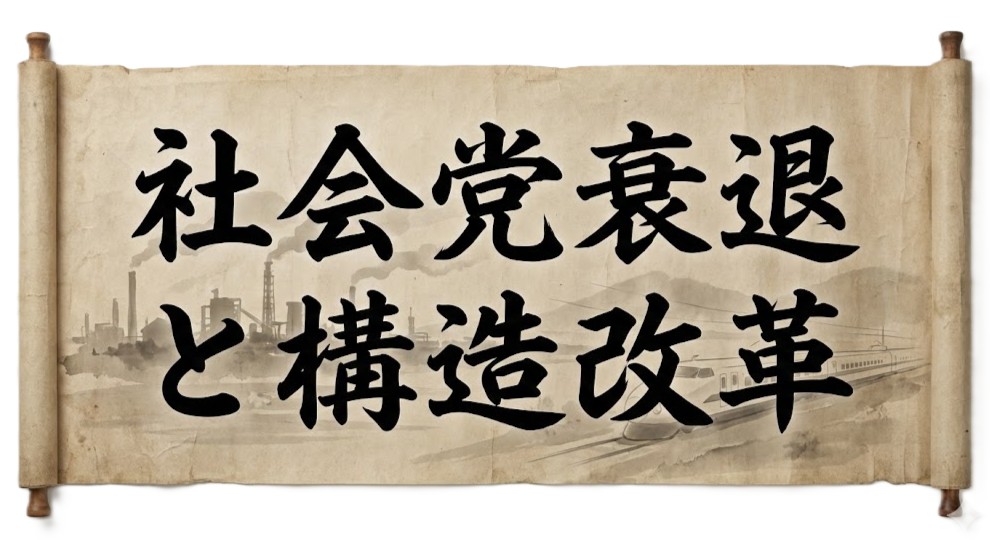
Following the failure to block the 1960 Security Treaty, the Japan Socialist Party spectacularly self-destructed through intense ideological warfare. The pragmatic right-wing, led by Nishio Suehiro, defected to form the Democratic Socialist Party. Subsequently, radical Marxist factions viciously crushed Eda Saburo’s popular, realistic “Structural Reform” vision. Ultimately, by prioritizing rigid dogma over voters’ actual needs, the Socialist Party initiated its own permanent, irreversible decline during Japan’s era of explosive economic growth.
Although the 1960 Anpo Protests successfully toppled the Kishi cabinet, they completely failed to block the actual security treaty. Consequently, instead of uniting against the conservatives, the Japan Socialist Party initiated a vicious, internal witch-hunt to assign blame. This catastrophic infighting fundamentally destroyed their political foundation and guaranteed their long-term irrelevance as a viable alternative government.
The most devastating blow occurred when Nishio Suehiro (The pragmatic leader) and his right-wing faction permanently defected. Backed by the powerful Zenro Kaigi labor federation, they adamantly refused any political cooperation with the revolutionary Communist Party. This was not a minor policy disagreement; it was an unbridgeable philosophical war between rigid Marxism and pragmatic humanism. Ultimately, this bitter schism birthed the Minshato, instantly stripping the Socialist Party of nearly 40 crucial parliamentary seats.
🔍 Key Takeaways 🔍
The massive failure of the Anpo Protests triggered explosive internal finger-pointing. Consequently, the pragmatic right-wing defected to form a new party, irreversibly fracturing the opposition and completely destroying their ability to challenge conservative dominance.

Even after the massive right-wing defection, intense ideological warfare continued to paralyze the Socialist Party. Eda Saburo (The visionary secretary) introduced the concept of Kozo Kaikaku. This pragmatic approach rejected violent revolution, focusing instead on gradually amending capitalism through democratic elections to immediately improve workers’ daily lives.
Eda specifically proposed the highly popular Eda Bijon. This brilliant blueprint aimed to combine America’s high living standards, Soviet social security, British parliamentary democracy, and Japan’s pacifist constitution. However, the radical Marxist left furiously condemned this pragmatic plan as pathetic “surrender to imperialism.” Ironically, Eda’s sincere attempt to align the party with actual voters was violently crushed by his own dogmatic comrades.
🔍 Key Takeaways 🔍
Eda Saburo proposed a highly realistic, globally inspired reform plan that strongly appealed to ordinary citizens. However, radical Marxists prioritized strict ideological purity over electoral success, brutally destroying their best chance at national leadership.

This relentless ideological civil war completely destroyed public trust in the Nihon Shakaito. Kijima Masamichi (The insightful advisor) delivered a devastatingly accurate post-mortem: “The Eda Vision was rejected by the party precisely because the public accepted it.” This perfectly illustrated how Socialist members obsessed over proving their Marxist purity while demonstrating absolute contempt for the practical desires of everyday voters.
Consequently, the party paid a catastrophic price at the ballot box. Their Giseki-su plummeted from 166 seats in 1960 to a pathetic 90 seats. During Japan’s rapid economic growth, massive populations migrated to urban centers—a demographic shift that theoretically should have guaranteed a socialist landslide. However, by stubbornly rejecting reality, they completely squandered this historic opportunity, permanently condemning themselves to the role of a powerless opposition.
🔍 Key Takeaways 🔍
By obsessively guarding rigid Marxist dogma, the Socialist Party completely alienated the rapidly modernizing electorate. They essentially committed political suicide, voluntarily abandoning any realistic chance of governing the nation.
── Finally, let's recap with the summary and FAQ of this article.
The catastrophic decline of the Japan Socialist Party during the 1960s was entirely self-inflicted. By prioritizing absolute ideological purity over pragmatic governance, they spectacularly alienated the public they claimed to represent. The main points of this article are:
‣ Radical Marxists viciously destroyed Eda Saburo’s highly popular, realistic reform vision.
‣ Rigid dogmatism completely alienated voters, causing an irreversible electoral collapse.
We hope these historical lessons offer valuable perspectives on the fatal consequences organizations face when they obsess over internal purity while completely ignoring the rapidly changing realities of the outside world.
Q1. What was the ultimate legacy of the Anpo Protests for the opposition?
While they successfully forced the Prime Minister’s resignation, the protests completely failed to stop the treaty. More importantly, the failure violently fractured the Socialist Party, permanently destroying their political power.
Q2. How did the Socialist Party and the Democratic Socialist Party fundamentally differ?
The Socialist Party clung to rigid Marxism and occasionally allied with communists. Conversely, the Democratic Socialist Party explicitly championed democratic, anti-communist reform within the existing capitalist framework.
Q3. Why did the party reject the highly popular Eda Vision?
The powerful left-wing factions viewed any pragmatic compromise with capitalism as absolute ideological treason. They deliberately chose to maintain Marxist purity even if it guaranteed continuous electoral defeat.
コメント欄