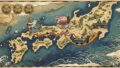
Ashikaga Yoshimitsu successfully built the golden age of the Muromachi Shogunate, establishing the Hana-no-Gosho and becoming the first warrior to achieve the rank of Daijo-daijin. Furthermore, he secured the title “King of Japan” from Ming China to monopolize lucrative trade. However, this prosperity masked a fatal structural weakness: the founder’s wartime concessions had granted excessive power to regional lords, creating a fragile government entirely dependent on their cooperation.
Ashikaga Yoshimitsu (The absolute ruler) completely ended the Nanboku-cho turmoil and manifested the Shogunate’s absolute authority visually.
He constructed the Hana-no-Gosho in Kyoto, boasting twice the scale of his grandfather’s palace. Consequently, this magnificent headquarters permanently established the historical name “Muromachi Bakufu” and projected warrior prestige nationwide.
Yoshimitsu’s ambition extended far beyond military leadership. He became the first samurai to serve as Daijo-daijin, successfully subjugating the aristocratic society.
After retiring, he built the luxurious Kitayama-dono. Therefore, he reigned as an absolute monarch in both politics and culture, permanently etching his name as Japan’s supreme ruler.
🔍 Key Takeaways 🔍
Yoshimitsu secured unquestionable authority by building overwhelmingly massive residences and capturing the highest imperial rank. Today, Kinkakuji still shines as the ultimate symbol of his unprecedented dominance over both warriors and nobles.

Having mastered domestic affairs, Yoshimitsu turned his attention overseas. He accepted an official letter from the Ming Emperor, styled himself as Nihon Kokuo, and actively entered the Sakuho Taisei.
This decision formally positioned Japan’s top leader as a vassal to China. Surprisingly, it was a highly pragmatic choice prioritizing tangible benefits over national pride.
The primary objective was overwhelming economic profit. The Kango Boeki, utilizing official tallies to certify legitimate envoys, generated massive wealth for the Shogunate.
For Yoshimitsu, monopolizing lucrative trade routes and utilizing foreign authority for domestic control far outweighed any superficial loss of dignity.
🔍 Key Takeaways 🔍
Yoshimitsu submitted to the Chinese Emperor as a vassal to exclusively secure immensely profitable trade networks. He was a rare, rationally calculating politician who prioritized substantial economic power over temporary prestige.

While Yoshimitsu’s era appeared invincible, the Bakufu harbored a structural defect. To secure allies during the civil war, the founder Ashikaga Takauji (The pragmatic founder) granted sweeping privileges, such as the Hanzei-rei, to regional Shugo.
Consequently, these governors independently collected taxes and morphed into overwhelmingly powerful Shugo Daimyo, making centralized control impossible.
Decentralization severely crippled the government. The Kamakura Kubo actively opposed Kyoto, while Kyushu and Tohoku remained highly autonomous.
Essentially, the Bakufu functioned as a fragile coalition of formidable territorial lords. Therefore, this fundamentally unstable balance was destined to collapse immediately without a charismatic dictator like Yoshimitsu.
🔍 Key Takeaways 🔍
Takauji’s desperate wartime concessions permanently stripped the Shogunate of direct regional control. The Shogun’s power was never absolute; it relied entirely on the fragile cooperation of powerful territorial lords, guaranteeing future systemic collapse.

Ashikaga Yoshimitsu conquered both aristocratic and warrior hierarchies and amassed vast wealth through Ming trade, forging the Muromachi Shogunate’s golden age. However, its governance structure remained critically unstable due to extreme wartime compromises with regional lords. Ultimately, the Shogun’s authority depended on personal charisma rather than a robust systemic foundation. The main points of this article are:
‣ Pragmatic submission to China secured immense trade wealth.
‣ Wartime concessions birthed uncontrollable regional lords.
We hope these historical lessons offer valuable perspectives for navigating your own complex professional and personal environments.
Q1. Why did Yoshimitsu accept a title making him a Chinese vassal?
To secure the enormous profits of the tally trade. Additionally, gaining the Ming Emperor’s official endorsement strengthened his domestic authority and helped suppress pirates.
Q2. What is the difference between a Shugo and a Shugo Daimyo?
Initially, Shugo were merely military commanders. However, after acquiring tax collection rights like the Hanzei-rei, they began directly ruling the land and people, transforming into powerful territorial lords known as Daimyo.
Q3. Why was the Muromachi Shogunate so structurally unstable?
Because it was forced to appease regional warriors during its formation. The Shogun possessed weak direct military power and structurally depended on the conditional cooperation of powerful Shugo Daimyo to govern the nation.