When does Japanese history begin? Written records only date back roughly 1,500 years. However, archaeology reveals our ancestors crossed land bridges during the Ice Age over 35,000 years ago.Uncovering this unwritten past presents unique challenges, notoriously highlighted by the Paleolithic hoax incident. Ultimately, early humans utilized advanced hunting techniques to drive massive animals to extinction, setting Japan’s independent history in motion.
The question of when Japanese history begins reveals a stark contrast between sources. Standard Bunken-shiryo trace back a mere 1,500 years.
Therefore, to understand the true genesis of the archipelago, we must rely entirely on Kokogaku to unlock a far older world spanning tens of thousands of years.
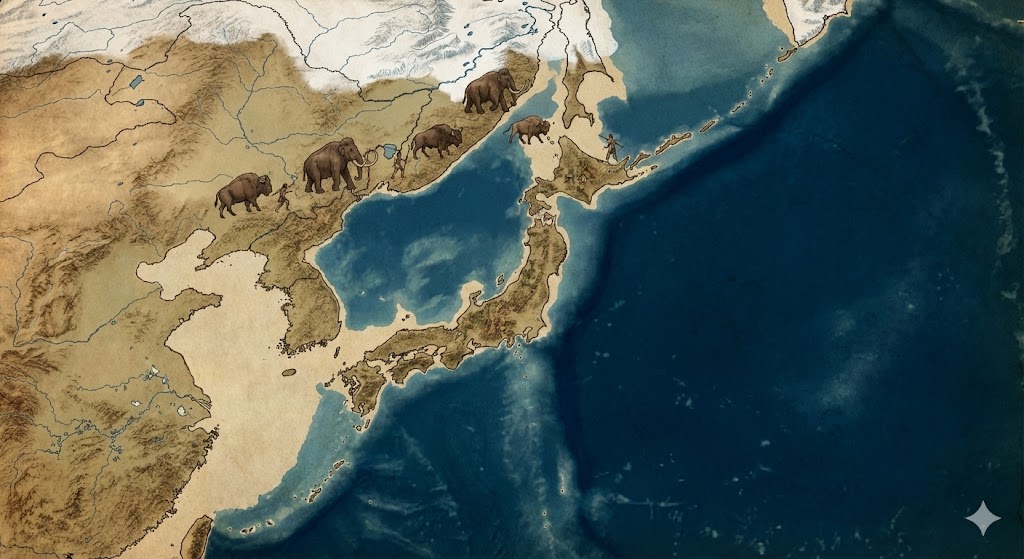
Consequently, during the harsh Hyogaki roughly 35,000 to 40,000 years ago, lower sea levels physically connected the Japanese archipelago to the Asian continent.
Early ancestors simply walked across this land bridge pursuing animal herds, initiating an impossibly long, unwritten era.
🔍 Key Takeaways 🔍
The history we read in writing represents merely a recent fraction of human existence; the vast majority slumbers underground. Japan was originally part of the continent, and the first arrivals migrated on their own two feet.
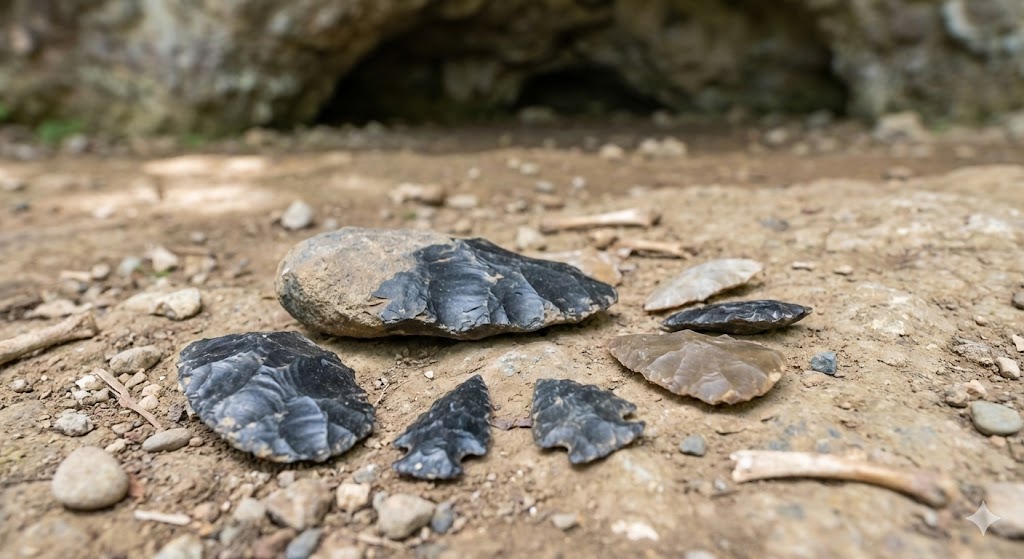
Without written records, society must trust excavated artifacts. Surprisingly, a massive scandal shattered this trust in the year 2000.
Fujimura Shinichi (The “God’s Hand” archaeologist) orchestrated the Paleolithic hoax, “discovering” stone tools he had planted himself to artificially extend Japan’s historical timeline.
Why did this deception persist for years?
A distorted sense of Aikokushin—specifically the intense desire to claim an older history than China or Korea—blinded the academic community. This collective wishful thinking completely derailed rigorous Kensho.
🔍 Key Takeaways 🔍
The desire for Japan to be special created severe vulnerabilities that allowed fake history to flourish. Without strictly objective eyes, human biases easily distort archaeological truths.
Setting aside the hoax, verified evidence paints a fascinating picture. Roughly 20,000 years ago, enormous creatures known as Megafauna dominated the archipelago.
Our ancestors tracked these giant deer and elephants—many exceeding two meters in height—eventually settling in expansive hunting grounds like the modern Kanto Heiya.
However, this prosperity inevitably ended. Humans engineered sharp Dasei-sekki and utilized highly coordinated teamwork driven by language to hunt these apex predators to extinction.
Ultimately, combined with rapid climate warming, this mass extinction transitioned humanity out of the Paleolithic era.
🔍 Key Takeaways 🔍
Early humans conquered nature’s giants. “The technology of stone tools” and “cooperation through language” held overwhelming ecological power, ultimately becoming the driving force of history.

The dawn of Japanese history lies completely in the darkness before writing. However, solid evidence remains of early humans surviving the Ice Age and confronting massive beasts. Learning from the bitter lessons of the hoax, modern archaeology approaches the truth with cautious precision. The main points of this article are:
‣ Human desires and patriotism create dangerous academic blind spots.
‣ Advanced hunting and climate change triggered megafaunal extinction.
We hope these historical insights encourage a more critical, objective perspective in your everyday thinking.
Q1. Where did the Japanese come from?
During the Ice Age, ancestors walked across massive land bridges from the Asian continent in pursuit of migrating animal herds.
Q2. What is the difference between the Paleolithic and Jomon periods?
Paleolithic humans relied exclusively on chipped stone tools without pottery. Conversely, the Jomon period introduced pottery and permanent settlements as the climate warmed.
Q3. What is the most important mindset for studying history?
Critical thinking remains paramount. Always demand objective evidence and actively eliminate wishful thinking or nationalistic bias from your analysis.