The true origins of Japan stretch far beyond written records, which only cover the last 1,500 years. Archaeology reveals that the first humans walked across land bridges during the Ice Age around 35,000 years ago. While uncovering this ancient past has faced setbacks—like the infamous Paleolithic hoax driven by misplaced patriotism—the story of our ancestors utilizing teamwork and stone tools to hunt massive beasts to extinction marks the true dawn of Japanese history.
“When does Japanese history begin?” This simple question carries a complex answer. Textbooks often rely heavily on written records (Bunken Shiryo), but these documents only illuminate the past 1,500 years. Therefore, relying solely on texts leaves tens of thousands of years in complete darkness.
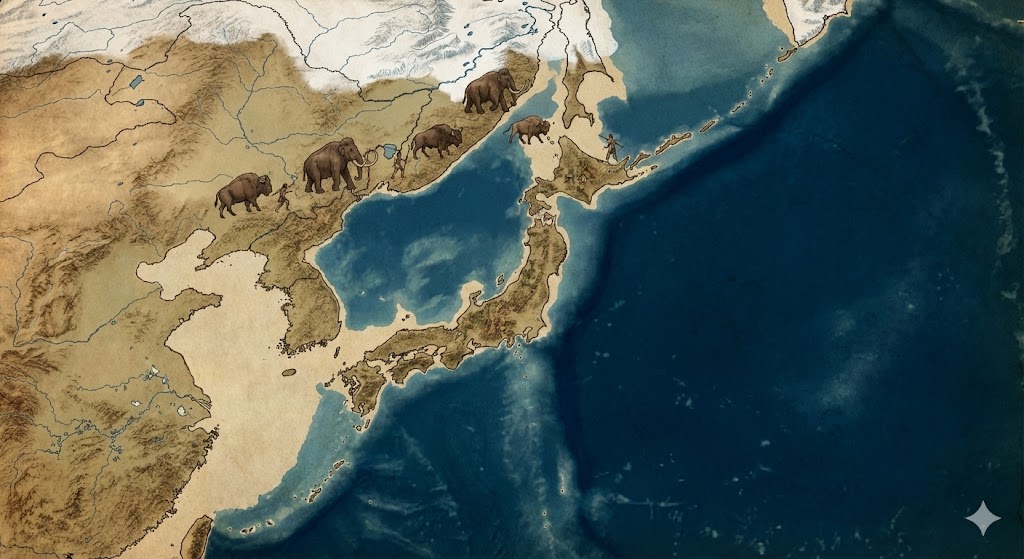
Surprisingly, archaeology (Koukogaku) opens the door to a much older world. Between 35,000 and 40,000 years ago, the earth was gripped by a freezing Ice Age (Hyogaki). Plummeting sea levels forged land bridges connecting the Japanese archipelago to the Asian mainland. Consequently, our ancestors literally walked across these bridges in pursuit of game, sparking an immensely long history completely devoid of writing.
🔍 Key Takeaways 🔍
The written history we study represents merely a fraction of Japan’s timeline. The vast majority of the Japanese story slumbers beneath our feet. Japan was originally part of the Asian continent, and the very first “Japanese” people arrived on foot, not by boat.
Without written records, we must trust excavated artifacts. However, the year 2000 witnessed a massive scandal that shook this trust to its core: the Japanese Paleolithic hoax. Fujimura Shinichi secretly buried stone tools and later “discovered” them. His actions deliberately falsified history to make Japan’s origins appear much older than they actually were.
Why did this deception last so long? The root cause was a distorted sense of patriotism (Aikokushin). Many people desperately wanted to believe that Japan possessed a history older than China or Korea. This collective desire blinded scholars, preventing rigorous scientific verification (Kensho). Today, this teaches modern Japanese society a crucial lesson: objective truth must always override nationalistic desires, a principle essential for healthy international relations and modern journalism.
🔍 Key Takeaways 🔍
The collective yearning for Japan to be “special” created a blind spot that allowed fake history to flourish. Archaeology requires absolute objectivity. When researchers lack a “fair eye,” desires easily warp the truth.
Setting the hoax aside, verified evidence paints a fascinating picture. Around 20,000 years ago, massive creatures known as Megafauna dominated the Japanese landscape. Our ancestors tracked these two-meter-tall giant deer and Naumann elephants, gradually expanding their settlements into favorable hunting grounds like the modern-day Kanto Heiya (Kanto Plain).
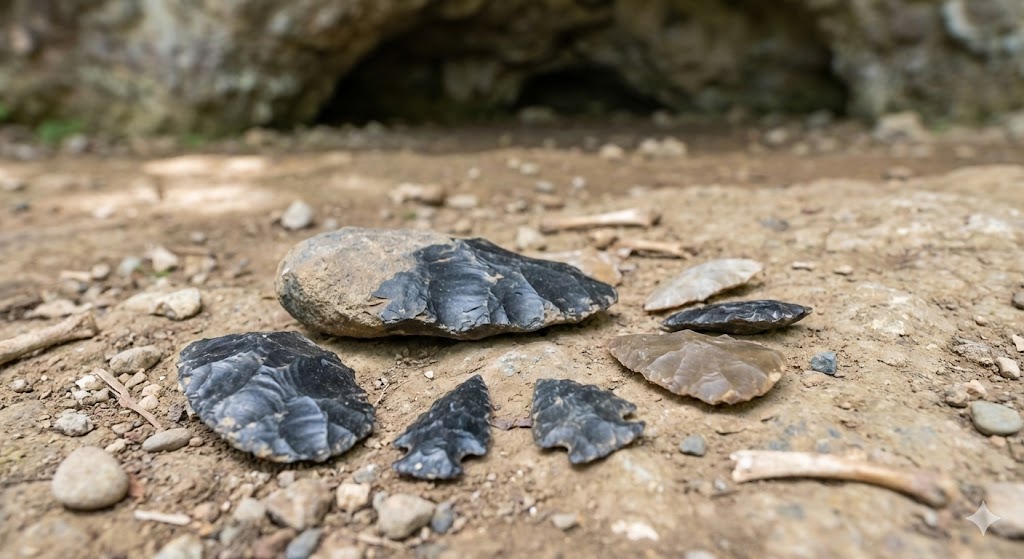
However, the reign of these giant beasts was short-lived. Humans developed sharp chipped stone tools (Dasei Sekki) and utilized advanced verbal teamwork to hunt these megafauna to extinction. Combined with rapid global warming, this overwhelming human impact forced the end of the Paleolithic era. This ancestral ability to adapt, communicate, and collaborate still echoes deeply in the highly cooperative nature of modern Japanese corporate and social structures today.
🔍 Key Takeaways 🔍
The first Japanese people fought and conquered the titans of nature to survive. The combination of technological innovation (stone tools) and verbal cooperation gave humans an overwhelming advantage, becoming the true engine of historical change.
The dawn of Japanese history lies hidden in the darkness before writing. Yet, the footprints of our ancestors who crossed the Ice Age land bridges and battled giant beasts remain undeniably real. Through the bitter lesson of the Paleolithic hoax, modern archaeology now approaches the truth with greater caution and accuracy.
‣ Human desires can create dangerous academic blind spots.
‣ Environmental changes and human teamwork drove megafauna to extinction.
We hope this exploration into the unwritten past offers a fresh perspective on human resilience and the importance of objective truth.
Q1. Where did the Japanese people originally come from?
During the Ice Age, dropping sea levels created a land bridge connecting Japan to the Asian continent. The ancestors of the Japanese people walked across this bridge in pursuit of wild game.
Q2. What is the difference between the Paleolithic and Jomon periods?
The Paleolithic era relied solely on chipped stone tools without pottery. The subsequent Jomon period introduced pottery and permanent settlements as the global climate gradually warmed.
Q3. What is the most important lesson when studying history?
We must maintain a critical mindset. Always question whether an accepted theory is backed by objective evidence or merely fueled by collective desires and biases.










コメント欄