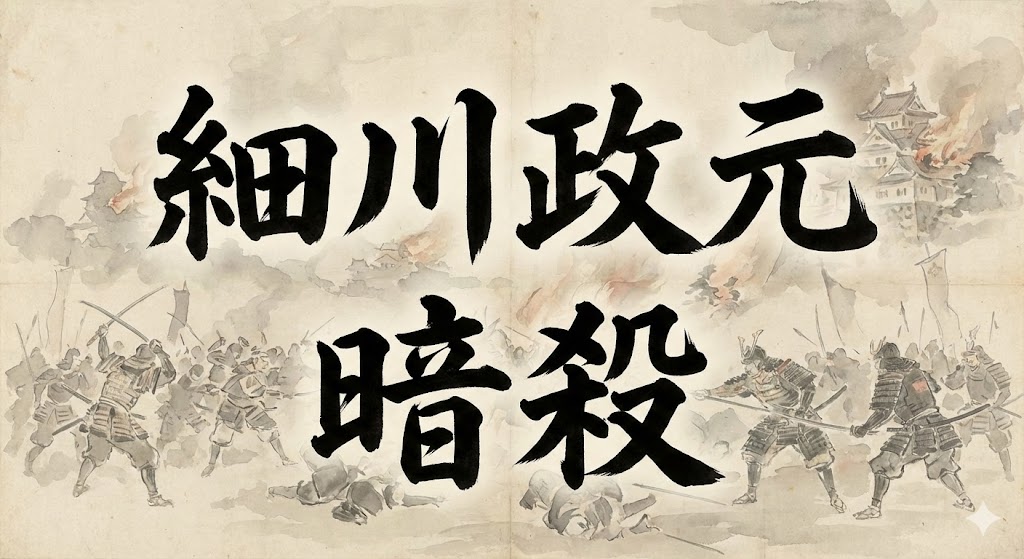
Hosokawa Masamoto maintained lifelong celibacy due to his devotion to Shugendo, recklessly adopting three sons from different backgrounds. Following his assassination by retainers, a brutal succession war erupted, drawing in the powerful Ouchi clan and the Shogun to prolong the conflict for decades. Ultimately, their vassals, the Miyoshi clan, usurped their power. The prestigious Hosokawa clan perished entirely because they failed to transition from authority-dependent Shugo Daimyo to self-reliant Sengoku Daimyo.
Hosokawa Masamoto (The autocratic ruler) led his clan to absolute supremacy, yet he harbored a fatal vulnerability. His extreme devotion to Shugendo required strict celibacy, leaving him without a biological heir. Fearing a power vacuum, he made the highly reckless decision to simultaneously adopt three sons from completely different backgrounds.
Naturally, only one could inherit the leadership. Sumiyuki originated from the aristocratic Kujo family, while Sumimoto and Takakuni belonged to Hosokawa branch lines. When Masamoto leaned toward designating Sumimoto, Sumiyuki’s furious faction violently rebelled. Consequently, this reckless succession planning ignited brutal factional warfare that doomed the prestigious clan immediately following their charismatic leader’s death.
🔍 Key Takeaways 🔍
A leader’s failure to establish clear, logical succession rules guarantees organizational destruction. Masamoto’s personal religious choices and subsequent haphazard adoptions directly triggered the bloody internal conflicts that shattered the clan’s foundation.
In 1507, the Eisho no Sakuran drastically altered the political landscape. Sumiyuki’s retainers assassinated Masamoto and immediately claimed clan leadership. However, Sumimoto swiftly counterattacked and eliminated Sumiyuki. Surprisingly, this was merely the beginning. The third adopted son, Takakuni, then mobilized massive external forces to seize power.
Takakuni formed a formidable alliance with the Ouchi clan (The western hegemons) and Ashikaga Yoshitane (The vengeful former Shogun). Backed by overwhelming military might and Shogunal legitimacy, Takakuni successfully expelled Sumimoto from Kyoto. Therefore, this disastrous foreign intervention escalated a private family dispute into a prolonged, nationwide civil war, permanently crippling the Hosokawa’s internal strength.
🔍 Key Takeaways 🔍
Inviting powerful external factions into an internal power struggle is suicidal. By involving the Ouchi clan and the Shogun, the Hosokawa succession crisis transformed into an uncontrollable national war, bleeding the clan dry and making independent resolution impossible.
Decades of relentless infighting inevitably invited Gekokujo. The Miyoshi clan (The ambitious retainers) systematically exploited the weakened main Hosokawa line, eventually expelling them from Kyoto and usurping their power. Meanwhile, only branch members like Hosokawa Yusai (The cultured survivor) survived the chaos, though the clan’s supreme political dominance was permanently erased from history.
This tragic downfall brutally illustrates the expiration date of borrowed authority. The Hosokawa fatally clung to their Bakufu-granted “Shugo” titles and Kyoto power struggles, completely neglecting practical local governance. Conversely, the true victors of this new era were Sengoku Daimyo, who aggressively consolidated direct territorial control. Ultimately, tangible local power eclipsed empty central prestige.
🔍 Key Takeaways 🔍
Clinging to outdated central authority ensures obsolescence. The Hosokawa perished because they failed to evolve into self-reliant Sengoku Daimyo, proving that organizational survival requires adapting to new realities and maintaining firm control over local foundations.
── Finally, let's recap with the summary and FAQ of this article.
The fall of the Hosokawa clan represents far more than a mere family tragedy. It actively symbolizes the definitive collapse of the authority-dependent Muromachi system and the violent transition into the meritocratic Sengoku period. Their history serves as a stark warning about the absolute necessity of solidifying one’s own foundations rather than relying on an organizational signboard. The main points of this article are:
‣ Devastating external interventions following the Eisho no Sakuran.
‣ The fatal failure to evolve into independent Sengoku Daimyo.
We hope these historical lessons offer valuable perspectives for navigating your own complex professional and personal environments.
Q1. When did the Hosokawa clan’s internal conflict begin?
It was directly triggered by the assassination of Hosokawa Masamoto (Eisho no Sakuran) in 1507. This event sparked intermittent civil wars that lasted for nearly half a century.
Q2. What is the precise difference between a Shugo Daimyo and a Sengoku Daimyo?
A Shugo Daimyo governed through authority officially delegated by the Shogunate. In contrast, a Sengoku Daimyo was an independent lord who ruled their territory exclusively through their own military and political strength.
Q3. What modern lesson can we learn from the Hosokawa clan’s downfall?
The extreme danger of resting on past titles or central authority. It highlights the critical importance of maintaining continuous, direct control over one’s operational base, and demonstrates how the lack of a clear succession plan can utterly destroy an organization.



コメント欄