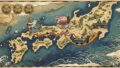
The ambitious Kenmu Restoration rapidly lost its initial support by unjustly favoring Kyoto nobles over the battle-hardened warriors who made the new government possible. Consequently, Emperor Go-Daigo and the powerful warlord Ashikaga Takauji clashed fatally over the supreme title of Shogun. Ultimately, Takauji secured a truly miraculous victory from the distant island of Kyushu by promising tangible land rewards, proving that cold pragmatism inevitably triumphs over empty idealism.
Emperor Go-Daigo (The idealistic monarch) launched the Kenmu no Shinsei with a fatal flaw: mistreating the warriors.
For samurai, warfare functioned as a business to acquire land. However, the Emperor systematically rewarded confiscated territories to Kyoto nobles rather than the frontline fighters.
The Taiheiki records that aristocrats monopolized over 50 Shugo positions. For instance, Akamatsu Norimura (The veteran commander) lost his rightful post to a noble despite leading a successful rebellion in Harima.
Therefore, this severe unpaid compensation inevitably ignited massive anti-government resentment among armed factions.
🔍 Key Takeaways 🔍
Prioritizing aristocratic wealth over warrior compensation destroys military loyalty. This blatant reward disparity alienated the samurai, creating fertile ground for a new leader who would protect their economic interests.

Disillusioned samurai soon rallied behind Ashikaga Takauji (The ambitious warlord). Takauji desperately desired the title of Seii Taishogun.
However, Emperor Go-Daigo, despising military rule, stubbornly refused and appointed his own son, Prince Morinaga, instead. This decision delivered a clear message of rejection to Takauji.
Surprisingly, the Nakasendai no Ran in 1335 forced a drastic shift. Amidst the chaos, Takauji reclaimed Kamakura without imperial permission, independently rewarded his troops, and declared himself Shogun.
Consequently, the furious Emperor branded Takauji an enemy of the state, plunging them into irreversible armed conflict.
🔍 Key Takeaways 🔍
The ideological clash between a warrior-led government and direct imperial rule peaked over the Shogun title. Takauji’s forceful seizure of power and the Emperor’s uncompromising retaliation made full-scale war inevitable.

Designated as a Choteki, Takauji suffered a crushing defeat in Kyoto and fled to distant Kyushu. Yet, he brilliantly executed extreme Jitsuri-shugi.
First, he secured an imperial decree from Retired Emperor Kogon, forcibly transforming his rebel army into a legitimate state military force.
Furthermore, Takauji effectively bribed regional samurai factions. He guaranteed the Hosokawa clan total control over Shikoku and promised the betrayed Akamatsu clan three Shugo positions.
Therefore, this ironclad promise of tangible wealth completely won over the exhausted warriors who despised the unrewarding imperial government.
🔍 Key Takeaways 🔍
A combination of forged legitimacy and massive land promises enabled rapid military recovery. A pragmatic leader guaranteeing immediate profits easily outmaneuvered an idealistic government offering nothing.

The Kenmu no Shinsei collapsed swiftly because Emperor Go-Daigo ignored the fundamental economic needs of the warriors. Conversely, Ashikaga Takauji expanded his support by fulfilling their deepest desires while manipulating imperial authority. This fatal gap between idealism and pragmatism determined the ultimate victor. The main points of this article are:
‣ The vacant Shogun title sparked irreversible political conflict.
‣ Cold pragmatism and land promises enabled a miraculous comeback.
We hope these historical lessons offer valuable perspectives for navigating your own complex professional and personal environments.
Q1. Why did Emperor Go-Daigo treat the samurai so poorly?
He prioritized restoring an emperor-centric government, which required rebuilding the traditional economic foundations of the aristocrats and nobles above all else.
Q2. How did Takauji win over the western samurai in Kyushu and Shikoku?
He made concrete, irresistible promises to grant them vast territories and prestigious official positions upon his victory, directly appealing to their economic needs.
Q3. What modern lesson can we learn from this history?
Idealism alone cannot sustain an organization. Without providing adequate compensation and tangible incentives, leaders will inevitably lose the loyalty of their members.