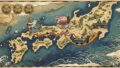
The Kenmu Restoration collapsed, sparking a fierce conflict between Ashikaga Takauji and Emperor Go-Daigo. Following the tragic death of the loyalist Kusunoki Masashige at the Battle of Minatogawa, Takauji seized Kyoto and established the Muromachi Shogunate. Consequently, the Emperor fled to Yoshino, fracturing Japan into the Northern and Southern Courts. Furthermore, brutal internal strife within the Shogunate plunged the nation into a chaotic 60-year civil war.
When Ashikaga Takauji (The ambitious warlord) rebelled, the court split into two factions. Nitta Yoshisada (The aggressive general) advocated for an immediate attack, but Kusunoki Masashige (The tragic loyalist) proposed a strategic peace treaty.
However, Emperor Go-Daigo (The uncompromising monarch) chose the hardline approach, ordering Masashige to intercept the enemy at Minatogawa. Knowing the battle was hopeless, Masashige resolutely obeyed the command.
Surrounded by naval forces, Masashige quickly recognized his impending defeat. Consequently, he and his brother pledged Shichisho-hokoku and committed suicide.
This spectacular demise immortalized him as the ultimate symbol of imperial loyalty. Meanwhile, this decisive victory allowed Takauji to capture Kyoto and successfully overthrow the Emperor.
🔍 Key Takeaways 🔍
Emperor Go-Daigo rejected a realistic peace proposal, opting for a doomed decisive battle. This rigid decision sacrificed an irreplaceable loyalist and directly caused the Emperor’s exile, marking the critical turning point that birthed a new warrior government.

After capturing Kyoto, Takauji enthroned Emperor Komyo and established the Muromachi Bakufu. Surprisingly, Emperor Go-Daigo refused to abdicate. He fled to Yoshino with the sacred imperial regalia.
This unprecedented situation created two simultaneous emperors: the Northern Court in Kyoto and the Southern Court in Yoshino. Therefore, samurai across the nation divided into two warring factions.
Even after Go-Daigo’s death, fierce resistance continued through loyalists like Kitabatake Chikafusa (The ideological defender). Chikafusa authored the Jinno Shotoki to inspire his allies by asserting their bloodline’s legitimacy.
Although Takauji eventually defeated his primary rival, Nitta Yoshisada, the Southern Court’s stubborn resilience dragged the conflict into a decades-long quagmire.
🔍 Key Takeaways 🔍
The simultaneous existence of two imperial governments created a persistent state of nationwide civil war. Although Takauji controlled the capital, his inability to secure a decisive victory against the resilient Southern Court guaranteed a protracted conflict.

While fighting the Southern Court, a fatal rift shattered the Muromachi Bakufu from within. A bitter power struggle erupted between the military commander Takauji and the chief administrator, Ashikaga Tadayoshi (The bureaucratic brother).
Specifically, the intense hostility between Tadayoshi and Ko no Moronao (The ruthless deputy) escalated into assassination plots.
Shockingly, to counter his brother, Tadayoshi surrendered to their mutual enemy, the Southern Court. This chaotic internal conflict, known as the Kanno no Joran, forced Takauji to hunt down his own flesh and blood.
Consequently, this disastrous internal fragmentation severely weakened the Shogunate’s control and revitalized the Southern Court. Ultimately, Takauji died in 1358 without ever seeing the end of the war.
🔍 Key Takeaways 🔍
Internal division is far more destructive than external threats. The vicious infighting within the Shogunate prolonged the civil war, preventing Takauji from unifying the country during his lifetime.

The Nanboku-cho period finally concluded 60 years later under Takauji’s grandson, Ashikaga Yoshimitsu. Although Emperor Go-Daigo’s dream of direct imperial rule perished, the resulting debates over “loyalty” and “legitimacy” profoundly influenced the Japanese psychological landscape for centuries. The main points of this article are:
‣ Two rival courts engaged in a protracted war for legitimacy.
‣ Internal power struggles fatally weakened the governing organization.
We hope these historical lessons offer valuable perspectives for navigating your own complex professional and personal environments.
Q1. Why did Kusunoki Masashige fight an unwinnable battle?
He possessed absolute loyalty to Emperor Go-Daigo. He actively chose to obey his lord’s command and die honorably rather than prioritize tactical victory.
Q2. What was the main difference between the Northern and Southern Courts?
The Northern Court was based in Kyoto and heavily supported by the Ashikaga clan. Conversely, the Southern Court was based in Yoshino and fiercely asserted the exclusive legitimacy of Emperor Go-Daigo’s bloodline.
Q3. Why couldn’t Takauji achieve total victory despite his overwhelming military advantage?
Continuous internal conflicts, most notably the Kanno no Joran, severely hampered his efforts. This devastating infighting created critical vulnerabilities that allowed the Southern Court to survive.