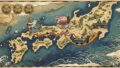
The Muromachi Shogunate suffered from a fragile governance structure that inevitably invited civil war. To secure victory, the founder Ashikaga Takauji granted sweeping powers to regional Shugo. Consequently, these governors evolved into massive territorial lords who threatened the Shogun’s authority. Ultimately, the assassination of a tyrannical Shogun shattered this precarious balance, plunging Japan through the Onin War and into the chaotic Sengoku period.
Ashikaga Takauji (The pragmatic founder) made massive compromises to win the civil war against the Southern Court.
Specifically, he granted regional Shugo powerful incentives, including military dispute resolution authority and tax collection rights via the Hanzei-rei. However, this short-term tactical decision generated irreversible structural side effects.
Leveraging these new powers, Shugo actively integrated local samurai into their organizations as personal Hikan.
Originally, warriors answered directly to the central government. Therefore, this transfer of personal loyalty transformed mere administrators into independent lords possessing massive military forces and exclusive territories, severely undermining the Shogun’s control.
🔍 Key Takeaways 🔍
To secure immediate military victory, Takauji surrendered vital taxation and administrative powers to regional governors. This dangerous compromise birthed highly independent territorial lords who operated completely beyond central government control.

Under the Ashikaga regime, hyper-powerful Shugo emerged. For instance, the Yamana clan (The formidable regional lords) dominated 11 provinces, earning the title Rokubun-no-ichi Dono.
Conversely, the Shogun’s economic foundation remained incredibly fragile. The Hokoshu managed the central government’s scattered lands, but frequent famines and mismanagement caused severe revenue losses.
Lacking stable land-based income, the Shogunate desperately relied on commercial taxes in Kyoto, Sekisho tolls, and selling official posts.
Furthermore, unlike the later Edo Shogunate, the Muromachi government lacked massive direct territories. Consequently, this overwhelming financial disadvantage made it physically impossible for the Shogun to forcefully suppress bloated Shugo Daimyo.
🔍 Key Takeaways 🔍
While regional lords accumulated massive wealth by systematically exploiting vast territories, the central government struggled with unstable, insufficient revenue. This fundamental economic disparity guaranteed the Shogun’s military inferiority.

Maintaining this structurally weak Bakufu required either immense charisma or the terrifying brutality employed by the 6th Shogun, Ashikaga Yoshinori (The tyrannical ruler).
However, when the Akamatsu clan assassinated Yoshinori during the Kakitsu no Ran, the fragile equilibrium shattered. Subsequently, under child Shoguns and Ashikaga Yoshimasa (The apathetic leader), the government completely lost its ability to mediate Daimyo conflicts.
Without a strong Shogun acting as a functional counterweight, disputes among powerful Shugo quickly escalated into a catastrophic nationwide conflict.
Ultimately, the total absence of an institutional safety mechanism proved to be the Ashikaga system’s fatal flaw. Heavy reliance on individual leadership inevitably doomed Japan to the bloody Sengoku Jidai.
🔍 Key Takeaways 🔍
The Shogunate lacked institutional frameworks to check Daimyo power, relying entirely on the personal strength of the Shogun. Once competent leadership vanished, the flawed system instantly collapsed into endless civil war.

The fall of the Muromachi Bakufu was not merely a political failure but the result of deep-rooted structural defects. Extreme decentralization of power and a fatally weak financial foundation ultimately triggered uncontrollable warfare. Studying history requires looking beyond individual capabilities to understand the systemic flaws that dictate organizational survival. The main points of this article are:
‣ Shugo Daimyo like the Yamana clan acquired overwhelming economic dominance.
‣ The charisma-dependent system collapsed into the chaotic Sengoku period.
We hope these historical lessons offer valuable perspectives for navigating your own complex professional and personal environments.
Q1. Why did Ashikaga Takauji grant such immense power to the Shugo?
To win the civil war against the Southern Court. He desperately needed to secure the loyalty of regional warriors by offering powerful incentives, such as local territorial control and tax collection rights.
Q2. What is the precise difference between a “Shugo” and a “Shugo Daimyo”?
A “Shugo” was originally just an appointed administrative and military official. However, when they began using decrees like the Hanzei-rei to manage private estates and assemble personal retainer armies, they transformed into highly autonomous territorial lords known as “Shugo Daimyo.”
Q3. What modern lesson can we learn from the failure of the Muromachi Shogunate?
The severe risk of unchecked delegation. Delegating authority without establishing proper oversight or balancing mechanisms will inevitably cause the central organization to lose control over its own members.