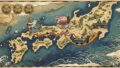
The collapse of the Ashikaga Shogunate ushered in the era of Gekokujo, where subordinates ruthlessly overthrew their superiors. The Yamana clan, despite their prestigious Seiwa Genji lineage, perfectly symbolized this era by prioritizing pragmatic profit over loyalty. At their peak, they controlled “one-sixth” of Japan and orchestrated the devastating Onin War. However, cultural indulgence and poor leadership ultimately caused their rapid downfall amidst the chaotic Sengoku period.
Understanding the chaotic Sengoku period requires examining the concept of Gekokujo. This phenomenon perfectly encapsulates the radical social upheaval where traditional hierarchies completely collapsed.
The Yamana clan (The pragmatic opportunists) embodied this ruthless survival mechanism better than anyone else.
The Yamana possessed the prestigious Seiwa Genji bloodline and served as loyal Gokenin during the Kamakura period.
However, unlike their Nitta relatives who perished for absolute loyalty, the Yamana operated purely on calculated self-interest. Therefore, they flexibly switched allegiances and actively utilized betrayal to consistently win the brutal survival competition.
🔍 Key Takeaways 🔍
The Sengoku period demanded pure meritocracy over noble lineage. The Yamana clan successfully expanded their power because they discarded outdated loyalties and adapted flexibly to maximize their profits. Unconventional and pragmatic thinking became the ultimate weapon for survival in this turbulent era.

By the 1390s, the Yamana had accumulated unprecedented wealth. The clan head, Yamana Ujikiyo (The Lord of One-Sixth), concurrently governed eleven provinces, earning the formidable title Rokubun-no-ichi Dono.
However, this massive territorial control naturally triggered intense paranoia in Ashikaga Yoshimitsu (The absolute ruler). Consequently, a violent clash became inevitable.
Yoshimitsu employed brilliant political maneuvering to incite internal Yamana conflicts and directly provoke Ujikiyo. Unable to endure the pressure, Ujikiyo launched the Meitoku no Ran.
Although the Yamana army threatened Kyoto, the Shogunate forces eventually crushed them, killing Ujikiyo. As a result, the government confiscated vast territories, forcing the clan into a long period of severe decline.
🔍 Key Takeaways 🔍
Excessive military power inevitably invites devastating countermeasures from the central authority. Yoshimitsu’s calculated provocation successfully neutralized the Bakufu’s greatest threat. However, the Yamana clan’s ability to patiently endure this failure set the stage for their future resurrection.

Yamana Sozen (The ambitious restorer) orchestrated a dramatic resurgence from ruin. Exploiting the Kakitsu no Ran, he actively hunted down the Shogun’s assassins and absorbed their territories.
This swift, opportunistic military action propelled Sozen back into the Shogunate’s political core. He perfectly demonstrated that political chaos serves as a ladder for rapid ascension.
Furthermore, Sozen deeply intervened in the Shogunal succession crisis, aggressively backing the infant Ashikaga Yoshihisa. This intervention ignited the catastrophic Onin War.
However, after Sozen’s death, his successor Yamana Masatoyo (The cultural escapist) abandoned territorial management to obsess over tea ceremonies in Kyoto. Consequently, this fatal neglect of local governance shattered the clan’s unity and triggered their rapid, irreversible decline.
🔍 Key Takeaways 🔍
While Sozen brilliantly exploited wartime chaos to seize power, his successors fatally prioritized peacetime cultural indulgence over practical leadership. In the Sengoku period, abandoning active territorial management guaranteed immediate organizational destruction.

Despite their noble lineage, the Yamana clan survived the turbulent era by prioritizing pragmatic profit over empty ideals. However, their ultimate downfall proves that organizations will rapidly collapse without adaptable and focused leadership, regardless of their past military might. The main points of this article are:
‣ Overwhelming localized power invites targeted attacks from central authorities.
‣ Escaping into cultural indulgence guarantees organizational disintegration.
We hope these historical lessons offer valuable perspectives for navigating your own complex professional and personal environments.
Q1. When did the Yamana clan begin to lose power?
After the Onin War, when Yamana Masatoyo prioritized a luxurious cultural life in Kyoto over practical land management. This fatal absence from their territories caused their definitive decline.
Q2. What separated the fates of the Yamana and Nitta clans?
The choice between absolute loyalty and pragmatic self-interest. The Nitta clan perished due to their rigid loyalty to the Southern Court, whereas the Yamana clan prospered by continuously siding with the inevitable victors.
Q3. What does the title “Rokubun-no-ichi Dono” mean?
It translates to the “Lord of One-Sixth.” It highlights the Yamana clan’s massive territorial control, as they simultaneously governed 11 of Japan’s 66 provinces—roughly one-sixth of the entire country.