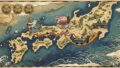
Sengoku warfare transformed from elite mounted warriors to massive squads of salaried Ashigaru infantry. As combat prioritized quantity, Mori Motonari steadily expanded his power. Meanwhile, the wealthy Ouchi clan lost their lucrative Chinese trade and perished from a retainer’s rebellion. Consequently, Motonari lured this rebel army to Itsukushima, blockaded the sea, and annihilated the massive force, establishing the Mori clan as the absolute hegemon of the Chugoku region.
Sengoku warfare shifted drastically from elite mounted knights to massive formations of Ashigaru foot soldiers. These infantrymen were primarily salaried second sons of farmers and merchants.
As the Asakura Takakage Jojo explicitly stated, arming one hundred men with standard spears became far more rational and effective than fielding a massive formations of Ashigaru foot soldiers with a priceless sword.
Mori Motonari (The brilliant tactician) perfectly capitalized on this new era of mass mobilization. Initially, he struggled as a minor lord trapped between the formidable Amago and Ouchi clans.
However, he successfully unified local factions and pragmatically submitted to the stronger Ouchi. Therefore, this realistic survival strategy allowed him to preserve his forces and patiently prepare for future opportunities.
🔍 Key Takeaways 🔍
The military paradigm shifted entirely from elite individual prowess to cost-effective mass infantry. Motonari adapted flawlessly, preserving his strength through calculated submission to larger powers while waiting for the perfect moment to strike.

Initially, the Ouchi clan’s overwhelming dominance stemmed from their absolute monopoly on the Kango Boeki. This exclusive Chinese trade generated unimaginable wealth.
However, in 1523, the Ningpo no Ran destroyed this economic engine. The Ouchi violently clashed with the rival Hosokawa clan in the Chinese port of Ningpo, prompting the furious Ming dynasty to immediately terminate all trade relations.
Consequently, the sudden evaporation of this primary revenue stream devastated the clan. Following successive military defeats and his heir’s death, Ouchi Yoshitaka (The wealthy Daimyo) entirely lost his political drive.
His fatal neglect of military retainers provoked a successful rebellion by Sue Harukata (The ambitious rebel), forcing Yoshitaka’s suicide. Surprisingly, this sudden internal collapse of western Japan’s greatest power provided Motonari with his ultimate opportunity.
🔍 Key Takeaways 🔍
Complete reliance on a single foreign trade monopoly creates critical vulnerability. The abrupt loss of Chinese trade revenue, combined with apathetic leadership, triggered a catastrophic internal rebellion that instantly erased a massive empire.

After five years of calculated silence, Motonari declared war against Sue Harukata to ostensibly avenge his former lord. Facing an overwhelming numerical disadvantage, Motonari masterfully engineered a psychological trap.
In 1555, he deliberately used his own fort as bait, luring Harukata’s massive army onto the narrow island of Itsukushima where their sheer numbers rendered them immobile.
The ultimate key to this brilliant reversal was the Murakami Suigun (The naval hegemons). By securing their alliance, Motonari seized total control of the sea, permanently severing the Sue army’s supply lines and escape routes.
Consequently, the trapped Harukata was utterly annihilated and committed suicide. Therefore, this unprecedented giant-killing victory instantly propelled Motonari to become the absolute ruler of eight Chugoku provinces.
🔍 Key Takeaways 🔍
Strategic terrain manipulation and crucial alliances easily overcome massive numerical disadvantages. Motonari executed a flawless psychological trap on a confined island and utilized naval supremacy to completely annihilate a vastly superior force.

Mori Motonari’s phenomenal rise resulted from his exceptional ability to read era shifts and his ruthless decision-making. By maximizing the new Ashigaru infantry, exploiting the Ouchi clan’s self-destruction, and leveraging geographic advantages, he achieved total regional supremacy. The main points of this article are:
‣ The Ouchi clan collapsed after losing their trade monopoly.
‣ Naval alliances secured the miraculous victory at Itsukushima.
We hope these historical lessons offer valuable perspectives for navigating your own complex professional and personal environments.
Q1. When did Mori Motonari begin his rapid expansion?
Following Ouchi Yoshitaka’s death in 1551, and especially after his decisive victory at the Battle of Itsukushima in 1555, he rapidly expanded his control over the entire Chugoku region.
Q2. What caused the Ningpo Incident?
The Ouchi and Hosokawa clans violently fought in China over the legitimacy of their official trade tallies (Kango). This armed conflict angered the Ming dynasty, causing them to completely refuse further commerce with Japan.
Q3. Why was the Murakami Suigun essential for Motonari?
Because Itsukushima is an island. To successfully trap the enemy and cut off their supplies and retreat routes, absolute naval supremacy and a strict maritime blockade were mandatory for the operation’s success.