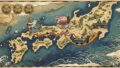
During the Sengoku period, commoners and monks united in “Ikki” uprisings, harboring democratic potential akin to European autonomous cities. Meanwhile, the religious sphere experienced significant ideological shifts as Yoshida Shinto established unique doctrines to seek independence from Buddhist dominance. Furthermore, the 1543 arrival of the Portuguese brought a military revolution through firearms and the dark tragedy of the slave trade, profoundly shifting non-samurai society.
“Ikki” often evokes images of bamboo-spear-wielding peasant mobs, but they actually functioned as highly sophisticated organizations.
Specifically, Kuni Ikki operated as “autonomous leagues” where local communities united to protect their rights. For instance, the famous Yamashiro Kuni Ikki in southern Kyoto saw warriors, merchants, and farmers successfully collaborate to resist unilateral Daimyo exploitation.
Surprisingly, the Ikko Ikki, centered around the Jodo Shinshu faith founded by Shinran (The influential monk), wielded absolute regional influence. Operating from Ishiyama Honganji, they successfully conquered and governed some of Japan’s wealthiest territories.
Therefore, these uprisings transcended mere rebellion; they vividly demonstrated a potential alternative democratic future resembling European free cities, entirely independent of warlord control.
🔍 Key Takeaways 🔍
Ikki were not chaotic riots but highly advanced autonomous organizations uniting diverse social classes. Specifically, religiously driven uprisings commanded immense economic and military power, temporarily realizing a potential future governed by the populace instead of warrior regimes.

Sengoku Japan essentially functioned as a Buddhist nation. Under the traditional Shinbutsu Shugo ideology, indigenous Japanese deities were merely explained as avatars of Buddha, rendering unique Shinto teachings highly ambiguous.
Amidst this environment, the Kyoto priest Yoshida Kanetomo (The ambitious reformist) actively moved to sever Shinto from Buddhism and establish it as a completely independent religion.
Kanetomo named his teachings Yuiitsu Shinto, presenting a radical approach completely distinct from Buddhist enlightenment or detachment. Instead, he preached that individuals could connect directly with deities through esoteric purification rituals.
Consequently, this bold movement functioned as a spiritual independence movement, offering the populace a spiritual shortcut and an alternative path to salvation entirely outside the dominant Buddhist framework.
🔍 Key Takeaways 🔍
After centuries of functioning as a mere subset of Buddhism, Shinto finally asserted itself as the primary spiritual authority. This groundbreaking ideological reversal sought to reclaim indigenous religious perspectives without relying on imported Buddhist logic.

In 1543, storm-blown Portuguese merchants accidentally drifted ashore on Tanegashima. The Hinawaju they introduced instantly captivated Daimyo nationwide.
While mastering a bow required years of training, muskets transformed conscripted farmers into lethal assets almost immediately. Consequently, highly skilled Japanese swordsmiths quickly reverse-engineered this technology, successfully establishing massive domestic mass-production.
However, this Nanban trade also harbored a profound darkness: the Dorei Boeki. In exchange for gunpowder and weapons, Portuguese merchants systematically purchased Japanese prisoners of war and exported them overseas.
Therefore, the tragic reality of human trafficking operating behind this cutting-edge military technology brutally highlights the severe nature of international relations during this chaotic era.
🔍 Key Takeaways 🔍
The arrival of the Portuguese and firearms completely shifted the paradigm of Japanese warfare from professional martial arts to mass firepower. Simultaneously, Japan’s integration into the global trade network tragically commodified its own people, exporting war captives overseas.

The Sengoku period was not merely a tale of warring warlords. It functioned as a massive transformative era where the foundations of Japanese society violently shook through autonomous grassroots experiments, religious independence movements, and unprecedented encounters with Western civilization. The main points of this article are:
‣ Yoshida Shinto actively sought total independence from Buddhist dominance.
‣ Imported firearms and global trade permanently altered warfare and international dynamics.
We hope these historical lessons offer valuable perspectives for navigating your own complex professional and personal environments.
Q1. Why did the autonomous Ikki rule disappear?
Powerful unifying authorities like Oda Nobunaga ruthlessly crushed them through absolute military force. These independent autonomous leagues were identified as the greatest obstacles to centralized national control.
Q2. Did Yoshida Shinto spread immediately during that time?
While partially accepted, it did not secure complete mainstream dominance. However, its core doctrines profoundly influenced later ideological movements like Kokugaku (National Study) during the Edo period.
Q3. Why were the Japanese able to domestically produce firearms so quickly?
Because domestic swordsmiths already possessed exceptionally high metallurgical skills. They efficiently reverse-engineered the complex mechanisms and rapidly established mass-production systems in mere months.